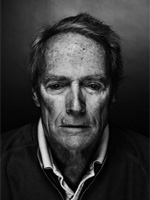
 Now I know I mention British film publication Sight & Sound quite often (I don’t work for them, honest), but they keep printing such good stuff. The September issue, just out, has an extensive career profile, with accompanying interview, on Clint Eastwood – a happy coincidence in the week that our friend Mr Foote’s book on the man has emerged.
The piece, by the venerable Geoff Andrew, echoes the oft-stated view – one I understand, but still don’t share – that Eastwood is America’s finest living filmmaker, one who “believes in the old-fashioned art of drawing us into a film rather than in displays of virtuosity.”
There’s also an evaluation of “Changeling” in which Andrew disagrees with S&S’s editor, and matches the breathless trade paper reviews at Cannes, making lofty comparisons to “Chinatown” and “LA Confidential” to boot:
J. Michael Straczynski’s deft script and Eastwood’s measured, quietly meticulous mise en scene manage to fashion (many) disparate elements into a complex, multi-stranded but entirely coherent drama … What’s possibly most impressive is the way Eastwood makes it all look so easy; as the story steadily grows broader and deeper in its import, it still feels like a damned good yarn.
With each review I read, I change my mind regarding the contender status of this oddly-scheduled film – Andrew’s take certainly suggests it has the gravitas to the distance, though there’s nothing on Angelina Jolie’s much-hyped performance. (Neither the profile nor the interview, however, feature any reference to “Gran Torino,” which is still something of a mystery package sitting in prime awards-season territory.)
Eastwood is typically straightforward in the interview: on “Changeling,” he discusses the practical and historical aspects of the narrative rather than dwelling on his own creative process. Moving on to his career at large, he turns a little more inward, though he’s as matter-of-fact as ever. When Andrew mentions his trademark directorial restraint, he responds:
I like the audience to come with me on a trip. I don’t want to beg them to come along if they don’t want to. If they don’t want the trip you’re offering, they can go next door to the next complex and see what’s on there.
I particularly liked his statement about his low-key visual approach, in which he unsurprisingly cites John Ford as an inspiration:
I try not to gild it too much. By today’s standards Ford didn’t do a lot of crazy shots. But when he had Fonda sitting with his feet up on the porch in “My Darling Clementine” or Wayne walking out the door into the prairie in “The Searchers,” that one shot would be impressive and really make something of a scene. Nowadays, there’s a tendency to do it in six or eight instead of just showing one still portrait which you can look at, like some beautiful painting by Velasquez or whoever.
Indeed. Plenty more quotable stuff from both Andrew and Eastwood in the piece – as always with S&S features, it’s not available online yet, but if you’re an Eastwood fan, it’s worth finding a copy. (For the patient, the magazine usually posts a selection of material on its website a month after the issue.)
Comments
3 responses to “Sight & Sound celebrates Eastwood”
Is there any doubt he will be among the five nominees for best director? Not for me. Like fine wine he gets better and more complex with age…the more I learned about him while researching the book, the mnore admiration and respect I have for him. His films are lean, to the point and quite often (though not always) superb. Looking forward to my copy of Sight and Sound arriving.
I always liked him as an actor (and took him for granted) but it’s only been the last several years that’s it’s dawned on me what a great director he’s become (has been for a long time?). I hold my breath watching, thinking, so these are the choices an artist makes. He is deep and profound, daring and straightforward, and in his prime. His work and example raise the standards for everyone else.
[…] it is too. It’s more in line with the idolising tone of Sight and Sound’s recent profile than Alex Cox’s hastily executed contrarian view in the New Statesman (a missed opportunity, […]