 As pundits continue to posit art-versus-genre arguments around the 10 titles vying for Best Picture, the finest film to be nominated in any category at this year’s Academy Awards is to be found a little further down the list – and it’s one that would bridge the discussion rather nicely.
Nominated last week for the Best Foreign Language Film Oscar, and bedecked with numerous accolades besides, Jacques Audiard’s “A Prophet,” is a brazen, brilliant marriage of pulp, prestige and politics.
A bloody prison drama that phrases intricate social analysis in the language of gangster cinema at its most hardboiled, it’s Audiard’s beefiest excursion yet into the noir territory that he visited in his last two films, lean thrillers “Read My Lips” and “The Beat That My Heart Skipped.”
Critics have been quick to make comparisons to assorted American genre masters since the film’s Cannes premiere nine months ago , with “GoodFellas” and even “The Godfather” routinely surfacing in discussions around the film. But while Audiard acknowledges his kinship to U.S. cinema – this is a man, after all, whose last feature was a remake of a 1978 James Toback thriller – he takes such talk with a healthy pinch of salt.
“People keep saying, oh, it’s like Scorsese, or it’s like Coppola, and of course that’s very flattering,” the native Parisian says over the phone, via the translation (and occasional embellishment) of his co-writer Thomas Bidegain.
“But what I say to that is that those directors themselves were heavily influenced by European cinema, just as I am. It’s a constant back-and-forth. At the moment, I’d say there are more filmmakers playing with genre film, with noir film, in Europe than in the States. And in the rest of the world – look at someone like Bong Joon-ho (“Mother”). It’s never been just an American thing.”
According to Audiard, the film’s original screenplay by Nicolas Peufaillit and Abdel Raouf Dafri (the latter of whom went on to write last year’s Gallic gangster smash “Mesrine”) had a more overt Hollywood influence. Audiard was passed the script merely to read and appraise, but was sufficiently engaged to embark on an extensive rewrite with Bidegain. The development process took three years.
“The initial script was more of a ‘Scarface’-type story of a rise to power, and while I didn’t really want to make that movie, I was intrigued by the chance to make a film centred on a type of character I didn’t know much about,” he says, referring specifically to the French-Arabic background of protagonist Malik (played in the film by astonishing newcomer Tahar Rahim).
 “So the character was there, but we worked a lot on the structure. The first script was built in a very different way to the film – there, Malik was out of jail in just three years, and then the story really took off. But I thought it was much more interesting to keep him in jail, to focus on the balance of power inside there. There’s a lot of irony in that world. It’s more than a gangster story.”
Indeed, the film’s depiction of brutal inner-prison gang conflict is vivid and unsettling enough to have prompted heated French media debate about the country’s corrupt corrections system. Audiard is glad of the attention, but insists the film is not intended as tract.
“To demonstrate or to protest against the system would have been to move closer to documentary,” he says. “And while the film is a work of realism, it’s also a work of fiction. The characters authorize that freedom. It’s normal that art should inspire discussion about real life, and not many French films have dealt with prison. So it’s good that people are talk about it, but our plan was always to work as much fiction into a structure of realism as we could.”
Audiard views his film first and foremost as a character study, and it is in the characterization of Malik that “A Prophet” proves itself of a piece with the director’s oeuvre: in particular, “The Beat That My Heart Skipped” and his 1996 breakthrough “A Self-Made Hero” also center on unmoored young men and conflicted father figures. (The great Niels Arestrup fills the latter role in both “Beat” and “A Prophet.”)
“I’m conscious of the parallels,” he admits, “but they’re things I understand better now, so it makes sense to revisit them. In all my films, I’ve been interested in the idea of what makes a hero in the real world. But you don’t wake up in the morning and decide that’s exactly what you’re going to explore.”
In casting 28 year-old livewire Rahim, Audiard further demonstrated his keen eye for rising male talent; Mathieu Kassovitz and Romain Duris were approximately the same age when they made vivid early impressions in Audiard projects. The actors are hardly alike, but Audiard says he responded to the same virtues in each of them: “They all have an intensity in the eyes, and an agility – they know how to move on camera.” He pauses. “And they’re not too tall!”
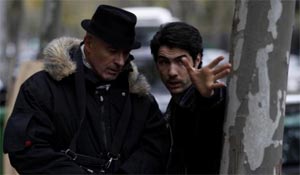 The French-born, Algerian-descended Rahim does, however, stand out by way of his ethnicity. In a country still rife with racial tension, moreover, Audiard was emphatic about making an French-Arab Muslim the focus of his story.
“It wasn’t part of the project,” he says of the film’s socio-cultural backdrop. “It was the project. It was about using people who have little representation in French life, much less in French cinema. To have someone of Tahar’s background anchoring a mainstream film in our country, it’s not done.”
Despite the presence of a Muslim protagonist, Audiard insists that the film’s title should not be subjected to a religious reading. “It refers more to a new kind of gangster, a new kind of hero in society,” he explains, his voice dipping almost sheepishly. “To be honest, if I made the film today, the title would be different. It’s just a word. It’s just a movie.”
Quite a movie, at that.
“A Prophet” opens in limited release on February 26.
Comments
6 responses to “INTERVIEW: Jacques Audiard”
Great interview Guy, he sounds unusually lucid in the interview instead of just mumbling some choice quotes. And to nobody’s surprise, his movie has received absolute raves so far from American critics.
Why wasn’t this nominated for anything other than Foreign Language Film?
Did it not open in LA and/or NY on time? If not, will it be eligible next year?
Patryk: No, there was no 2009 qualifying release in the U.S., so it wasn’t eligible in any other categories.
And thanks to the Academy’s peculiar rule, it won’t be eligible next year either, because it was nominated for Best Foreign Language Film this year. (If it hadn’t been nominated, it would be eligible.)
They really need to revise that.
I did not know that. I always imagined Foreign Language Films had separate eligibility rules. I guess that explains how City of God was able to be nominated a year after it competed in Best Foreign Language Film because it didn’t get nominated.
It doesn’t take away the brilliance of the film though. A great piece of cinema. The Oscar is just extra.
Guy, I’m pretty sure it opens on 2/26, not this Friday.
You’re right — it was scheduled for 2/12 at one point, but they obviously pushed it back. Apologies.