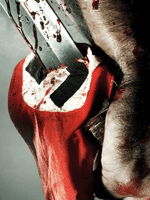
 You might remember right-wing author Andrew Klavan’s head-strong declarations last year that “The Dark Knight” was a pro-Bush meditation that made him feel warm and fuzzy that a filmmaker from diluted leftist Hollywood was making a creative stand along such lines within the parameters of a blockbuster franchise. Kooky, I know.
Well, Klavan is at it again, this time catching Quentin Tarantino’s “Inglourious Basterds” on pay-per-view (because the Netflix wait was too long, he makes sure to point out). In a nutshell, his summation is that Tarantino ultimately trivializes the holocaust and has an uneasy streak of insensitivity to it.
I was referred to the piece by a recent Big Picture post by Patrick Goldstein, appropriately irritated by the level of artistic ignorance in the conservative set. “They either detest pop culture or have such inflexible rules about how it is supposed to be created that they end up stuck on the outside, looking at the filmmaking process with either scorn or derision,” he says in response.
Anyway, here is the meat of Klavan’s point:
…I found it an appalling movie – really; appalling. I can’t remember the last time I used the word offensive about a work of art. Art never offends me – well, hardly ever. But this film isn’t offensive in any petty Piss Christ way – you know, where some adolescent vandal scrawls obscenities on the sacred to annoy the grown-ups and get some attention. This is offensive in the moral, “Let them eat cake,” sense: that is, it exhibits an understanding of human suffering so shallow it falls outside the bounds of civil discussion.
But for Tarantino, no matter how talented, to address the issues inherent in the event as pure fodder for storytelling, to think his squirrelly man-on-man torture fantasies or his video geek understanding of life provide an adequate moral response to that level of history – I don’t know, man – it just felt to me like he was molding toy soldiers out of the ashes of the dead. Even real Jews torturing real German soldiers would not provide a profound or even interesting resolution, but this stuff?
The thing is, I kind of, sort of agree with him, though certainly not to the extreme level of distaste he takes matters. In my review of the film, I discussed what I saw as “rage” and “frivolity” in the narrative that ultimately amounts to little more than a cinematic “tantrum.” Admittedly, in revisiting the film multiple times sense, I have come to enjoy much of it that doesn’t include this nonsense (anything without the Basterds, namely). And those are the elements that should have been, in my view, refined throughout. The rest of it holds the power of the piece back, and while it remains an unpopular opinion, I have to stand by it.
Anyway, read the rest here if you like.
Comments
27 responses to “Klavan strikes again: ‘Basterds’ and trivializing the Holocaust”
“Inglourious Basterds” is a film with some great set-pieces, some great performances, and a great overall sweep of the power of the cinematic form.
But, it’s too squeamishly and thoughtlessly amoral at times, especially in the Eli Roth batter-up scene. We’re supposed to laugh and cheer and become gleefully bloodlust at the sight of a Jew bashing in the skull of a Nazi – but mostly I was just disturbed. I hate that line by Samm Levine: “I’d be shittin’ in my pants if I were you…”
I want to ring his neck everytime I hear it.
IB is historically based fantasy fiction – why so serious?
Without reading his column, I will say this: as far as the summery given is concerned, Klavan has a point.
But without reading it, you don’t…
I actually have to semi-agree with a caveat. I found the revenge fantasy offensive, but that’s because I thought that part of the movie was bad.
@Chase K.: Tarantino has said so himself (particularly with regards to that sequence) that, while he did want the film to be fun, he wanted it to be (his words, not mine) “complicated fun.” Tarantino wants his audience to question what their seeing and question their response to it. Everyone sees the graphic violence and assumes its a celebration, when Basterds is probably the greatest treatise on violence in cinema since Haneke’s original Funny Games.
Klavan should really pay attention to the scene where the Nazi’s are watching their propaganda film and then the tables are turned on them.
Like Adam just reflected it was a mental test to how the viewer felt about the violence that is despicable in one act, yet celebrated in another.
Adam Smith:
How is “Basterds” “the greatest treatise on violence in cinema since Haneke’s original Funny Games”? I’m seriously interested in why you would think that.
As a political and social Conservative, I have two points I would like to address from this article;
1) I do agree with Tapley that many people on the Right tend to be artistically ignorant when it comes to film. I seem to be in the minority when it comes to films lovers’ political persuasions, but I tend to leave my own political inclinations at the ticket counter. Whether the film (this does not include documentaries) portrays a loosely based leftist or rightist or ambiguous agenda, at the end of the day, it does not really make a big impact on how I view the film. Case in point – Brokeback Mountain and The Passion of the Christ.
Both of these films were HIGHLY controversial before their releases. Many on the Right said that BM was political indoctrination from the homosexual Left. Many on the Left said that The Passion was religious indoctrination from Christian fundamentalists. And in my opinion, both sides were wrong in each case.
I loved both of these films, regardless of what the public perception might be. And most of the people who I met or knew who subscribed to each of these groups’ opinions of each movie, never saw the particular film in question. So, I tell anyone who harbors any of the type of feelings described above, I have the solution: watch the movie first, and then if your still confused, watch it again. Then your opinion will have more clout.
2) I do disagree with Klavan’s assessment of Inglourious Basterds because it is a work of FICTION. I just don’t understand how people can apply real history to films that are based entirely on one’s imagination. There does not exist some rule in Hollywood that says, “if you want to make a film about WWII and/or the Holocaust, you must make the film historically accurate.” That type of rule would kill creative thinking entirely.
With all that being said, Hollywood is a bastion for a Leftist point-of-view. The majority of individuals working in Hollywood are Left-of-center in their politics. You could also include blogs such as this one, and movie critics in general. But that never stops me from going to see the films that Hollywood creates. I guess I’m a purist, and that I tend to see a film on its own merits and not on what a particular segment of the population thinks the film “means.”
@Chris:
Fitz actually summed that up pretty succinctly. Tarantino boldly deconstructs the iconography that we typically view the world through. He takes a situation where good and evil have been black and white forever (Jews v. Nazis) and turns the tables completely. The American Jews in the film fight for a noble cause through treacherous, despicable means, whereas the German soldiers are, more often than not, depicted as men doing a job, not men taking joy in murder. Really think about the violence in the film for a moment: the Basterds kill Germans/Nazis with great glee. Notice that we never ACTUALLY see Germans/Nazis kill Jews in the film. I emphasize “actually see,” because Shoshanna’s family being shot is seen purely through the floor–we never see their actual bodies. The only times we see Germans kill Jews is in self-defense (the soldiers v. the Basterds in the bar, Fredrick killing Shoshanna after she shoots him), while Donnie and [the other Basterd whose name I forget] indiscriminately gun down anyone in the theatre they can hit. Everyone in that theatre is going to die anyway, but they’re determined to shoot these fish in the barrel. And it’s because of the juxtaposition between the opening “batter-up” sequence and the sequence of the crowd watching “Nation’s Pride” where Tarantino forces us to ask what gives us the right to laugh at or enjoy one act of violence, while we look down our noses at the Germans enjoying essentially the same thing? Hopefully, if you cheered Donnie on as he bashed that soldier’s brains in, you see yourself in the German crowd. It makes you think about our reactions to violence and iconography in very subtle and provocative ways (in fact, when it comes to getting its message across without beating you in the face with it, Tarantino one-ups Haneke).
@ Adam Smith: I’d buy into it more if you sold me the “propaganda juxtaposition” between the Eli Roth scene and “Nation’s Pride,” but I still don’t completely agree.
The film is too tonally haywire and knee-slapping tongue-in-cheek at times to function as a commentary on violence/propaganda/right/wrong. Even if I bought what Tarantino was selling there (and I don’t) it wouldn’t work in the context of the film.
(By the way, I love the scene at the end with Zoeller and Shoshanah in the projector booth as a better example of how this could work.)
The problem remains that 99% of audiences are too dumb to even catch any of what Tarantino is supposedly doing – they think it’s a stylish and bloody Jewish-revisionist revenge fantasy, and they aren’t far from the truth.
I agree with Kris. Get rid of everything containing the Basterds and I’d love the film.
@ Adam Smith: I wrote my response before reading your comment #10, so disregard anything I wrote that is not addressed in your previous comment…
Don’t think I’m buying the “mental test” thing.
Judging by Klavan’s comments, it sounds like he was actually offended by Pulp Fiction in the first place. In other words, he is prejudiced against anything Tarantino does because QT’s work uses vulgar language and imagery.
Getting angry with one of Tarantino’s films is completely futile and a waste of one’s energy.
I’m not going to lambaste people for getting offended by the film–it surely trod on shakey terrain, here–but I do believe that such people are screaming at the wind.
Their perogative, I guess [shrug]
As for me, I tried to view the film the way I believe Tarantino wanted me to see it. I’d personally be damned if I condemn him, because I know if I did, I’d equally have to condemn other such films, or tv shows like South Park, or any other media that satirize in this way.
Just not worth it.
How the heck was The Dark Knight pro-Bush??!?!?!?!!
“How the heck was The Dark Knight pro-Bush??!?!?!?!!”
The conservative theory is that Batman’s wiretapping was the same as Bush’s wiretapping. They also managed to take the comparison even further by stating that the wiretapping could also be compared to the Iraq War. Their idea is that “the hero” has to do some bad things along the way that people won’t like, but in the end “the hero” is doing the right thing. Iraq War and Bush’s wiretapping were/are unpopular, but conservatives argue that these actions were the right thing to do.
Ok… I just read TDK article and WTF…?!?! Seriously this guy is pathetic.
And clearly, the guy missed the point… TDK was about how there’s good in evil and evil in good and therefore shows Batman, the “good” guy, as a flawed man facing his darker sides. It’s like a ying yang. It’s a complex character study.
And WTF does it have to do with Bush being a hero? Uhm… seriously that guy should be fired from his job or something.
I was with two elderly friends who had to leave the theater during IB. It was just too close to home for them, having had friends and family who died in the Holocaust. There are going to be people that don’t want that certain piece of history made into a campy splatterfest, even if it does portray a revenge fantasy favorable to those who were persecuted.
What I think Tarantino was trying to do was an old fashioned Nazi exploitation film kind of like “Ilsa She Wolf of the SS”. That the film has been taken seriously enough to get awards nominations, is more a testament to Tarantino’s filmmaking than to the subject matter he has chosen. Ultimately though, while I see this film getting some crafts nominations for cinematography and costumes, it’s hard to see it winning best picture or director due to its lack of seriousness and the campy fashion in which it treats the very serious situations of WWII.
As for the Basterds, I thought it was awesome… it’s not a moral, emotionally complex study on war, but it’s not the point. It’s more of a fun film that re-imagines the Hollocaust in a hilarious, entertaining way. I think Tarantino is brave enough to take such a serious subject and transform it into a fun film. Also, the climax was epic although I would have prefered it to be a surprise. Shoshanna was the best character IMO
Anecdote: One of the few things in life I ever truly felt offended by was the episode of the aforementioned South Park where Russell Crowe went “fightin’ ’round the world,” and just started wailing on a guy with cancer. My dad had just gotten treated for it, and to see a guy who looked like my dad, tubes and all, on a cartoon get beaten horrified the shit out of me.
Were Parker and Stone deliberately making light of terminal illness? Were they really out to hurt and offend people on such a painful topic?
What Klavan and people of his frame of mind don’t get is that people who make his offensive things oftentimes don’t set out to offend-they’re just approaching life’s atrocities in a way that’s tangible to them: through humor and satire. Sometimes the world is so fucked up that trying to approach stuff in a sensible way just doesn’t happen.
Am I saying this is the case for Tarantino? Well, I can’t speak for him, obviously. But whenever I feel tempted to get truly offended by something, it helps to remember that, rather than go on a burning tirade.
I’ll agree that in IB, the parts are better than the whole. But that’s Tarantino – nobody crafts scenes better. The opening scene, the brunch with Goebbels, the cellar bar scene, the negotiations between Landa and Raines – all amazing.
***It’s more of a fun film that re-imagines the Hollocaust in a hilarious, entertaining way***
Um, exactly. And that isn’t highly disturbing to you?
I’ll just make one point: The ending line of the film reflects the sentiments of Goebbels earlier when he says “Nation’s Pride” may be his masterpiece. I doubt that’s an accident.
@Silencio:
Thank you. I get the feeling that people take such things for granted. Some filmmakers are sloppy, but I think Tarantino is nothing if not meticulous. If you think he didn’t intend such obvious parallels as the one Silencio mentioned or the reaction of the Basterds (slash some of the audience members seeing “Inglourious Basterds”) with the reaction of the audience at “Nation’s Pride”, then I can’t help you.
megan, is your dad okay now?