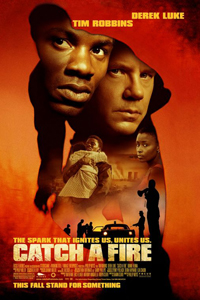
 Phillip Noyce has made a relatively stealthy career of tackling political subject matter without being a blatant mouthpiece for the issues with which he sides. Endeavors like “Patriot Games” and “Clear and Present Danger” approached agendas from a more entertaining standpoint, both being based on Tom Clancy best sellers.
Meanwhile, “The Quiet American” and “Rabbit-Proof Fence” were more specific and cultured in their perspectives of Vietnam and Australia respectively. Now the director takes on the South African atrocity that was Apartheid in “Catch a Fire,” a film that seems too boiled down and ultimately resembling the shell of something much greater.
“Catch a Fire” is the true-life story of Patrick Chamusso (Derek Luke), an oil refinery worker who witnessed a political awakening when his family was violated by government-sanctioned terror squads in 1980. Misunderstanding him as a political enemy, the government created in Chamusso what they wrongly feared he might have been from the start: a driven and violent opponent of their racist regime.
Under the guise “Hotstuff,” Chamusso joined a legion of freedom fighters led by collaborator Joe Slovo and wreaked havoc on the refinery that once employed him. He was eventually apprehended and served ten years of a 25-year sentence, finally gaining passage back to his country when Apartheid disintegrated in 1991.
The story is obviously a grand and epic one, yet the screenplay by Shawn Slovo (daughter of Joe), seems to be aiming for much more majesty than it ultimately reaches. “Catch a Fire” actually feels like the first two acts of something larger and more cultivated, while various characterizations lie contradictory on the page.
Nic Vos (Tim Robbins), for instance, is an immediate paradox. Vos is presented as the anti-terrorist agent responsible for Chamusso’s apprehension.
 In the beginning, Slovo attempts to place a sympathetic face on Vos, a man who supposedly sees his prey as human beings above and beyond terrorists. Early scenes with his family reveal Vos as the diplomatic sort.
But as the narrative moves forward, the screenplay takes the easy route and Vos winds up considered a two-dimensional “monster,” in the words of Luke’s narration in the denouement. The result is a rather unbelievable character all around.
Chamusso’s wife, Precious (Bonnie Henna), also feels ill conceived as a woman ultimately pitted against her husband and responsible for turning him into authorities. This honest and human frailty doesn’t come across, and a simple “I’m sorry” in the end, even matched with the power of Chamusso’s own personal apology for past wrongs and dishonesty, does not feel satisfying in the least bit.
Noyce does make a number of directorial choices that are interesting, however. There are many moments equally promising in majesty and purpose that feel like portions of another movie entirely, building suspense with creative editing and thematic resilience.
He utilizes Ron Fortunado’s camera in specific and unique ways as well, capturing performances from striking perspectives with surprising style. But on the whole, the director’s creativity seems oddly stifled.
 As for performances, Tim Robbins feels terribly miscast in an underwritten role, while Bonnie Henna handles her own half-baked responsibility with a delicate ease.
But Derek Luke is the real shining grace of the cast, proving that he is still one of the cinema’s best-kept secrets, waiting for a pivotal role in a special project that will place him on the A-list. His layered and emotional portrayal of Chamusso lives and breathes on the screen as an efficacious representation, and likely the film’s solitary hope for film awards attention this year.
If anything can be said of Slovo’s debut screenwriting effort, it is that she does a fine job of presenting a political awakening and qualifying that transition throughout. Chamusso is a well-rounded character who has a very specific and thematic arc.
But beyond her main character, the writer seems to push through the tale with reckless abandon, leaving a definite sense of want. The script is certainly a labor of love, being based on recollections passed to Slovo from her father (to whom the film is dedicated).
But labors of love can all too often blind the artistic eye to further potential or necessary restraint. Such is the case with “Catch a Fire.”
 Philip Roth is author of 25 novels and other works of non-fiction. Revered in America, he has won every major American literature prize, including the National Book Foundation’s Award for Distinguished Contribution to American Letters in 2002. Despite his literary success, his films have had a difficult journey to the silver screen.