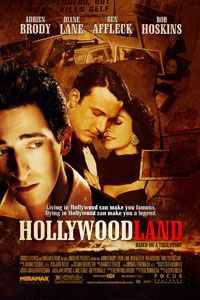
 The death of George Reeves, television’s original Superman, in 1959 defined the loss of innocence for a generation. There are many who remember where they were the moment they discovered Reeves’s body had been found, the victim of an apparent suicide.
The lore surrounding the event has even wound itself into incorrect information that perpetuates itself mythically, forever living on as one of Hollywood’s greatest mysteries –- or is there a mystery at all?
“Hollywoodland” is a project that has seen a long road to the screen, bouncing from one studio to another and back again, enduring rigorous casting scrutiny and a number of raised eyebrows regarding the direction a screenplay based on these questionable events would take.
Now the feature film debut of television veteran Allen Coulter, “Hollywoodland” is a vivid and self-propelling experience that lingers much longer than you would expect it to.
In the film, Adrien Brody portrays the fictional private investigator Louis Simo, who makes his way from buck to buck stringing along suspicious husbands and picking at closed LAPD cases like a scavenger of public enforcement. When he is tipped off to the notion that, following a quick investigation deeming Reeves’s death a suicide, Reeves’s mother believes her son was murdered, Simo embarks on a journey that will become much more personal than he would have ever intended.
The Reeves story is told through flashback, with Ben Affleck (in his career best work) taking on the role of the tragically typecast actor who rose to stardom as television’s Superman. Parallel to Simo’s investigation, we’re made witness to the long, inevitable and sad road Reeves travels, at once a handsome lady-killer and a depressed dreamer.
You see, Reeves was cut from the classic movie star mold. Cary Grant, Clark Gable and Spencer Tracy would have been fitting company for the talented thespian. However, such stardom always seemed just out of Reeves’s grasp, and after ambivalently taking the role of the Man of Steel merely to make ends meet, he would endure the sort of fame that would forever seem cheap and lacking artistic context.
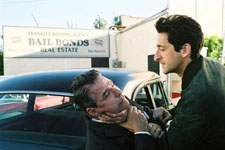 When audiences were distracted by the actor’s iconic image during his scenes in Fred Zinnemann’s “From Here to Eternity,” the director inevitably had the work Reeves had put into the picture removed. Suicide, it seemed, made complete sense to the community at large.
The film takes time to properly examine three popular theories about how Reeves actually met his end. The perspectives stem from a raucous girlfriend (Robin Tunney) peeved at the actor’s refusal to marry her being responsible, to former mistress Toni Mannix (Diane Lane) becoming so grief-stricken over his leaving her that her husband, MGM general manager Eddie Mannix (Bob Hoskins), had Reeves murdered – not the most implausible act in the eyes of many Angelenos.
And, of course, the script – written by Paul Bernbaum – takes a thorough look at the classically accepted suicide theory, which certainly carries more legitimate pathos than any other.
Brody’s work in the film takes a moment to really fit the character, but once he gets into the groove of a divorced father struggling to make his own ends meet, he taps into the personal ferocity that really begins to drive Simo after a tragedy late in the second act propels him to reassess his own perspective. This is his first true starring role since his Oscar winning performance in “The Pianist,” and he reminds us exactly why he is worthy of the distinction.
The supporting cast fills out in typical fashion, with Bob Hoskins and Diane Lane seemingly phoning their work in. Though Robin Tunney really stands out as Reeves’s fiancé, Lenore Lemmon. The real story, however, is certainly Ben Affleck, in a role that could easily be seen as too demanding given the work we’ve seen out of the actor in recent years.
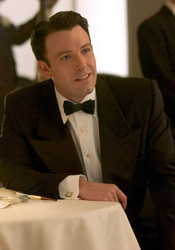 No, in “Hollywoodland,” Ben Affleck shows us what he can do when he really wants it. The actor took a sizeable upfront pay cut on the film (as did pretty much everyone), and while at first glance it may seem that his beefcake persona would laughably overpower the mythos of George Reeves, we soon discover just how tailor-made his screen presence is for the role.
He captures the man in spirit, voice and mannerism like I certainly wouldn’t have expected, and perhaps many other filmgoers, casual and otherwise, will see the same awards-caliber work.
When the film opens on September 8th, the Best Supporting Actor race may have truly commenced — or maybe the film will just stay low on everyone’s radar altogether. But this is a savory, layered performance that does its job in context and is commanding as a supporting turn, giving us a character on which to base the events of the present – a character to care about, to root for and, all at once, to mourn.
All things considered, Allen Coulter’s work on his first feature is capable and smooth-sailing, if unremarkable by virtue of necessity. He never gets overly fancy, even with the unique structure, and he guides the film with the anonymous sort of hand that is certainly a positive thing. This may well be the only cinematic testament to the legacy of George Reeves, and it is as thorough a testament as one could have asked for, despite dramatic twists and turns that might have been more suitably trimmed for a tighter overall experience.
In the end, however, a focused performance in the film’s background works off of a truly driven performance in the foreground to give an appropriately rounded take on what has to be considered one of the most devastating events in television history.
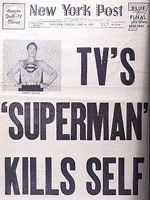 Lou Lumenick reminds me today of the 50th anniversary of actor George Reeves’s untimely death, largely considered by his own hand but some would say there was foul play involved. The story was dramatized in Allen Coulter’s 2006 film “Hollywoodland,” which featured a top-notch portrayal by Ben Affleck as the doomed Reeves.

 So I’m on the phone today with Adrien Brody, interviewing him for that New York Times piece I’m putting together on “Hollywoodland.” We’ve had some delays in connecting – the poor guy has been traveling a lot – and we finally got a block of time on the calendar this afternoon, both of us in traffic in our cars (well – I was parking, to be fair).