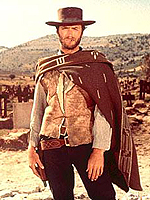
 When I was in London over the summer, a friend landed a position at New Statesman magazine, so I became familiar with the periodical. I enjoyed it’s dry, slightly askew view of the world (and it fit my friend’s outlook like a glove). It also seems a perfect fit for this somewhat lifeless op-ed from multi-hyphenate Alex Cox regarding Clint Eastwood’s debt to filmmakers Sergio Leone and Don Siegel.
A wandering, seemingly aimless swath of prose that eventually comes to the conclusion that Eastwood has become an uninteresting filmmaker, Cox spends much of his word count praising Leone’s work in The Man with No Name trilogy. He’s on board for Eastwood when discussing the actor’s shrewd decision to pare down much of his dialogue in the films, but he jumps ship immediately when Eastwood’s falling out with the director is discussed.
Here’s a taste:
Resisting the usual actor’s temptation to expand his role and to increase his share of the dialogue, Eastwood took a red pencil to the script. Something like 90 per cent of his scripted dialogue was eliminated. What remained counted: “Now, if you’ll just apologise to my mule . . . like I know you’re gonna . . .”
But the shoots for The Good, the Bad and the Ugly (1966) were longer, and – at times – dangerous, as when Leone wanted Eastwood and Eli Wallach to crouch near a bridge that was to be blown up.
Originally Leone had planned to have Volontè appear in The Good, the Bad and the Ugly, but he fell heavily for Wallach’s charms and cast him instead. Wallach’s character, Tuco, dominates the film to such an extent that both Eastwood and Van Cleef tend to become his foils. Eastwood wasn’t interested in this development. It was the last time he and Leone worked together.