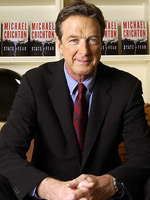
 One of my wish list items that happened to be under the tree this Christmas was Michael Crichton’s “State of Fear,” an anti-global warming thriller that is likely to both infuriate (given the politics) and keep me turning the page (given Crichton’s story-telling skill).
It’s been a while since I flipped through a Crichton book, but I’ve been in a somewhat nostalgic mood for his work ever since the author’s untimely death last month. I’ve always found myself sharing an opinion of him similar to New York Times writer Charles McGrath’s, who noted in his obituary, “As a writer he was a kind of cyborg, tirelessly turning out novels that were intricately engineered entertainment systems. No one — except possibly Mr. Crichton himself — ever confused them with great literature, but very few readers who started a Crichton novel ever put it down.”
As we move closer and closer to the end of the year, In Memoriam installments will fly fast and furious for the entertainers we lost in 2008. With that in mind, Rachel Abramowitz has penned an appreciation in the Los Angeles Times for the departed scribe: “Michael Crichton’s Hollywood legacy.” She opens the 11-page photo gallery with the following words of remembrance:
It’s hard to imagine modern-day Hollywood without provocative potboiler author Michael Crichton, the Harvard-trained doctor whose fertile imagination fused science and fear in heart-stopping fashion, launching upon unsuspecting moviegoers extraterrestrial killer micro-organisms (“The Andromeda Strain”), the black-market trade in organs (“Coma”), an amusement park full of fantasy-fulfilling androids (“Westworld”), Adrenalin-junkie tornado chasers (“Twister”) and of course, genetically recreated dinosaurs running amok (“The Jurassic Park” franchise).
In his spare time, the 6-foot-9 author who could churn out 10,000 words a day, tackled the murky politics of sexual harassment (“Disclosure”), questionable Japanese business practices (“Rising Sun”), and created “ER”, one of the most popular television series of all time. He’s probably the only person in America ever to have a No. 1 book, No. 1 movie and No. 1 TV show all at the same time.
Take a trip down memory lane here. And here’s one of Crichton’s last in-depth interviews, an hour-long discussion with Charlie Rose last year as he was making the publicity rounds on “Next,” including maybe a 20-minute chunk on Crichton’s controversial views on global warming:
 I truthfully wasn’t even aware that Crichton was