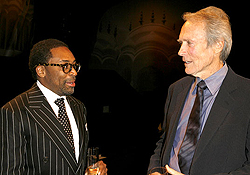
 Roger Simon seems to think so:
Why would Lee pick this fight?
Unfortunately, it couldn’t be more obvious. Like Jesse Jackson and Al Sharpton, time has been passing Spike Lee by. His worldview comes from another era and he has never really sought to revise it, to open his eyes. Proof of that is that for more than a decade Spike has barely made a film any of us can remember. Compare that to Eastwood, who, although some twenty-seven years Lee’s senior, is at the top of his career, having scored big in 2003-2004 with Mystic River and Million Dollar Baby.
No wonder Spike’s jealous. So what does he do? He reaches back to an era when he was more successful. He plays the old identity/race card. Now we could all laugh and say this is just another case of an (prematurely) aging artist grasping for attention, but these times are more complex than that. We don’t know which way we are going – toward a post-racial future or back to a racist past.
His argument is interesting because it is equal parts over-simplified and shrewd. The Lee/Eastwood dispute has been talked to death…and again…and again, but the overriding feeling I had following the initial Cannes fracas was sadness — sadness that Lee has shown yet again that he is unable to prove his (at times justified) contradictory opinions without the stench of clichéd rhetoric and steadily outdated reason.
And in a sense, this has always been Lee in a nutshell. His work as an artist speaks volumes to this. “Do the Right Thing” is a modern masterpiece, if only because it is represents the perfect storm of his penchant for culling and frankly exploiting the stereotypes of his heritage while demanding an equal playing field.
It worked for that film. The anger was necessary for his vision and not altogether out of context, especially at a time so dynamic and artistically progressive for the culture he was depicting. “Do the Right Thing” is one of the greatest films of the last 20 years, and it was do to Lee’s youthful spark plug tenacity.
But any time Lee has approached a new masterwork, this steadily stagnating quality seems to have gotten in the way (“Bamboozled” leaps to mind). Films like “Malcolm X” could survive on the work that shines above those flaws, while the vast majority of his filmography has buckled underneath them.
And that carries things right back to Simon’s thesis. Lee worked in more easily definable times when he hit his early-career marks. Today his dust-ups seem more a product of running on those fumes than of reason.
It’s a shame, because here is a man who could have been a much better filmmaker had he allowed his artistic self to evolve beyond a time when his youthful insight counted most.
Comments
9 responses to “Spike Lee = the Jesse Jackson of film?”
Spike doesn’t need to have a battle with Clint. The facts lay in the history books. And you make it seem like he’s a bad filmmaker. Spike and Clint are two different types of directors. Clint goes by the book and is praised for it. As for Spike his techs and his pay no mind attitude leaves people the wrong way. It’s not a big deal but I really think it’s blow up too big now.
“It’s a shame, because here is a man who could have been a much better filmmaker had he allowed his artistic self to evolve beyond a time when his youthful insight counted most.”
Has he retired?
The insinuation obviously wasn’t that his career is over, but one is obviously free to comment upon where it is at the moment. Don’t twist things.
And nowhere here am I praising Eastwood. Simon is, but I conceded that portions of his argument are over-simplified. But his strongest point is made in noting that Lee seems to be clutching to a sensibility that is becoming outdated.
I thought I made that clear enough. Maybe not.
I happen to think Spike Lee is far, far, far more talented and important a filmmaker than Clint Eastwood (and I really like Eastwood!).
“Proof of that is that for more than a decade Spike has barely made a film any of us can remember.”
This is one of the most foolhardy statements I’ve ever read. Also, as we know, getting recognition in the form of Oscars, has never ever indicated staying power. The idea that Spike made a challenging movie about race relations that failed to win any goddamn awards, whilst a white Canadian dude wins Best Picture for a piece of tripe about race relations is very telling.
Back to the past decade, for Spike… two of the decade’s bests… When the Levees Broke and 25th Hour are both far more important, in my estimation, and memorable than Mystic River and Million Dollar Baby (again, both of which I like). Let’s also add the highly underrated Summer of Sam and Inside Man… both of which are superior to Flags of Our Fathers and Letters from Iwo Jima (I hate Flags… but like Iwo Jima). I’m not hating on Clint here… I just think Spike is truly one of the most exciting and best American directors alive today. The man is prolific… he misses the mark sometimes… but he’s still made more great movies in the past 10 years than Clint.
Oh, and He Got Game came out in 1998… that’s easily better than Blood Work, Space Cowboys and True Crime combined.
I’m with you on 25th Hour. One of the few examples of Spike getting out of his own way and firing on all creative cylinders.
But again, the point of this post isn’t Spike vs. Clint. It’s, essentially, Spike vs. Spike.
Great article Kris I agree with you 100 percent. I have felt for quite sometime that Spike as great as filmmaker as he is won’t reach his potential. I once had an argument with my friend who said Hollywood is Spike’s biggest enemy I laughed. I said it’s Spike himself.
The funny thing is, Summer of Sam is actually my favourite Spike Lee film (even more so than Do the Right Thing), and its racial agenda really lies in the subtext, with storytelling as first priority – not something that can be said for much of his weaker work.
I think that should be the way forward for him. At his best, he has creative and structural reach that exceeds many American filmmakers.
Did everyone forget 4 little girls and requiem for a dream the wonderful Hurricane KAtrina documentary. I feel that he is a great filmmaker and documentarian. To me his only real miss was “SHE HATE ME”. Inside Man really had me engaged and interested and it was a departure from his normal material. He is the only black filmmaker who has really broke into widespread crtitical acclaim and I think he feels the burden of being that voice for African Americans in the film arena. If he felt like some people were having there voices and images silenced I thinkn he felt it was his duty to speak on it right or not. He is still one of the greatest filmmakers ever and will continuie to make great films. i think people didn’t like BAmboozled because it was a bitter pill to swallow, to me it was painfully accurate. I hope Miracle at St. Anna is great.
“The funny thing is, Summer of Sam is actually my favourite Spike Lee film (even more so than Do the Right Thing), and its racial agenda really lies in the subtext, with storytelling as first priority – not something that can be said for much of his weaker work.”
I agree with this completely. Though I tend to keep my positive opinion of “Summer of Sam” to myself, to dodge the inevitably oncoming argument.