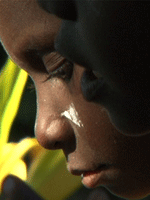
 This is the first year the documentary shorts will be a part of Magnolia Pictures and Shorts International’s annual program. They will open with the live action and animated contenders in New York on February 11 and in Los Angeles on February 18. Bravo for including them.
It’s also a great slate of films. As we know, 2010 was a very strong year for documentary feature filmmaking. But that quality seems to have extended well into the short subject side of things if this year’s nominees in the category are any indication. Each entry is powerful in its own way, a wide array of issues and personas skillfully tackled across the board.
The nominees are:
“Killing in the Name” (Jed Rothstein)
“Poster Girl” (Sara Nesson and Mitchell W. Block)
“Strangers No More” (Karen Goodman and Kirk Simon)
“Sun Come Up” (Jennifer Redfearn and Tim Metzger)
“The Warriors of Qiugang” (Ruby Young and Thomas Lennon)
Everything covered in this year’s slate of nominees is socio-political or environmentally conscious in nature. It’s very much an “issue” slate, lacking any kind of airy profiles or the like.
In 2005, Ashraf al-Khaled’s life changed forever when a suicide bomber attacked an Amman church on his wedding day, killing 27 members of the wedding party, including his father and new father-in-law. Today he’s waging his own one-man war against jihad, mujahideen and Muslim militancy. “Killing in the Name” tells the story of his new found mission of education and de-radicalization with remarkable focus and captivating access to key figures in the on-going crisis of terrorism. Films like this which have a central figure to follow and observe have fared well in the documentary short category over the years, and this film is a powerful one with enlightening interviews and interesting scenarios to document. I would definitely consider it a formidable contender in this year’s race.
If a central figure is going to play this year, though, it’s probably going to be 20-something Iraq War veteran Robynn Murray in Sara Nesson’s “Poster Girl.” Living with Post-Traumatic Stress Disorder after being made one of the poster women for the military on the cover of Army Magazine once upon a time, Murray is a fascinating subject, but she also makes for an unflinching portrait of frailty and the unfortunate psychological side effects of armed combat. Anything in a uniform scared her after coming home and the sound of firecrackers still makes her cry to this day. She’s found an outlet in a group of veterans who create art from their uniforms, but hers is nevertheless a daily struggle. Nesson’s camera intimately captures Murray’s plight in a way few contenders in the field accomplish.
It’s possible “Strangers No More” will be too touching to pass up. It shines a light on Bialik-Rogozin School in Tel Aviv, which welcomes children from 48 different countries and an array of homeland hardships, be it political strife or rampant poverty. It plays as a nice global balance to feature documentaries that focused on homeland educational concerns this year. And like those films, it excels at letting the students’ stories (all of them truly remarkable) drive the viewer’s emotions. It’s a good mixture of talking heads and documented scenarios, but it sticks out for diving into the minutiae of the students’ various experiences in their new lives in Israel. The last two winners in this field have told stories of third world hope. This would tie in nicely with that recent lineage.
Climate change and rising sea levels are threatening small island states around the globe. It’s the mission of organizations like islandsfirst.org to help relocate the endangered families and it’s increasingly becoming an issue of urgency. A documentary seeing its world premiere in Santa Barbara this week, “Someplace with a Mountain,” tells one story. But Jennifer Redfearn’s “Sun Come Up” perfectly distills the issue in a 38 minute account of Carteret Island representatives traveling to the Bougainville, Papua New Guinea mainland to ask for land to save their lives. The film is peppered with striking individuals (like a former Bougainvillian militiaman who sees this as an opportunity to help people after participating in a recent civil war) and it could hit the right notes.
Some 3,000 miles to the northwest in the village of Qiugang, China, another group of environmentally threatened families are fighting survive. The filmmakers behind “The Warriors of Qiugang” documented the situation there for three years and came up with a work less revelatory than it is riling. It’s a fight against corporatism and bureaucracy — that persistent theme of documentary filmmaking — and it could be seen as a distant cousin to the documentary feature “Gasland” (also nominated this year). With factory waste on the rise, they sign petitions in blood demanding clean land and breathable air, unpolluted streams and a safe environment for their children. It’s a quality film but it feels more derivative than most of the other entries, not to diminish the importance of it’s very serious subject matter, mind you.
Will win: “Strangers No More”*
Could win: “The Warriors of Qiugang”*
Should win: “Sun Come Up”
Should have been here: (abstain)

What do you think deserves to win this year’s Oscar for Best Documentary (Short Subject)? Have your say in the sidebar poll! (Note: I recognize the majority of you will not have seen all of the films and therefore don’t have an opinion on the matter, but in the service of uniformity, we’ll offer a poll anyway.)
*This prediction updated on 2/24/2011.
[Photos: Smiley Documentary Films, Portrayal Films]
Comments
3 responses to “OSCAR GUIDE: Best Documentary (Short Subject)”
I really like these write-ups on the shorts categories. They never get enough coverage and I think they’re really important. It seems they are the few categories that aren’t bogged down by politics (that we know of).
Not to mention shorts are one of the few categories where you have to actually watch the films before you can vote.
Imagine if all voters were required to sign in at a theatre to watch all the nominees before deciding…
REVIEW OF “STRANGERS NO MORE”
It is hard to imagine the challenge facing a school that serves over 800 children from forty-eight countries, children who’ve known wars and strife, who saw their parents killed in front of their eyes, or children who had walked the desert, or who come to school hungry and whose parents live under the radar screen of the authorities as foreign workers fearful of being caught and deported.
Yet Bialik-Rogozin school Tel-Aviv, Israel not only educates them, but gives them love, compassion, and hope. In the open and accepting environment created by an outstanding principal Karen Tal and a team of exceptional teachers, students support one another, play together and chat in the new common language, Hebrew. Racial and color divides drop completely in a place where each child is “different” yet none is made to feel anything less than unique. Each child learns to put his or her hauntingly traumatic past behind, adjust to the present, and look to the future. Unlike other public schools in the city that close at 1 or 2 PM, Bialik-Rogozin is open late, until these children’s parents are back from work. Furthermore, as in the case of Johannes, a war refugee who speaks only Tigrit, freedom acquires a new meaning when the boy is taken to the doctor where he is fitted with glasses, and his teacher gives him bicycles so he can ride around the neighborhood and connect with his new world. At a home visit, when the teacher learns of the father’s visa problems, the school takes on the task of navigating the bureaucratic maze for the family. It is heart-warming to see that merely a few months after Johannes’s arrival, he is an eager and engaged student who now translates and helps a new Tigrit-speaking child find his way around the school.
And Esther, whose mother was killed in South Africa (yet who still believes that she will return,) is surprised when her new white-skinned friends admire her tightly braided hair, hug her, and seek her friendship. Soon, the articulate girl, now clothed and fed by the school, is helped to accept the finality of her mother’s death, flourishes and becomes a leader.
Nothing testifies to the success of the school as when the charming and determined Mohammed, who arrived from Darfur at age sixteen, not only catches up on a lifetime of lack of schooling, but upon graduation plans to return to his village and open a school there.
The film avoids as the underlining political questions about a vulnerable country opening its borders to refugees or a public school that supports illegal immigrants by integrating their children into the new culture. Instead, the film teaches the most humane lesson as it demonstrates how far compassion, goodwill, and enormous patience can help change the life of children from utter despair to a world of possibilities offered by a sense of self, security and education.
It is easy to draw from the cliché of superlatives when describing an environment in which ethnic definitions and cultural differences—that all too often breed hatred—simply melt and fall away. Even the word “tolerance” is too trivial for the place that Lin Arison, the philanthropist who financed the documentary, calls “a miracle.” The tight throat and tear-filled eyes of the audience provide a better sense of the emotional power of the film.
And if “Strangers No More” fails to show Israel’s detractors her true face, then they ought to turn their critical eyes toward themselves.
–Talia Carner, Novelist, NY