 Every so often a film comes along that is so celebratory of the filmmaking process and fresh in its approach to visually conveying a story that it creatively demolishes anything within earshot.
“Metropolis” was an early example, as Fritz Lang opened up the world in front of the camera like no one before. Arthur Penn’s “Bonnie and Clyde” and William Friedkin’s “The French Connection” awakened the filmmakers of the 1970s to new boundaries willingly crossed. And Quentin Tarantino brought unique and highly innovative ideas to light in the 1990s when he unleashed “Pulp Fiction” on the filmmaking community.
Another such film has finally come along, and whether Kevin Macdonald receives the credit he deserves for melding the idiosyncrasies of documentation with the manner of narrative flow or not, “The Last King of Scotland” has become a landmark of ingenuity. In this viewer’s opinion, it is the best film of the year thusfar.
“The Last King of Scotland” was adapted from Giles Foden’s award-winning novel of the same name. Charting the chaotic journey of Scottish doctor Nicholas Garrigan, Foden unveils the sadistic regime of Ugandan dictator Idi Amin in ways much less conventional than one would expect of such a tale.
The fictional character of Garrigan was born out of the author’s many conversations with former Amin advisor Bob Astles, and the resulting tale is even, calculated and deliberately paced, very much a story meant for the page in its initial conception. The process of adapting the material to the screen could have gone a number of typical ways, but the choices made by Macdonald and co-writers Jeremy Brock and Peter Morgan are exhilarating if nothing else.
Scottish actor James McAvoy portrays Doctor Garrigan in the film. Following an extremely brief introduction, and an equally swift scene conveying Garrigan’s place as his father’s son, the recent college grad rushes off to a new place in the world where he can be of service. Anywhere but home will do, and the African country of Uganda becomes his new destination.
All of this is carried across in a number of beats, not even necessarily scenes, and Garrigan is off on his journey within five minutes. Lesser filmmakers would have taken inappropriate time establishing the character, meandering, before finally setting him off on his journey. Macdonald trusts the viewer to stay with him, and unveils the events of the narrative through the eyes of his protagonist better than the most seasoned of directors.
Garrigan soon settles into a missionary camp, providing health care for the few Ugandans willing to trust white doctors over village witch-doctors. The camp’s head physician and his wife, Sara (Gillian Anderson), could certainly use the help.
Meanwhile, political upheaval is the consistent state of affairs, as former president Milton Obote is overthrown by the regime of Idi Amin (Forest Whitaker), a “fighter for the people” – or so he would initially be considered.
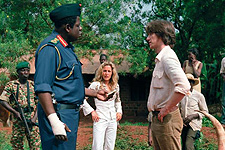 Following an automobile accident that is cleverly repositioned from its place in Foden’s novel, Garrigan and Sara are summoned to the aid of Amin. The president has sprung his wrist in the process of ramming his Maseradi into a giant bull.
Amin is immediately impressed by Garrigan’s tenacity and strength of mind, and he later offers the doctor a position as his personal physician. So begins one of the most interesting relationships between two men captured on the page or on the screen in some time.
Garrigan is abundantly charmed by Amin, a man who can seemingly see right through those at his side. The depth of his personality clashes with the childish nature of his sensibilities to form a persona impossibly ignored. But the longer Garrigan remains drunk with the importance of his position (soon considered an “advisor” by Amin), the longer it takes him to wake up to his complicity in a disastrous regime that will have been responsible for the deaths of over 300,000 Ugandans before Amin would finally be overthrown in 1979.
Kevin Macdonald has made a name for himself as a documentary filmmaker for the better part of a decade. Most notably, 1999’s “One Day in September” won the Oscar for Best Documentary, a painstaking dissection of the 1972 Munich Olympics tragedy.
2004’s “Touching the Void” was one of the most acclaimed films of that year, blending dramatic recreation with first hand accounts of the treacherous ascent of Siula Grande by mountain climbers Joe Simpson and Simon Yates.
What the director does so brilliantly in his first foray into narrative filmmaking is draw upon his instincts as a documentary filmmaker.
“The Last King of Scotland” is not shot like a typical narrative political thriller. The camera wanders frequently to various peculiarities in the scene, typically finding the motion of Amin’s hands, no matter how mundane the gesture.
The usage of zooms and erratic camera movement recalls guerilla filmmaking above all else, and it really feels like we are watching true events unfold, not dramatic interpretations of them. Danny Boyle and “Dogme” regular Anthony Dod Mantle served as cinematographer.
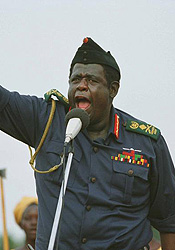 The performances on the whole are fantastic, but the central tension and these two men’s effect on one another could not have been portrayed more succinctly. James McAvoy is outstanding, and Macdonald should be applauded for casting someone so little-known. One would expect a pseudo-star like Ewan Macgregor to be forced into such a scenario, but the right decision has been made and McAvoy holds his own opposite the most explosive on-screen incarnation of the year.
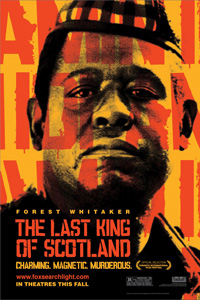
Forest Whitaker’s Idi Amin deserves a place in filmmaking history as one of the more vibrant depictions of the medium. One recalls the tagline of the film every moment he is on screen: “Charming. Magnetic. Murderous.” And when he enunciates each syllable of Garrigan’s name (“Nee-co-laas”), the chill rises up and down the viewer’s spine as it did when Sir Anthony Hopkins casually mentioned eating a man’s liver “with a side of fava beans and a nice Chianti.”
Gillian Anderson and Kerry Washington (as Kay, one of Amin’s wives) are suited to the production, though Anderson’s sudden exit from the film early on feels as unnatural as it is in the novel. It would have been nice to see more of her, and sporting a haphazard blonde hairstyle, she is sexier here than she has ever been. However, Macdonald and his writers do a nice job of blending other characters and circumstances from the book into these two women, which makes for a fascinating adaptation on the whole.
In fact, the biggest accomplishment outside of the style and innovation of the camera work would have to be the screenplay. Foden’s novel, as mentioned, is deliberately paced. But the writing team somehow made it much more electric and exciting, while at the same time combining various elements with the greatest of ease to make for a solid, swiftly-paced narrative.
They utilize the Palestinian hijacking of an Air France flight in 1976, for instance, to its fullest effect as the climax of the film. The flight was infamously held at Entebbe airport in Uganda while Amin, a PFLP supporter, supplied the hijackers with extra troops and weapons. The event was the beginning of his downfall in the court of public opinion.
Ultimately, “The Last King of Scotland” can work above or below the surface. One could enjoy the film as a run-of-the-mill political thriller and be satisfied, taking nothing else away from it. On the other hand, the depth present in the seamless creation of the story lies in wait for anyone willing to notice.
It really is a staggering initial narrative outing, and if this is the talent Kevin Macdonald has been incubating while documenting the real world, we can only consider ourselves lucky that he has finally crossed over into the imaginary world. He is truly an artist to watch.
 With two days to go until wrap-up, and a host of journalists having defected to Toronto, one can feel the air not-so-slowly hissing out of the Venice balloon. And while this certainly has its upsides — it no longer takes half an hour to get an espresso as the festival café, for example — it’s difficult to escape the sense that we’re drinking the dregs of the film programme. (If I had a euro for every time I’ve heard the term “front-loaded” uttered around the Lido…)
 “Why Venice and not Toronto?” a colleague asked when I mentioned I was heading to the Lido for the world’s oldest film festival for the third straight year. Given the North American bent of this site, it was a fair question, but also one I found easy to answer — and not just for the dully practical reason of relative airfare expense.
 These days, so much media speculation precedes the announcement of any major festival lineup that the eventual unveiling comes almost as an anti-climax — or at least it would do if the long-expected films weren’t so appetizing in the first place. As was the case with the Toronto lineup on Tuesday, the just-revealed programme for this year’s Venice Film Festival is as heavy on highlights as it is light on surprises, and that’s good enough for this Lido-bound journo.