In Contention

Tag: Warner Independent Pictures

  • Too many independents?

    I know I’m just one of many who have been concerned about the future of independent film, following the closing in quick succession of Picturehouse and Warner Independent Pictures, and the incorporation of Paramount Vantage into the main body of the studio.

    Someone who has a different perspective on matters, however, is Miramax head Daniel Battsek. Screen Daily reports that, in his keynote speech at the London Film Finance Market, he expressed the view that the specialty field is, if anything, overcrowded:

    Asked whether Miramax had been helped by the recent closure of Warner Independent Pictures, Picturehouse and Paramount Vantage, he replied:

    “Not significantly…the sector of the business was definitely overcooked. There were too many players. There probably still are too many players … Even with the slight reduction of companies operating in this space, there are still too many movies being released. It is very, very difficult to get your voice heard.”

    (more…)

  • The long journey to Searchlight for Boyle’s ‘Slumdog’

    (from left) Dev Patel and Freida Pinto in Slumdog MillionaireThe Envelope’s John Horn does a wonderful job today of reporting on the long, winding road home for director Danny Boyle and his festival hit “Slumdog Millionaire.”  Fox Searchlight has handled the domestic distribution of most of the director’s titles, but “Slumdog” had to face some trials and tribulations to get there.

    Here’s a taste:

    When Warner Bros. announced in early May that it was closing its two specialty film divisions, Warner Independent Pictures and Picturehouse, other art house distributors immediately starting telephoning around, trying to determine the fate of director Danny Boyle’s film, which Warner Independent had penciled in for a Nov. 7 release.

    So why wasn’t Boyle’s biggest Hollywood benefactor actively chasing the British filmmaker’s latest movie? The studio somehow knew that “Slumdog Millionaire” would eventually make its way from Warners to Fox and that the best strategy (and smartest bargaining tactic) was to sit back and wait.

    It’s a way of thinking not unlike how Boyle shot his rags-to-riches movie in the disorganized sprawl of Mumbai. “If you trust it,” Boyle said of his Zen-like attitude of shooting a movie in the world’s largest city, “it will come back to you.”

    And then the scrambing:

    Rather than wash its hands of “Slumdog Millionaire,” Warners tried to figure out how it could handle the film without using Warner Independent. The studio asked Bob Berney, the head of Picturehouse, to take a look to see if Picturehouse could be reconstituted to distribute the film. “I really loved it,” Berney said. “I think it’s his real home run — it really brings it all together.”

    But the costs of reassembling Berney’s team were prohibitive, especially if “Slumdog Millionaire” wasn’t going to come out until early 2009. “They would essentially have to pay everyone double,” Berney said, “because we had already fired everybody” and had paid them severance.

    Before destiny beckoned:

    Producer Colson said that just as the movie is a fable about fate, so too is the story of “Slumdog Millionaire’s” zigzagging path to the screen.

    “It’s a movie about destiny, and we’ve had some twists and turns ourselves,” Colson said. “Is Fox Searchlight a better distributor for the film today than Warner Independent was 12 months ago? I don’t know. I’d like to think Warner Independent would have done a great job, but they never got a chance to show us what they could do.

    “But is the movie in a better position than it was four months ago? The answer is a categorical yes. Because now it will get a chance at the life it deserves.”

    It’s a great little story.  Read the rest here.

  • Warner ventures into the arthouse with ‘Chanel’

    Well, if nothing else, 2009’s Best Costume Design award is forespoken.

    Screen Daily reports that Warner Brothers is beginning production next month on “Coco Before Chanel,” a French-language biopic of the iconic fashion designer. Warner will distribute the film internationally next year.

    Audrey Tautou will play Chanel (presumably after flipping a coin with Marion Cotillard), while an interesting supporting cast includes Alessandro Nivola and Emmanuelle Devos. Actress-turned-filmmaker Anne Fontaine, probably best-known for the family melodrama “How I Killed My Father” is at the helm; she also wrote the script, with Christopher Hampton, no less, as consultant.

    In a nice touch, proving that Warner really is throwing a lot into the project, they’ve lined up none other than current Chanel director Karl Lagerfeld to personally supervise the costumes.

    A lot could be riding on this: after shamefully shutting down both Warner Independent Pictures and Picturehouse (which interestingly had great success with another biopic of a French icon, “La Vie en Rose”), “Coco Before Chanel” will test how well the parent studio can handle this kind of bijou release. It’s not the most adventurous foray into the arthouse they could have made – we all know how wary the Academy is of pretty period biopics – but it’s an encouraging sign nonetheless.

  • Israel leaves Vantage: “It’s not the same company”

    This strikes me as very bad news indeed. Amy Israel, head of acquisition and production at Paramount Vantage, has been shown the exit. You’d think overseeing the production of such titles as “No Country for Old Men” and “There Will Be Blood,” and acquiring, among others, “An Inconvenient Truth,” would count for something. Apparently not.

    Replacing Israel is Guy Stodel, a former exec from New Line. He has some history of acquiring arthouse titles (“The Sea Inside,” “The Upside of Anger”), but worryingly, his most emphasised accomplishment in the press release is having brought the two “Texas Chainsaw Massacre” remakes to fruition. Because that’s the kind of thing we’re looking for, right?

    Israel’s parting statement is diplomatic, but somewhat ominous:

    I’m proud of having been a part of building Paramount Vantage from the ground up under John Lesher, making great films. I love the company we built. It’s not the same company. (It) is evolving a different direction.

    Truthfully, we all knew this was coming. When Vantage was incorporated into the main body of the studio last month, it was pretty obvious they wanted to broaden their focus to more commercial genre projects. Vantage president Nicholas Meyer insists specialty films will remain a priority:

    Although the moves signal that Vantage is moving more in the genre direction, Meyer insists the studio is pursuing a more “eclectic and elastic” slate. “We are not abandoning the specialty business. We are too committed to it,” Meyer said. “As the company evolves, we need to morph and mutate in order to survive in a challenging environment.”

    (more…)

  • Time Warner weeds out indie filmmaking

    The news that Time Warner is phasing out Picturehouse Entertainment and Warner Independent Pictures was a bit upsetting this morning, I have to say.

    WIP may not have hit any major strides (though a Best Picture nominee one year after it became a brand wasn’t too shabby), but I believe Bob Berney had built something special at Picturehouse, a company that was beginning to look like a real home for filmmakers and visions you can’t put into little boxes.

    Of course, the “dependent” circuit, as it were, has claimed this sort of artists’ haven thing for some time. But long ago many of them began to succumb to the same inflated budgets and profit-obsessed mentalities as their parent companies. I never got that vibe from Picturehouse.

    Just look at some of the product: “Fur,” “A Prairie Home Companion,” “Pan’s Labyrinth,” “Tristam Shandy,” “Mongol” and “La Vie en Rose,” featuring a lead performance whose ultimate Oscar victory caught more than a few people off guard.

    Forgive me, but the notion that the now in-house New Line Cinema is somehow going to reach the niches that Berney and WIP did is a stretch. The potential seems all too clear for the brand to go back to the genre-soaked days of old, Dimension Films to Warners’ Miramax. But I’m happy to be proven wrong.

    But for me, it’s a sad moment. I liked what Berney had cooking and on the occassions that I spoke to him about this project or that, I thought he had a pretty hip (and, thankfully, realistic) vision of what he could do at the company.

    But what do I know?

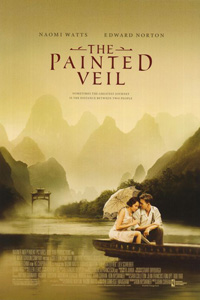
  • REVIEW: “The Painted Veil” (***1/2)

    Warner Independent Pictures\' The Painted VeilRomance seems to be the theme that sparks the most diverse reaction from the artistic community, filmmakers in particular.  There are various methods and structures utilized to tell tales of the elusiveness of love, and new, fresh takes on this binding structure of human interaction come into the cinematic arena every year.

    Some audiences prefer the restraint but equal probing of, say, “The Remains of the Day.”  Others might yearn for the creative ferocity of “Eternal Sunshine of the Spotless Mind.”

    John Curran’s “The Painted Veil” might not be as calm as the former, and certainly not as unique as the latter, but it is nonetheless a story fabulously woven and penetrating in its exhibition of a new kind of love story.  It is one of the year’s finest films.

    Based on the M. Somerset Maugham novel of the same name, “The Painted Veil” is a tale of forgiveness above all else.  It is a deconstruction of our surface frailties and a call to understanding the virtues that lie beneath, and certainly, the lessons that might be learned all too succinctly with the experience of poor decision.

    Conveyed through a creative structure and filmed with long, deep breaths of beauty and compassion, John Curran’s effort propels him from an independent background and into a stoic place of assured filmmaking competence.

    He might be a director to keep an eye on in the future.

    Naomi Watts stars in the film as Kitty, a spoiled and monetarily nurtured sort who longs to break away from her meddlesome mother and tiresome life in London.  She meets Dr. Walter Fane (Edward Norton) at a family gathering one night and the good doctor falls for her immediately.

    Inevitable courtship commences, though Kitty doesn’t seem to take a specific interest over the course of two years (which fly by in the tight structure of the first act) until Walter asks for her hand in marriage.

    Kitty agrees, if only to break free of the ties of London, and the doctor whisks her away to Shanghai, where he will be working and studying.

    All of this is told betwixt scenes depicting a very different Mr. and Mrs. Fane making an overland voyage to a Chinese village, a couple uncomfortable with one another and uninterested.

    This cross-editing comments directly upon the present in a structure recently apparent in Christopher Nolan’s “Batman Begins.”

    As the past blends with the here and now, the first act comes to a head with Walter’s discovery of Kitty’s affair with Charles Townsend (Live Schreiber), a popular diplomat in Shanghai who is also married.  Under the threat of divorce (and therefore scandal), Walter forces Kitty to accompany him to the faraway village where he will study and help treat a cholera epidemic, and in so doing, perhaps glean some sort of pleasure from Kitty’s distress at the expedition.

    Naomi Watts and Edward Norton in The Painted VeilTensions, meanwhile, are running high between nationalist Chinese and the westerners they feel are invasive to their way of life.  Held somewhat emotionally captive in this unfamiliar environment, Kitty spends her days and nights wasting away and feeling useless.

    Walter avoids her, quite clearly considering her with disgust and disdain.  But the man Kitty married, she never bothered understanding or even knowing, and so a trying excursion to the Far East, it seems, might reveal the good man she was too selfish to discover, and the life she has wasted on herself for far too long.

    “The Painted Veil” is a complicated but delicate film.  It really is a lasting sort of story, however, and credit seems to be best served to writer Ron Nyswaner.

    I personally have never read Maugham’s novel, so if the first act structure of the film is apparent therein, forgive my ignorance.  But my assumption is that is not so and it was the clever creation of Nyswaner to comment directly on the Fanes through a simple but purposeful structure from the first frame of the film.

    Whoever is responsible, the device is a brilliant one because it works on so many levels.  Nyswaner (who was nominated for an Oscar in 1993 for his original screenplay “Philadelphia”) also takes a certain care to pace the story with a sense of measure, but never at the expense of interest.  A film that might seem boring to some is in fact quite engaging throughout.

    Edward Norton and Naomi Watts have a specific chemistry that is extremely organic to the piece.  Norton in particular (who also served as one of the film’s producers) provides perhaps his best performance since “American History X,” and certainly his best since “25th Hour.”

    He trumps the quality he tends to have difficulty shaking, that tendency to be Edward Norton first, the character second.  Here, he is fully believable and lived-in as Walter.
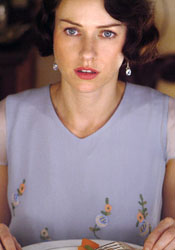
    Naomi Watts in The Painted VeilNaomi Watts shines and has the clear character arc of a woman who grieves for her past mistakes.  Kitty is extremely child-like at the film’s start.  By the end, she is a woman with a life of experience and a future that would have been uncertain otherwise.

    It is a slow revelation for the character, which in some ways makes it more poignant.  To paraphrase, a convent nun puts it to her late in the film, “When duty and love are one, then you are truly full of grace.”

    And that is the lesson Kitty learns a thousand miles from familiarity.

    Another performance worth commenting upon is Toby Jones’s portrayal of Mr. Waddington, a liaison for the Fanes who is quite the warm friend of the family, so to speak.  It’s the kind of small but meaningful turn that Harvey Weinstein would have ushered to a supporting actor nomination in the 90s, one that typically slips under the radar in today’s movie-going environment.

    The technical elements of the film are quite lovely, hinting at the works of James Ivory or Anthony Minghella in some instances.  Stuart Dryburgh’s cinematography thankfully avoids the temptation of drowning the scenery out in golden hues and tonal recreations, rather depending on putting forth beautiful imagery to tell the story first.

    The work of editor Alexandre de Franceschi is some of the most understated but clearly exemplary efforts at the AVID this year, and Alexandre Desplat’s majestic score is his finest work to date, fit with soaring themes and delicate subtlety.

    “The Painted Veil” is the crowning jewel of producer Bob Yari’s output this year.  It is also a fantastic get for Warner Independent Pictures, who might try harder with the film than a larger distributor would (though that is yet to be seen).

    It is a comforting reminder of the filmmaking medium, that stories can be told with beauty and simplicity and still evoke effective emotional impact.  A fantastic effort.