In Contention

Tag: Vera Drake

  • VENICE: What will win… and what should

    This year’s Competition strand of the Venice Film comprised 23 films — a large-ish number by major festival standards, and yet it still feels remarkably thin.

    Admittedly, I’m viewing the field with a slight eyepatch on, having only seen 17 of the 23 films. Yet compared to last year’s lineup — where the successes ranged from higher-profile American auteur works like “Black Swan” and “Meek’s Cutoff” to more rarefied critical hits like “Silent Souls” and “Post Mortem,” with several heavily discussed possibilities in between — it feels this year like the Lido conversation has centered on the same small handful of titles for the past week.

    Last year, Sofia Coppola’s “Somewhere” was something of a shock Golden Lion winner; this year, anything that extensively discussed would be in the thick of consideration. As I wrote earlier, the extreme front-loading of the schedule, combined with the lack of breakout critical sleepers in the festival’s quiet second week, has made for a rather static buzz wave.

    (Thoughts on this year’s contenders, and my own list of predictions and preferences, after the jump.)
    (more…)

  • Dr. Leigh and the women

    I often hear Mike Leigh described as a great “women’s director,” though that’s really only half the truth. Vivid, probing male characters abound in Leigh films, often as vital counterpoints to female star turns (see Eddie Marsan in “Happy-Go-Lucky” or Timothy Spall in “Secrets and Lies”) but sometimes in center stage too: in “Naked,” David Thewlis gives what might be the richest performance in any Leigh film to date. (Hefty statement. Hefty performance.)
    In other words, Leigh is not so much a great director of women as a great director of actors, period. But his actressy reputation sticks, partly because his women have an easier time impressing awards voters, but perhaps also because he’s tougher on the women he writes than most male auteurs, making harsh moral demands of some and pushing even the saintlier ones (Imelda Staunton’s Vera, Sally Hawkins’s Poppy) into behavioral extremes that render them tricky to play. There are no stock love interests, blandly supportive wives or femmes fatales in Leigh ensembles: every character, of either sex, in ensembles comes with an independent inner life.

    (more…)

  • Schnabel holds ‘Miral’ for Venice

    One of the more eyebrow-raising omissions from the Cannes official selection announced this morning was Julian Schnabel’s “Miral.” The New York artist’s biopic of Hind Husseini, with a cast including Hiam Abbass, Willem Dafoe and Freida Pinto, had been widely deemed a good bet for the competition lineup, given its lofty arthouse profile and the Cannes success of Schnabel’s last feature, “The Diving Bell and the Butterfly,” for which he won the Best Director award.

    Roger Friedman reports, however, that this year Schnabel was offered only an out-of-competition slot by festival organizers. The director declined the offer, choosing instead to unveil the film on the fall festival circuit: “Miral” will therefore premiere at the Venice Film Festival in September, before moving on to Toronto.Venice, of course, is where Schnabel premiered “Before Night Falls” in 2000 — he has form in both festivals.

    If the film turns out well, it won’t be the first time Venice has successfully fed off the bigger festival’s leftovers: both “Vera Drake” and “Brokeback Mountain” debuted on the Lido (and went on to win the Golden Lion) after being turned down by the Cannes selection committee.

  • Focus backs Mike Leigh’s latest

    Mike LeighHere’s something to brighten the day. It would seem that a new Mike Leigh joint (sorry, I couldn’t resist) is on its way sooner rather than later — great news considering the four-year gap between “Vera Drake” and “Happy-Go-Lucky.”
    Screen International reports that Focus Features International has secured worldwide rights to the still-untitled project, and will co-fund the film together with the UK Film Council and Film4 (the same folks behind the auteur’s last effort). Poignantly, this will be the last producing credit for the dearly departed Simon Channing Williams, Leigh’s longtime collaborator.

    If memory serves, this marks Leigh’s first go-round with Focus, and it sounds like a pretty good pairing to me — perhaps a necessary change after Miramax’s slightly indifferent handling of “Happy-Go-Lucky.”

    A formidable cast of Leigh veterans is already in place, with the “Vera Drake” team of Imelda Staunton and Phil Davis being joined by “Topsy-Turvy’s” Jim Broadbent — a heavyweight trio, by any standards. No plot details, of course, though the article promises “an intimate portrait of people’s lives” (from Leigh? I’d never have guessed) based on “unique improvisational techniques.” (Well, knock me down with a feather.)

    I’m totally in. But you knew that.

  • INTERVIEW: Sally Hawkins

    Sally Hawkins“We didn’t necessarily set out to create someone as perpetually sunny as Poppy,” says Sally Hawkins of her radiant performance in Mike Leigh’s “Happy-Go-Lucky,” which is currently making waves in the awards race. “But Mike was very dismissive of doing anything maudlin or moody with this project. So the optimism came early on for her. It’s like trying on different skins. And this skin just fit.”
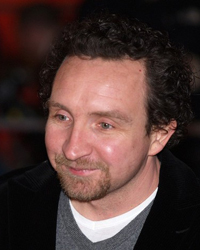
    Spoken in a breezy, unassuming tone, it strikes me as a statement — equal parts pragmatic and eccentric — that could as easily have some from the mouth of Poppy herself, the cheery North London schoolteacher who forms the delightful center of Leigh’s latest perceptive study of British social mores.

    Indeed, when I first encounter Hawkins in the top-floor café of a West End bookshop, dressed in a somewhat Poppy-esque ensemble of emerald-green cardigan and flowing tie-dye skirt, it’s difficult not to be reminded at least a little of her character. Hawkins is certainly calmer and a little softer in person, but her easy-flowing conversation, accompanied by increasingly wild hand gestures, reveals something akin to Poppy’s humor and generosity of spirit.

    “I’m nothing like as extroverted as she is,” she says, smiling broadly.  “But how many people are?  If anyone says they see even a little of me in Poppy, or vice versa, I take that as the hugest compliment, because she just has life worked out. It’s not as if she’s negating that it’s hard. She just finds a way to deal with it, and finds a way to flow with people. She’s an extraordinary person. I think I learned a lot from her.”

    (more…)

  • INTERVIEW: Eddie Marsan

    Eddie MarsanIt is somehow fitting that I meet Eddie Marsan not in the lounge of some swanky West End hotel or members’ club, but amid the worn wooden chairs and scuffed 1970s wallpaper of his local pub in the villagey West London suburb of Chiswick. For Marsan is not a movie star, but an actor — and that’s the way he likes it.
    “I have friends who are leading men, and they’re only ever allowed to play leading men of a certain type,” he says over a lunchtime drink once we’re settled into a corner booth. “But as a character actor, there’s a wider variety of projects available. On the big Hollywood films, all they care about is having their lead in place, so it’s actually easier for someone like me to slip in. And I’m happy to do so.”

    “Slipping in” is precisely what the 39-year-old London native has been doing to impressive effect over the last couple of years. After a long apprenticeship in British television, he can now boast having worked with such A-list auteurs as Martin Scorsese (2002’s “Gangs of New York”), Terrence Malick (2005’s “The New World”), Michael Mann (2006’s “Miami Vice”) and Alejandro Gonzalez Inarittu (2003’s “21 Grams”).

    2008, however, has been Marsan’s breakthrough year, with two major credits on opposite ends of the creative scale: an appearance opposite Will Smith in summer blockbuster “Hancock,” and now, a career-best performance in Mike Leigh’s serio-comedy “Happy-Go-Lucky,” which is garnering well-deserved awards buzz for the actor in the supporting race.

    (more…)

  • More than just happy

    I’ve already discussed how many critics seem to be misinterpreting Mike Leigh’s “Happy-Go-Lucky” and its protagonist, Poppy, by interpreting it as a sheer feelgood work — and in doing so, missing much of the film’s complex, subtle social observation.

    So I’m glad to see that Mike Leigh has addressed the issue at a NYFF press conference. In this video courtesy of IFC.com, Leigh and the film’s star, Sally Hawkins, discuss with Lisa Schwarzbaum the issue of Poppy’s optimism, with Leigh stressing that there is a lot more to her character than simple cheeriness. First saying that “to desribe her as being unadulteratedly happy is not really to understand her at all,” her goes on to draw an interesting parallel between Poppy and the title character in the very differently-toned “Vera Drake.”

    Finally, with a grin, he insists that while “Happy-Go-Lucky” is indeed “anti-miserablist,” it’s not necessarily the start of a trend in his work: “Wait until you see how depressing the next film might be!”

    More from the conference here.

  • ‘Wrestler’: Is Golden Lion just the beginning?

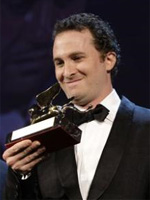
    As Kris just reported, Darren Aronosky’s “The Wrestler” has won the Golden Lion at the Venice Film Festival. No surprise there — in what was widely deemed a lukewarm festival, Aronofsky’s film, which only screened yesterday on the Lido, was one of the few outright critical sensations.

    What is surprising is that Mickey Rourke, whose lauded comeback performance is the predominant source of the film’s buzz, missed out on the Best Actor prize, which went to Italy’s Silvio Orlando for “Giovanna’s Father.”

    Perhaps the jury wanted to spread the love. Perhaps after wins for David Strathairn, Ben Affleck and Brad Pitt in the last three years, they felt American actors had been sufficiently rewarded for a while. Prize or no prize, however, this recognition for the film — to which his performance is so integral — makes it quite clear that Rourke is on the awards trail.

    But what of the film itself? In years past, the Golden Lion has been the start of a healthy awards-season run for a couple of films — examples include “Atlantic City,” “Vera Drake,” and most notably, “Brokeback Mountain.”

    It’s no guarantee of future glory, though. In 1996, Neil Jordan’s lavishly mounted biopic “Michael Collins” seemed poised for an awards sweep after it took the Golden Lion and its star, Liam Neeson, nabbed the Best Actor prize. But the film never quite clicked with other awards bodies — and on Oscar nomination morning, all that awaited it was a pair of technical nods.

    (more…)

  • ‘Happy’ season for Miramax?

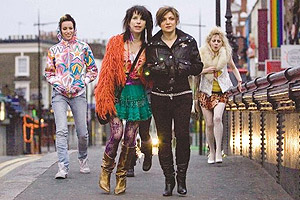
    I’ve been meaning to write about Mike Leigh’s “Happy-Go-Lucky” ever since I saw it some three weeks ago, but I haven’t found a window until now. I’m off to Berlin on the weekend and I’d really like to get this off my plate before I leave, so amid all the packing, I thought I’d hammer out some brief thoughts.
    I’m never really let down by a Leigh film. Even his lesser efforts seem to exist on some simple but probing level that makes argument a fool’s errand. More often than not, his work sparks appreciation during the awards season, and he even managed a second Best Director nomination for “Vera Drake” in 2004, which surprised more than a few people.

    “All or Nothing” was one of my absolute favorite gems of 2002, yet it was ignored completely, while going back to the epic year in cinema that was 1999, we find perhaps Leigh’s most ambitious effort in “Topsy-Turvy.” Then, of course, there was “Secrets & Lies,” which captured the hearts of many in an Oscar year dominated by independent film.

    Leigh’s pre-“Secrets & Lies” work is a slightly different breed, but still fundamentally the work of the same artist and, at times, the same vision of the world. And he has come back to it with “Happy-Go-Lucky,” the shrewd observation of which Guy made in his April review of the film.

    Something feels even more off-the-cuff about “Happy” than Leigh’s recent films. There is an even greater sense of spontaneity and improvisation lurking between the frames that can be both exciting and off-putting, but the purpose is served throughout: bringing the audience into the devil may care world of a woman hell-bent on saving the drama for your mama.

    (more…)

  • REVIEW: “Happy-Go-Lucky” (***)

    The common line in the British press so far on “Happy-Go-Lucky,” Mike Leigh’s alternately fascinating and frustrating new film, is that it’s a departure for him — an exuberant comic revelation following the spare, precise despair of “All or Nothing” and “Vera Drake.” How quickly we forget.

    Only nine years ago, Leigh gave us the similarly punctuated “Topsy-Turvy,” a period romp that in some moments rivalled “Shakespeare in Love” for broad music-hall humour. Even his biggest crossover hit, the 1996 Best Picture Oscar nominee “Secrets & Lies,” had a much more explicit comic tone than many seem to recall.

    However, the most accurate precedents for “Happy-Go-Lucky” date farther back still: the film is not so much a new direction for Leigh as a throwback to the gentle character-oriented comedy and wispy, free-form narrative of his breakthrough features “High Hopes” and “Life is Sweet.” It’s a welcome move. As immaculately crafted and performed as “Vera Drake” was, it didn’t, for me, play to Leigh’s strengths as a writer: his witty ear for vernacular language and his preoccupation with the tensions and absurdities inherent in everyday conversation.

    These qualities re-emerge with a vengeance in “Happy-Go-Lucky,” a film bursting with rapid-fire banter, cathartic outbursts and occasionally didactic speechifying. The inimitably fluid language of London’s multicultural, multi-class population is woven through the film’s every exchange; if Leigh could snag a Best Original Screenplay nomination for a film as comparatively underwritten as “Vera Drake,” it’s difficult to see him getting passed over for this.

    (more…)