In Contention

Tag: Unforgiven

  • LIFE WITHOUT OSCAR: 1991 and 1992

    Catch up with the idea behind this series here.

    1991 was a banner year for the Academy bucking trends. Of course, “Silence of the Lambs” was the big winner, a first for the horror genre and the first time the winning film was available to own on home video before nominations came out. That it was only the third film to win the “big five” was even more impressive.

    Arguably more daring was the Best Picture nomination bestowed upon “Beauty and the Beast,” which remains the only animated film to get the call in a field of five. Also noteworthy is the Best Picture nomination for “The Prince of Tides” and Best Director omission for Barbra Streisand. Many cried sexism since it was the third straight time a female-directed Best Picture nominee failed to also receive a nomination for Best Director.

    Instead, we got John Singleton, our first African American Best Director nominee and our youngest, at age 24! How exciting must it have been to be following the Oscars this year? I wouldn’t know because…

    1992 was the first year I watched the Oscars. I vividly remember Billy Crystal singing and dancing his way through the nominees and Clint Eastwood collecting his gongs for “Unforgiven.” I hadn’t seen a single nominated film from the big categories and since I was living in Cyprus and the show would have been at 4am live, I imagine my Dad must have taped it onto VHS for me, but I remember loving every second of it.

    But enough Oscar nostalgia. The real good films are never nominated anyway and here’s the proof.

    (more…)

  • We all got it comin’

    What was the last truly immortal Best Picture winner?  Cases can be made for this or that throughout the years, but for my money, the last film to win the Academy’s top prize that is absolutely a film for the ages was Clint Eastwood’s “Unforgiven.”
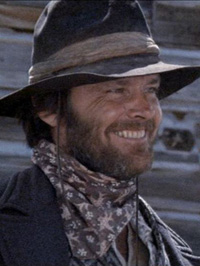
    And you can get the Blu-ray on Amazon for less than eight bucks.  Do it!

    Anyway, nothing other than that on a lazy Sunday.  Though it inspired me to dig up Eastwood’s acceptance speech for his Best Director win back in March of 1993.  Naturally, the Academy is stingy with embeds, but have a look and listen here if you’re bored.

    Oh, and here is Eastwood introducing the film at the AFI’s 40th anniversary celebration a few years ago.  And Gene Hackman winning Best Supporting Actor.  And Eastwood on Hackman’s character, Little Bill Daggett.

    Sorry, I could go on forever about this one.  After the jump, a few choice selections.

    (more…)

  • 1976: the last hurrah of the American western

    Jack Nicholson in The Missouri BreaksThe western was not yet dead in 1976 when  four high-profile installments were released to varying degrees of success. Four years later, of course, Michael Cimino’s “Heaven’s Gate” would kill the genre for several years (and United Artists for longer), and though it has seen ups and downs in the years since, for the most part, the western remains one of the least popular genres with studios.

    In my opinion, Cimino’s film was never as bad as the critics said it was at the time.  Many of them were lying in wait for a Cimino failure, hoping to ambush him for the lies told during the press interviews for ‘The Deer Hunter,” which won the man an Oscar and was the Academy’s choice for Best Picture. He was not a Vietnam veteran, he had never seen Russian Roulette used as torture, in fact he had never been out of America until he made the “The Deer Hunter.”  This all but ruined Cimino’s reputation, which is somewhat sad because the man had a hell of an eye for detail.

    That of course was the issue with “Heaven’s Gate”; though stunning in its detail, the film is insufferably slow and ponderous, with perhaps two truly stunning sequences, the best among them the community roller skating sequence, which pulsates with energy driven by a young man, the film’s composer David Mansfield and his fiddle, as they skate around the rink, veering in and out of surrounding bodies.

    There was a time in the 1950s and 1960s when 20% of the films coming out of Hollywood were westerns. There were 26 prime time western programs on television, all popular, and John Wayne ruled as the top box office star. By the 1970s, westerns were made less frequently, and Wayne’s box office throne had been usurped by another star of the genre: Clint Eastwood.

    (more…)

  • SANTA BARBARA: Clint Eastwood hailed as a Modern Master

    Clint EastwoodSo Clint Eastwood arrived in town tonight without all the pizazz you might have expected, as I reported from this evening’s Arlington Theatre event.  But inside the place was bananas.  Every single seat in the theater was filled, many of the locals vocalizing their shock on the way down the aisles.  “I’ve never seen it this packed before,” many of them said as they found a place to settle in and behold the career the festival was honoring.

    Moderator Leonard Maltin seemed to bite off a little bit more than he could chew.  Seriously, an hour and a half in and we were just getting to 1971.  I figured the 1980s would be a blur and indeed they were — Who wants to remember “Heartbreak Ridge” and “Firefox?” — but I would have liked some discussion on “Bird,” maybe, or “Pale Rider.”  But Maltin warned at the top that if he didn’t get to your favorite film, please understand.  We’re talking about six decades here.

    Early in the discussion Maltin spent a lot of time picking Eastwood’s brain on his early career — a contract player at Universal, roaming around the lot soaking up what information he could, getting the gig on television’s “Rawhide” and, of course, Sergio Leone’s spaghetti Westerns that didn’t find release in the states until rights were cleared up regarding Akira Kurosawa’s “Yojimbo.”  On the whole it was one of those kiss, kiss sessions, but the crowd was pumped.

    Every film that might be mentioned briefly in passing seemed to find this pocket of applause or that.  The “Dirty Harry” stuff was an obvious favorite (of course we were treated to the infamous “I gots ta know” sequence), but “Gran Torino” really brought the house down, especially the old guy vs. the homies scene that might have been Eastwood’s Oscar clip had the performance been nominated a week ago.

    (more…)

  • Lensers set to honor Jack Green’s lifetime achievement

    American Society of CinematographersThis report from Variety kind of got lost in the shuffle this week, but it seems the great Jack Green will be feted by the American Society of Cinematographers this year.  Here’s the story:

    Jack Green will receive the 2009 American Society of Cinematographers Lifetime Achievement award at the 23rd ASC Outstanding Achievement Awards on Feb. 15.

    The awards will be held at the Hyatt Regency Century Plaza Hotel and past recipients of the award have included Conrad Hall and Gordon Willis.

    In his time as a cinematographer, Green has compiled more than 40 credits and of those credits, has worked on eleven pics with Clint Eastwood as director.

    Very cool.  Green (typically credited Jack N. Green) has done a lot of work with Clint Eastwood, most notably the jazzy cool hues of “Bird” and the gritty sprawl of “Unforgiven.”  But they first began their collaboration way back in 1978 when Green was a camera operator on “Every Which Way But Loose.”

    I’ve always felt Eastwood had a great eye for good cinematographers.  His current collaborator is Tom Stern, criminally underrated and consistently ignored by the Academy for solid work year in and year out.  But it’s good to see that Green, who only has one Oscar nomination (and no wins) to his credit, is getting a boost from his peers.

  • More Eastwood…

    These must be hard times for anyone who doesn’t like Clint Eastwood, and I realise that we at In Contention aren’t doing much to reduce the saturation. But with two pictures coming up in the space of four months, and a massive retrospective at the BFI Southbank (formerly the National Film Theatre, for those of you who haven’t been in London recently), he is – again – the man of the moment.

    To tie in with the retrospective, the UK press has been awash with Eastwood coverage, but this piece in last week’s Independent was only just brought to my attention, and rather nice it is too. It’s more in line with the idolising tone of Sight and Sound’s recent profile than Alex Cox’s hastily executed contrarian view in the New Statesman (a missed opportunity, to say the least). Writer James Mottram doesn’t really have anything new to add, but in true Independent fashion, it’s considered and thorough, with a nice sprinkling of typically pithy Clint quotes. This one in particular raised a smile:

    Now he is 12 years into his second marriage, to former journalist Dina Ruiz, some 35 years his junior. And with seven children by five different women, it’s no surprise that he says: “I still feel film-making is the second most fun thing to do.”

    (more…)

  • And often, the Academy gets it right…

    United Artists' Midnight CowboyAs much as I rant about some of the bizarre choices made by the Academy, let’s be fair…there are times when they are right on the money.

    The AMPAS allowed for an embracing of the New American cinema with their awards for Best Picture and Best Director for “Midnight Cowboy” in 1969, and only they had the courage (and the smarts) to recognize that “The Godfather Part II” was a superior film to the first in handing it the same two trophies. They had awarded “The Godfather” Best Picture two years earlier, but much of the precursor circuit (and all of the critics groups) largely ignored the sequel, opting instead for films such as “Alice Doesn’t Live Here Anymore” and “Chinatown,” among others.

    The five awards betsowed on “One Flew Over the Cuckoo’s Nest” in 1975 are among the group’s best choices ever, in particular the honors for actor Jack Nicholson and director Milos Forman.

    Though far too often dismissed as a chick flick, “Terms of Endearment” was a marvelous slice of life that the Academy embraced with five Oscars, including Best Picture, Best Actress, Best Supporting Actor and Best Director. By the way, is it not odd that first time winner James L. Brooks has never again been nominated in the directing category again, despite two Best Picture nominees in “Broadcast News” and “As Good As It Gets?”

    I remember cheering loudly the many wins for “Amadeus,” “Out of Africa” and “Platoon” three years in a row, and though I believe “Goodfellas” is a better film, I was pleased to see a western, “Dances with Wolves,” win seven Oscars.

    No arguments from me between 1991 and 1993, with “The Silence of the Lambs,” “Unforgiven,” and “Schindler’s List” all most deserving winners. And though I prefer “Pulp Fiction,” I understand why “Forrest Gump” took the top prize in 1994.

    Bravo, too, to the Academy for honoring “The Lord of the Rings: The Return of the King,” a bonafide movie masterpiece, and again the following year for “Million Dollar Baby.”

    So you see, for all my bitching (and we all do it…come on), I concede that the Academy does, from time to time, nail the best.

  • THE LISTS: Top 20 movie endings of all time

    Anthony Perkins in PsychoAlright, this was painstaking indeed. After The Times of London saw fit to rock out a list of the 20 best movie endings of all time last week, I thought I’d try my own hand at such a collective.

    There are some omissions that might surprise some folks (“Bonnie and Clyde,” “The Graduate,” “Carrie”). At the same time, there are films that, on any other day, would easily slip into the list (“A Clockwork Orange,” “Once Upon a Time in the West,” “Reservoir Dogs”).

    Rest assured they were taken into account, but they didn’t speak to me on whatever levels must have been necessary to push into the top 20. But I can say these are the denouements that most affected me, be it viscerally or emotionally.

    Send in your picks for the top five movie endings of all time and I’ll publish a collective readers’ list in a few weeks. Email me or post your list below in the comments section.

    Here’s what I came up with:

    20. “The Iron Giant” (Brad Bird, 1999)
    “You stay. I go. No following.”
    Animation genius Brad Bird made his feature directorial debut with this effort, packing an emotional punch by film’s end with shades of “E.T.: The Extra-Terrestrial” — and an energizing final shot to boot.

    19.”Jacob’s Ladder” (Adrian Lyne, 1990)
    “He looks kind of peaceful, the guy.”
    Capping off one of the most bizarre cinematic visions ever captured (and, ultimately, quite underrated as well), this closing scene is a twist that has been lifted in various other forms ever since. (see next)

    18. “The Sixth Sense” (M. Night Shyamalan, 1999)
    “I think I’m okay, really. I think it just went in and out.”
    Hot prospect M. Night Shyamalan tainted the original power of the twist ending by attempting to make a career of it, but in the final moments of this early effort, his buried talent poked through the surface.

    17. “The Shawshank Redemption” (Frank Darabont, 1994)
    “Get busy livin’ or get busy dyin’. That’s God damn right.”
    Less a closing scene than a closing sequence, the entire third act of Frank Darabont’s Stephen King adaptation manhandles the heartstrings and lifts the spirit.

    16. “Se7en” (David Fincher, 1995)
    “John Doe has the upper hand.”
    Andrew Kevin Walker crafted a near masterpiece that culminates as perfectly as it could have, death and despair, ambition and art, plus a Hemingway rebuttal for the ages.

    15. “The Conversation” (Francis Ford Coppola, 1973)
    “We’ll be listening to you.”
    The calmly paranoid conclusion to a mind-bender from a mid-“Godfather” Francis Coppola, this finale put Gene Hackman in a position to give perhaps the greatest performance of his career.

    The full list after the jump!

    (more…)

  • Clint Eastwood: the unlikely Oscar favorite

    Clint Eastwood at the Academy Awards in 2005Had anyone said to me in the 1970s that Clint Eastwood would in time become one of the finest and most important American directors in modern cinema, I would have laughed — quite loudly — in their collective faces.

    The star of “Dirty Harry” and “Every Which But Loose?”  The guy who shares the screen with apes?  Are you kidding???  Yet here we are, 37 years after he first pulled that 44-Magnum (“The most powerful hand gun in the world”), and things have changed.  He has won four Academy Awards — two as director, two as producer.  He has been nominated for each on two other occasions and has two Best Actor nominations to his credit as well. He has twice been honored by the Directors Guild of America for and won countless critics awards.

    Eastwood is indeed among the filmmaking elite.  And with the upcoming releases of “Changeling” and “Gran Torino,” he looks primed to flirt with the film awards season yet again.

    While researching my book “Clint Eastwood: Evolution of a Filmmaker,” my respect and admiration for the man has grown considerably. Obviously there was a great deal of admiration to start, otherwise I wouldn’t even begin a bhook on the subject.  But leanring more and more about Eastwood and his work has, understandably, taken things up a level.

    Eastwood challenges himself each time he makes a film.  His choices to act in films such as “Any Which Way You Can” were driven by the fact that he knew the studio would then finance a personal project such as “Bronco Billy.”  What really astounds me, though, is his growth as an actor through the years.

    (more…)

  • Best of the 90’s

    John Travolta and Uma Thurman in Quentin Tarantino\'s Pulp FictionTime is the enemy of all films as it erodes what was once exciting and original. Truly great movies are able to withstand the test of time, but I wonder if enough time has passed to take a look back at the 1990s cinema and make some decisions.

    There was a major breakthrough in the decade with filmmaker Quentin Tarantino, who did not so much open the door for indies as he did kick it in and stomp on it with his “Pulp Fiction,” a gloriously acted, directed and written masterpiece about criminals in Los Angeles.  When Godard spoke of making films with a guy, a girl and a gun, was this what he had in mind?

    Though Tarantino has strugled to follow up his legendary 1994 effort with an equally powerful offering, there is little doubt he will, or at least could if he wanted to. (Though he keeps stopping and starting on his latest ambitious project.)  After all, he is still growing as a director.  And just look at Steven Spielberg, who for my money has grown artistically through the last 15 years more so than any other major filmmaker. It was as though “Schindler’s List” and the release of winning the Oscar set him free.

    Anyway, for the record and argument, here are my ten best films of the 1990s:

    1. “Pulp Fiction”
    2. “Schindler’s List”
    3. “Goodfellas”
    4. “Unforgiven”
    5. “Saving Private Ryan”
    6. “The Sweet Hereafter”
    7. “Magnolia”
    8. “L.A. Confidential”
    9. “The Shawshank Redemption”
    10. “The Silence of the Lambs”

    You?

  • Clint Eastwood — anything he does grabs Oscar’s attention

    Let me begin with something very personal, something I prefer not to do in this column. Movies have not mattered much this past week, as my wife of 18 years, the love of my life was diagnosed with a malignant brain tumor. This Thursday we journey to Sunnybrook Hospital in Toronto to allow the finest surgeons in the country to go in and take the tumor out, with the hope she does not have to have chemotherapy or radiation. There is a chance I could lose her, and that I couldn’t bear. The past few days have been a blur, and yet it is her who urged me back to the computer, with a gentle, “You can’t let the movie writing stop because of this…please…write…” God I love that girl. She is at this moment snoozing behind me as I write this.

    Later this year we will see the release of “Changeling,” the latest from Clint Eastwood who over the last 16 years has become one of the finest directors working in movies. Now seriously, had anyone ever told me in the 70s that one day I would be celebrating the works of Eastwood the director by writing a book about him and his work, I would have laughed in their face at the thought.

    Dirty Harry, the man who acted with apes, becoming a world class director? Yet here we are in 2008 and Eastwood has won two Academy Awards for Best Director, twice been honored by the Directors Guild of America, and won countless critics prizes for his work. Revered by actors, beloved by the studios for whom he works, and respected by his colleagues, he has quietly risen to the very peak of the directing world, sitting alongside Steven Spielberg and Martin Scorsese. His films have the lean feel and look of the best work of John Huston and Howard Hawks to whom story was paramount.

    (more…)

  • Actors winning Best Director — always deserved?

    Of course not. Quite often the Academy gets behind an actor for the simple reason they pulled of the film without screwing too much up.

    How else can one explain Mel Gibson’s win for “Braveheart” but failure to be nominated for his masterpiece “The Passion of the Christ” and “Apocalypto,” easily two of the finest directed films of the last ten years? Somewhere along the road, the Academy fell in love with actors who try their hand at directing (unless your name is Sean Penn or Barbara Streisand) and began giving away Oscars, quite often over more deserving directors.

    Poor Martin Scorsese has watched actors win the Best Director prize over his work three times. In 1980, of course, Robert Redford won for his drama “Ordinary People” over Scorsese’s searing “Raging Bull,” while ten years later Kevin Costner won the Oscar for “Dances with Wolves,” besting Scorsese for “Goodfellas.” But hey — this is the Academy…right? Clint Eastwood also bested Scorsese’s “The Aviator” in 2004 with a win for “Million Dollar Baby.”

    One year after Redford won his Academy Award for Best Director, Warren Beatty took home the award, much deserved for his criminally under-appreciated epic “Reds.” But he would watch in shock as “Chariots of Fire” ran to the Best Picture award over his film. The following year, a minor British actor, Richard Attenborough directed “Gandhi,” which the Academy fell in love with, honoring the achievements of the film’s subject rather than the effort itself, which even at the time seemed old-fashioned and rather ordinary. Attenborough himself, on the way to accept the Directors Guild Award for the film, stopped to chat with Steven Spielberg to make clear what everyone in the room seemed to know: that Spielberg should have won the award for “E.T.: The Extra-Terrestrial!”

    (more…)