In Contention

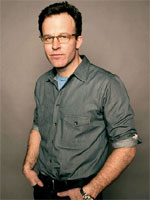
Tag: Tom McCarthy

  • OSCAR GUIDE: Best Writing (Original Screenplay)

    Woody Harrelson in The MessengerBest Original Screenplay: 2009’s most difficult category to predict. Why? Certainly not because of each contender’s merits (when does that ever come into play with the Academy). No, this field is a hair-puller because you have a vibrant, likable personality up against the Best Picture frontrunner, always a recipe for a close race (and, sometimes, a recipe for upset).

    This year’s nominees contain four Best Picture nominees and one surprise (which thankfully ousted the most overrated indie charmer of the year). Atypically, there are as many Best Picture nominees represented here than in the adapted field, which can’t be a bad thing.

    The nominees are:

    “The Hurt Locker” (Mark Boal)
    “Inglourious Basterds” (Quentin Tarantino)
    “The Messenger” (Alessandro Camon & Oren Moverman)
    “A Serious Man” (Joel Coen & Ethan Coen)
    “Up” (Screenplay by Bob Peterson, Pete Docter; Story by Pete Docter, Bob Peterson, Tom McCarthy)

    (more…)

  • Lenny Bruce is not afraid

    2012I’m in San Francisco through the weekend and, having missed the week’s “2012” press screenings, I headed on over to the Van Ness AMC to settle in for Roland Emmerich’s two and a half hours of global destruction, and as overwrought, cheesy, painstakingly contrived (“Where’s the map!?”) and downright BAD as the film is — and it is all of those things — I ate it up.

    Mainly, I salute Emmerich’s gargantuan, platinum cojones for giving us the exact…same…escape sequence not once, not twice, but THREE times.  And make it four if we want to go ahead and trace the roots of the by now standardized moment back to “Independence Day.” I kept waiting on someone to open a laptop with a countdown clock.  Oh wait, they’ve got one on the ark — we’re good.

    Staggering.  Every unconscionable drop of it.  And you know what?  Good.  I want this movie in the marketplace right now.  Sure, it’s a bastardized piece of “drama,” but squeezing damn near every 2012 theory into the mix, cranking the production up to 11 from frame one and STILL Tom McCarthy is able to keep a straight face?  This is high art on some level.  Has to be.

    (more…)

  • ‘The Wrestler’ wins big at the Indie Spirits

    Mickey RourkeDarren Aronofsky’s “The Wrestler” walked away three trophies at today’s Independent Spirit Awards, including top honors for Best Actor (Mickey Rourke) and Best Feature.

    In his greatest acceptance speech of the season, Rourke seemed fully uninhibited, almost as if he said, “Screw it, ballots are in,” and he cut loose.  The tough guy thing poked through here and there as well as a lot of humorous forgetfulness. (He thanked Searchlight honcho Peter Rice and Rice’s “boss, Jim Jimanopoulos, or something like that.”  Of course he meant Fox studio chief Jim Gianopoulos).  But mostly, it was expletive-laden (like the Spirits like), raunchy and overall, still strangely endearing.

    Rourke briefly dedicated the award to recently deceased pet chihuahua Loki, of course, in a choked-up moment that seemed to beautifully contrast with the rest of the rant.  He held the mic like a rock star might, pushing it away during the applause moments and bringing it back to his lips to finish his thoughts.  He also dedicated a solid 60 seconds to his friend Eric Roberts.  “Whatever he did 15, 20 years ago should be forgiven,” Rourke said.  “Eric Roberts is the fucking man and he deserves a second chance.  I wish there’d be one God damned filmmaker in this room that’d let him fly because the man is something else.”

    Melissa Leo’s speech in acceptance of the lead actress award — not so much.  She rambled, she seemed self-involved, overly dramatic, pompous…let’s just say it’s probably a good thing she hasn’t accepted too many awards publicly this year because I think it would have damaged her Oscar chances.  That’s just me, but it’s a hell of a performance and justly rewarded tonight.

    “Milk” won two trophies early on, James Franco taking down a win in the Best Supporting Actor category and Dustin Lance Black’s first screenplay award.  “Vicky Cristina Barcelona” also secured a pair: Best Screenplay for Woody Allen and Best Supporting Actress for Penelope Cruz.

    Tom McCarthy won the Best Director prize despite his film “The Visitor” not showing up in the Best Feature category, while Charlie Kaufman took home the Best First Feature prize for the exceptional “Synecdoche, New York,” which also won the pre-announced Robert Altman Award.

    (More, plus the full list of winners after the jump.)

    (more…)

  • SANTA BARBARA: Writers talk writing, Cruz walks the red carpet

    Penelope Cruz talks to festival director Roger Durling at the Santa Barbara International Film FestivalYesterday was another busy event day for the Santa Barbara fest.  It was a shame the Director’s Panel was canceled, but participant Andrew Stanton switched gears to join Robert Knott (“Appaloosa”), Tom McCarthy (“The Visitor”) and Dustin Lance Black (“Milk”) for an Anne Thompson-moderated discussion on their work at the keyboard this year.

    It was a good discussion, though I couldn’t help a double take at Black’s prepubescent appearance as he waltzed casually on stage.  I mean it as a compliment.  I was also intrigued by his noting one of the things that really interested him when working on the spec “Milk” script was the famed politician’s not-so-heroic side.  “Sometimes he’d be in the bath house when he should have been home with his boyfriend,” Black said.  I say intrigued because one of the key criticisms of the film has been its overly haloed depiction of the man, a criticism that, frankly, hasn’t been properly defended by even the film’s legion of supporters (and I count myself in their ranks).

    Stanton, meanwhile, was perhaps the most thought-provoking member of the panel, finding a nice place amid Black’s low-key veneer, McCarthy’s wit and Knoll’s hilarious interjections.  And thankfully, Jeffrey Wells martyred himself by asking why Stanton continued to be “oblique” when addressing the overweight “teletubbies” of “WALL-E.”  This has been a bone of contention for me on the film for some time, not so much because I feel it undermines the film, but because I believed it to be an easy opportunity for mean-spirited “fat” jokes, so to speak.

    (more…)

  • In the round

    I don’t know why exactly, but the “roundtable” format of interviews that crops up a lot during awards season often strikes me as rather less fascinating than it’s meant to be. Unless the panel is very smartly chosen, I find the discussion tends to veer towards back-patting and faintly smug in-jokery, rather than stimulating argument between widely differing creative forces.

    Maybe I’m just blasé. But on reading the Hollywood Reporter’s two recent “Oscar Roundtables” with six screenwriters and six producers that THR thinks are likely to figure in the Oscar race, I couldn’t help being disappointed that, despite the level of talent involved, they didn’t have that many interesting things to say between them. (I’d go so far as to say that the best soundbite is quoted from the not-present Charlie Kaufman.)

    The selected writers are Jenny Lumet (“Rachel Getting Married”), Dustin Lance Black (“Milk”), Thomas McCarthy (“The Visitor”), John Patrick Shanley (“Doubt”), Andrew Stanton (“WALL-E”) and J. Michael Straczynski (“Changeling”). I have a hard time imagining the latter two will score writing nominations, but the race is young, I suppose.

    Writers can be pretty insufferable when talking about their “process” — I know, I am one. So there’s the usual semi-serious comparing of hours spent at the computer, feverish notebook scribbling and messy first drafts, but there isn’t much discussion of the specific screenplays and films at hand. McCarthy seems to be the most reticent of the group, only entering the discussion halfway through. A shame, really, as I’d venture that he’s possibly the best writer of the lot.

    (more…)

  • Best Original Screenplay: beyond the obvious

    Everyone has a favourite Oscar category, and Best Original Screenplay is mine. It’s partly because I’m a screenwriter myself, so I feel a little more invested in the outcome. My evaluation of the category often comes down to the question: “Which screenplay do I most wish I’d written first?”

    More importantly, however, it’s the category where the Academy takes its greatest artistic risks. With the Best Picture category generally weighted towards adaptations, they often use Best Original Screenplay as a way to acknowledge the edgier, more adventurous work that voters can see the greatness of, but don’t yet have the guts to honour with their biggest prize. Hell, once in a blue moon they even give it to (gasp) a foreign-language film.

    It’s this convenient ghettoising mentality that ensures the likes of “Citizen Kane,” “The Red Balloon,” “Chinatown,” “Pulp Fiction,” “Talk to Her” and “Eternal Sunshine of the Spotless Mind” don’t go empty-handed. Sure, it sucks that they couldn’t win more. And, being the Academy, they make more than their share of screw-ups. (Let’s try and forget that, in 1960, “Pillow Talk” beat — wait for it — “Wild Strawberries,” “North by Northwest” and “The 400 Blows,” shall we?) But they occasionally hit on an otherwise-snubbed masterpiece, and for that we should be grateful.

    This year’s Best Picture slate appears to be heavy on prestige adaptations, allowing for a more idiosyncratic ragbag of contenders on the Original Screenplay front, mixing familiar Academy-anointed favourites with some exciting new voices.

    There is, of course, a chance this could be a year when the paths of the Best Picture and Best Original Screenplay races converge, principally in the shape of “Milk” scribe Dustin Lance Black. Already high hopes for “Milk” were amplified by an excellent trailer, and a number of Oscar clairvoyants are labelling it the front-runner in the top race. If this turns out to be the case, Black will likely benefit.

    (more…)

  • Harwood and Oliver share Humanitas Prize

    To revisit some old friends from the 2007 awards season, the Humanitas Prize in the feature film category has been jointly awarded to Ronald Harwood, for “The Diving Bell and the Butterfly,” and Nancy Oliver for “Lars and the Real Girl.”

    The prize is a screenwriting award aiming to honour achievements that “explore the human condition and reveal our common humanity.” (Previous winners include “Crash,” “You Can Count on Me” and “The Shawshank Redemption.”) Under those criteria, both winners strike me as worthy — even if I find Harwood’s script a rather more substantial achievement.

    Amusingly, the tie leaves Diablo Cody as the lone unrewarded nominee in the category — somewhat appropriate given the lack of maturity or insight she recently displayed in her online hissy-fit. Oh well, to borrow her words, at least she still has her fake name engraved on an Oscar.

    Elsewhere, the Sundance Feature category was awarded to the TV-movie adaptation of “A Raisin in the Sun” over Tom McCarthy’s “The Visitor,” which strikes me as a little odd. But humanity isn’t exactly a quantifiable achievement, is it now?

  • Variety ponders the season at the mid-way point

    We’ve already been over what a thin year it’s been so far for Oscar candidates – or good films at all, for that matter. Now Variety has come to the same conclusion. In his mid-year awards-season study, Timothy M. Gray goes so far as to say that “the past six months have offered fewer potential contenders than any January-June period in memory,” and wonders if we’re seeing a return to the days when the Oscars were dominated by winter releases from the majors.

    Indeed, Gray only finds one title from the first-half of the year that he thinks has main category potential: Overture Films’ “The Visitor,” the prospects of which I discussed extensively yesterday. I’m not sure I’d boil down an entire half-year to a sole film (“In Bruges,” anyone?), but I agree that “The Visitor” has a real campaigning advantage:

    Keep an eye on Overture’s “The Visitor”: Lead actor Richard Jenkins has rightly earned awards buzz, but the film has many other virtues (Thomas McCarthy’s script and direction, the other performances, etc.). McCarthy, a talented actor in his own right, has crafted an actors’ movie — a character study with current-event concerns — that will play well on DVD, so late-year mailings could pay off.

    (Indeed, the more I think about the film’s position in the awards derby, the more it reminds me of a certain tiny spring release from last year: “Away From Her.”

    Looking forward into the rest of 2008, Gray ends up pondering most of the same questionmarks that we all are, including the following questions:

    Will the early buzz sustain for Disney-Pixar’s “Wall-E” and WB’s “The Dark Knight” and Heath Ledger?

    What effect will the Clint Eastwood double whammy — November’s “Changeling” and the December bow of Warner Bros.-Village Roadshow’s “Gran Torino,” in which he stars as well as directs — have on kudos? Similarly, Scott Rudin, who was in the winner’s circle with “No Country,” has two December openers — but will he have a third with “The Reader,” whose opening date is not yet set?

    Benicio Del Toro won Cannes’ actor award for Steven Soderbergh’s “Che,” but will it find a U.S. distrib this year and, if so, in what form will the two-part film be released?

    And then there are … other questions. In the last few years, the song category has been dominated by tunes that were production numbers (as opposed to those end-credit or background songs). So does this bode well for Disney’s “High School Musical 3” and Focus’ “Hamlet 2”? (If the song “It’s Hard Out Here for a Pimp” can win, there may be hope for the latter pic’s “Rock Me Sexy Jesus.”)

    (more…)

  • Will Oscar have an unexpected ‘Visitor?’

    Richard Jenkins and Hiam Abbas in The VisitorAs you all know, we in the UK tend to be a bit behind the curve on most American releases, so I didn’t get to see Tom McCarthy’s wonderful “The Visitor” in time for our mid-year review. Had I done so, it certainly would have been in contention for my ‘best of the year so far’ title. (Happily, Blake recognised it in his contribution.)

    The film opens in the UK tomorrow (July 4 — an auspicious date for a film that challenges American ideals of liberty quite insistently) and, amid the summer movie crush, is getting a fair amount of publicity here, including this interesting piece in last weekend’s Guardian. Drawing comparison to such indie word-of-mouth successes as “In the Bedroom” and “Junebug,” critic Damon Wise believes that McCarthy’s gentle, wry but politically impassioned film could make a similar dent in awards season:

    Normally, articles about the Oscar race appear in late November, once the studios have dusted off their A-list movies. But almost every year when the noms come in, there’s a film that leaves everyone scratching their heads because it seems to have appeared from the ether: it’s the film that came out ages ago, got some good reviews but didn’t do so well at the box office …

    Today’s strangers arrive unannounced, and after the surprise appearance of In The Bedroom at the 2002 festivities, the industry now realises that there is no pattern any more: they can come from anywhere. Which, coincidentally, is, in some ways, the plot of The Visitor, a film that ticks several potential nomination boxes – it features a powerhouse central performance, it ponders on the flaws and foibles of being a so-called normal human being, it finds drama in the everyday – and it does it really rather well.

    (more…)

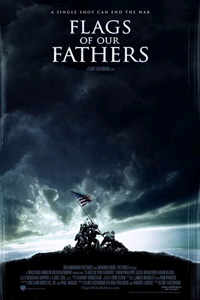
  • REVIEW: “Flags of Our Fathers” (***)

    Paramount Pictures\' Flags of Our FathersClint Eastwood is largely considered one of the most uneven directors working today.  For every probing piece of thematic greatness (“Unforgiven,” “Mystic River”) there are three or four considerable missteps, from “The Gauntlet” and “Heartbreak Ridge” to “Midnight in the Garden of Good and Evil” and “Blood Work.”

    Such inconsistency is the price a hard-working filmmaker pays, for anyone willing to crank out a new project every other year for three decades is bound to miss the bull’s-eye frequently.

    At the same time, amidst these lesser efforts, Eastwood has always shown a process of honing his artistry, remaining a singular talent and every once in a while experiencing the serendipity of matching that talent with exceptional material.  Indeed, more often than not, a failing Clint Eastwood film is doomed on the page before principle photography even begins.

    “Flags of Our Fathers” is certainly a singular figment of the war film oeuvre, fit with promising themes rather unrepresented in the genre’s history that speak eloquently to today’s environment of deception of the masses for the gain of the establishment.

    But it is also an exercise ultimately hampered by an unfocused and erratic narrative, one that constantly seems to be searching for itself and feels hastily lifted from the pages of James Bradley’s best selling book of the same name by William Broyles, Jr. and last year’s Oscar-winning scribe Paul Haggis.

    Bradley’s book was a personal endeavor for the author.  The son of John Bradley, one of the six infamous Iwo Jima flag-raisers immortalized by Associated Press photographer Joe Rosenthal in March of 1945, James Bradley crafted a human account of the lives of unassuming heroes captured in time.  Only three of them survived the war to see the image’s impact on the western world, and within the pages of “Flags of Our Fathers,” their stories are told with painstaking clarity and at times sluggish accuracy.

    The task in adapting the book as a film was to amplify the central theme of manipulation and marketing for the greater good.  Broyles and Haggis succeed in doing this to a point, but as the yarn unfolds, the depth of potential seems to thin out in the mix.

    The three survivors in the photo were John “Doc” Bradley (Ryan Phillippe), a medic who certainly saw his share of carnage on Iwo Jima; Rene Gagnon (Jesse Bradford), a man portrayed as intent on becoming a “hero”; and Ira Hayes (Adam Beach), a Pima Native American paradoxically proud to serve a country that had relegated his people to the confines of reservations.

    Upon their return to the United States, the flag-raisers find themselves ensnared in a publicity tour that represents the core of what Haggis is trying to get across.  Behind the scenes, the aim is for Rosenthal’s lasting image to spearhead a wave of hope and patriotism that will inspire citizens to purchase bonds as the country suffers financial asphyxiation four years into the war.
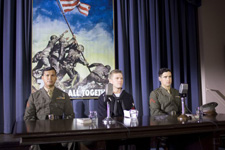
    (from left) Adam Beach, Ryan Phillippe and Jesse Bradford in Flags of Our FathersThe ubiquity of the photo puts Gagnon in the appreciated place he had sought to be, Hayes in the hesitant position he feels he doesn’t deserve, and Bradley as an awkward observer of it all, strangely passive as a character, given the book’s origins.

    This repetitive sense of exhaustive handling is intercut with the infamous battle that claimed the lives of over 27,000 human beings – three quarters of them Japanese.  More congressional medals of honor were awarded for the Battle of Iwo Jima than any other battle in American history.

    A large chunk of this military excursion is presented in the first act – a good ten or fifteen minutes of solid chaos.  Had Haggis chosen to tell the story in a more linear fashion, keeping the battle at the top and using its memory as a haunting element throughout the rest of the film, the pieces might have come together more organically.

    But the stink of manipulation and even amateurism emanates from the decision to continuously go back to Iwo Jima when it feels thematically relevant.

    Eastwood and his technical crew, not the least of which being cinematographer Tom Stern and film editor Joel Cox, do a marvelous job of conveying an unnerving and multi-faceted battle sequence that will draw comparisons to Steven Spielberg’s “Saving Private Ryan.”

    Eastwood is working with much more than land infantry here, however, mixing in air battalions, battleship artillery and the symbiosis of it all as it pertains to the taking of Mount Suribachi on the east side of the island.  Exceptional visual effects mix seamlessly with Stern’s washed out photography for a truly gripping and visceral experience.

    However, where Spielberg successfully utilized the Battle of Normandy to visually tell his story, Eastwood seems to get lost in the elements, sacrificing thematics for admittedly surprising capabilities in the trenches.

    All of this might have made for a much more tolerable, even above average war film had the third act not dived so gratuitously into the binding structure of the rest of the film.  Multiple perspectives and narrations carry the tale here and there through fleeting scenes depicting James Bradley (portrayed by Tom McCarthy) interviewing subjects and preparing his book.

    It was laid out from the start, and a return ought to have been expected, but regardless, once the final act commences, the screenwriters make the unwise decision to concentrate on this aspect of the story for purposes much more sentimental than thematic.  And each unrelenting cue of a typically repetitive Eastwood score amplifies this perception of the final leg of the film.

    The performances throughout represent a true ensemble, but the focal points are surely Phillippe, Beach and Bradford.  Phillippe handles an under-written leading role as well as can be expected (that’s really all that can be said), while Bradford puts forth a stock, self-serving and rather uncomplicated character that hedges its bets in an obvious attempt by the screenwriter to steer clear of disrespect.
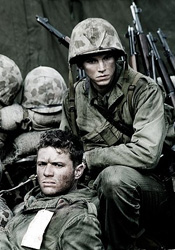
    Ryan Phillippe in Flags of Our FathersElsewhere, John Slattery offers a great supporting turn as the point man on this public relations whirlwind.  Barry Pepper, in the role of flag-raiser Mike Strank, comfortably stifles the urge to take a tough-as-nails character to the same places he has taken numerous similar characters numerous times before.

    Neal McDonough and Robert Patrick fill out the higher military ranks accordingly, while Jamie Bell, Joseph Cross, Benjamin Walker and a thankfully muted Paul Walker (as mistaken flag-raiser Hank Hansen) seem to blend together in the surrounding scenery.

    The real find of the film, however, is Adam Beach, already a 16 year veteran in the business and on the cusp of a defining moment in his career.  Portraying an alcoholic Native American in Ira Hayes (a character that attempts to avoid cliché when it can), Beach’s role automatically exists as the most complicated of the lot.

    There are times when the viewer catches a whiff of over-reaching in his performance, but more often than not, the 33-year-old actor lands the right emotional notes in key scenes that will evoke the most heart-felt reaction from audiences.  Even amidst a continuously tepid reaction to the goings-on, this viewer felt the threat of a tear when Hayes visibly breaks down and hugs the mother of one of his fallen comrades with all the meaning in the world.

    As war films go, “Flags of Our Fathers” had the opportunity to speak to greater truths of the actual machine of war than any other film of its kind.  The John Ford “print the legend” quality of the story is definitely apparent, and as mentioned at the top, these notions speak volumes to the modern environment of vast manipulation, deceit and even celebrity.  But they seem to be fighting through the dense foliage of spectacle at times, and at other times, the elaborate design of unnecessary artistry.

    Much of this is ultimately forgivable, however, if somewhat hesitantly so.

    Eastwood is as surprising as he is predictable in that he never seems to fully collapse under the burden of something new or unfamiliar.  He has found himself adept at conveying epic stories through the intimate brushstrokes of character in the past, the truest examples being his early westerns “High Plains Drifter” and especially “The Outlaw Josey Wales.”

    “Flags of Our Fathers” feels like his third or fourth war film endeavor much more than it does his first.  It was a valiant effort and a unique experience, but it ultimately isn’t enough to stretch beyond definitive flaws in the screenplay.

    During the production of “Flags of Our Fathers,” Eastwood reportedly felt as if he wasn’t conveying the full story of the Battle of Iwo Jima.  With this in mind, he set about preparing “Letters from Iwo Jima” (formerly “Red Sun, Black Sand”).  Told from the Japanese perspective and releasing February 9, 2007 from Warner Bros. Pictures, “Letters” may or may not find itself more in tune with its own thematic structure than “Flags of Our Fathers.”

    Regardless, as a duet, the films will inevitably find themselves unique in the pantheon of anti-war cinema.  It’s nice to see a seasoned filmmaker being this ambitious, and no matter how you slice it, these two films are an ambitious enterprise to say the least.