In Contention

Tag: The Turin Horse

  • OFF THE CARPET: And we’re off!

    This morning’s interview with “Into the Abyss” director Werner Herzog represented my last Telluride communique (though I guess I was already home) from this year’s 38th annual festivities. Five days, 18 posts, nine movies and three interviews. It was a dense sprint to start the race, and now, with Venice still in-progress and Toronto set to raise the curtain Thursday, we find ourselves in the thick of the season’s early breaths.

    Up in the Colorado mountains, the biggest takeaway was Alexander Payne’s “The Descendants.” Payne was highly visible throughout the festival, sometimes taking in six or seven movies a day, fielding compliments for his work and settling in to what has apparently become his favorite festival experience.

    His film first dropped on Thursday afternoon as a special invitation screening for press and patrons. That’s where most of the early word stemmed from as critics and bloggers (yours truly among them) raced back to offer up our thoughts on the director’s first film in seven years. But that’s not the story of that film’s life at Telluride. The story was its discovery for the rest of the attendees over the next four days.

    (more…)

  • ‘Turin Horse’ among latest foreign Oscar entries

    This news has been hanging around for a few days, but amid the Venice hubbub, I haven’t found a moment to post it until today — though we did address it briefly in Friday’s Oscar Talk. With less than a month to go until the deadline, the pile of official submissions for the Best Foreign Language Film Oscar is slowly growing — and the most prominent of them is a title I already reviewed at February’s Berlinale.
    That film would be Béla Tarr’s “The Turin Horse,” which won the runner-up Grand Prix at the festival and just screened at Telluride this weekend, and which I described as “a stately, granite-textured and altogether rather tremendous” work in the famously austere director’s canon. Hungary has a history of choosing ballsy and utterly doomed Oscar submissions — “Taxidermia,” anyone? — but this is the first time they’ve dared to enter a Tarr opus.

    (more…)

  • BERLIN: ‘Nader and Simin’ wins big

    Unlike large voting bodies such as the Academy, the decisions of rotating festival juries are rarely easy to anticipate — when only six people are determining the awards, as was the case at this year’s Berlinale, who knows what idiosyncratic personal tastes might come into play?

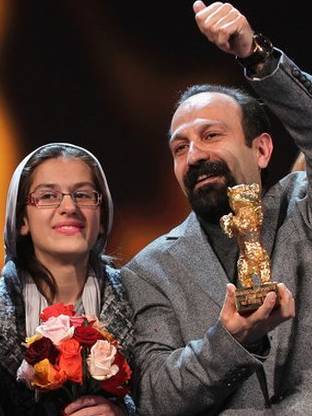
    So it is that the only truly surprising thing about this year’s Berlin Competition winners, announced at a ceremony last night, is just how unsurprising they are. As I predicted in my Friday review of both films, Isabella Rossellini and her fellow jurors sided with the critics, as it came down to Béla Tarr’s imposing survival study “The Turin Horse” and Asghar Farhadi’s intricate moral drama “Nader and Simin, a Separation” for the Golden Bear.

    As expected, it was Farhadi’s more accessible, though no less deserving, film that came out on top — two years after the filmmaker took the festival’s Best Director award for “About Elly” — while a seemingly surly Tarr had to settle for the runner-up Grand Prix. (The severe Hungarian auteur was there to pick up his award, but refused to give an acceptance speech.)

    (more…)

  • BERLIN: Béla Tarr and Golden Bear favorites

    The Berlinale competition drew to a close this morning, with Joshua Marston’s “The Forgiveness of Blood” — more on that in a final roundup this weekend — wrapping up a selection that’s been a typically mixed bag for the festival. Healthy critical argument has flared up over a number of titles — including lone Asian entry “Come Rain, Come Shine,” a bare-bones day in the life of a separating couple that struck some as delicately affecting and others merely as attractively vacant. (I’m one of the others, sad to say.)

    Meanwhile, films the critical majority has sided against include “Lipstikka,” a reportedly bananas Israeli melodrama that Telegraph critic Tim Robey warned me off with this choice dialogue sample: “You play games with me, like you used to do with your men, with your sex and boobs.” Part of me regrets missing this one.

    Amid the splinters of the Competition, however, a pair of critical favorites have moved comfortably ahead of the pack in terms of general approval and all-round buzz — they screened three days ago, eons in festival time, yet I’ve barely heard anyone talk about any other films since. I’m afraid to say that my own top film of the fest, Cameroon-set German drama “Sleeping Sickness” (reviewed here), isn’t one of them.

    (more…)

  • BERLIN: ‘Sleeping Sickness,’ ‘The Future,’ ‘The Guard’

    Sorry there was no Berlinale dispatch yesterday. It was my birthday, and after “celebrating” it with a triple-bill of variously despairing Competition entries — finishing with “The Turin Horse,” Béla Tarr’s impressive 146-minute ode to blizzards, boiled potatoes and dying — more traditional festivities were in order, beginning with several stiff drinks. There’s nothing like a film festival to infuse a birthday with bleaker-than-usual ruminations on mortality.

    After a dawdling start, however, the Competition really kicked into gear yesterday with a pair of substantial auteur works that will likely remain the prime topic of critical conversation for the duration of the festival: the aforementioned Tarr opus and Iranian writer-director Asghar Farhadi’s “Nader and Simin, A Separation,” now the runaway favorite for the Golden Bear for reasons both artistic and political.

    I’ll discuss both these films in due course, but neither one has quite displaced an earlier (and more critically divisive) Competition title from the top of my personal best-of-the-fest list — and indeed, if anything does in the next three days, I’ll be a very happy (and surprised) man. That title would be German director Ulrich Köhler’s third feature “Sleeping Sickness” (****), an arrestingly structured and humidly atmospheric study of immigrant living and integration in west Africa that would make a valuable companion piece to Claire Denis’s more pristine “White Material,” but also warrants discussion on its own merits.

    (more…)