In Contention

Tag: The Bourne Ultimatum

  • Guy’s top 50 of the decade: #31-40

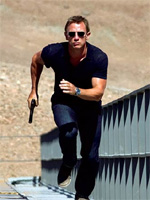
    Matt Damon in The Bourne UltimatumYesterday, I began my countdown of my 50 favorite — do note that last word, I hesitate to say “best” — films of the 2000s. Today, we creep up another ten rungs on the ladder.

    I wrote this in my introduction to the list yesterday, but it bears repeating: don’t read too much into the rankings at this level. I’m not the kind of person who can scientifically determine whether my 37th favorite film of the decade is marginally — but conclusively — superior to my 38th favorite. Just today, I did some mild shuffling with the following titles, only to change my mind a few minutes later.

    Bottom line: I think they’re all pretty darn special. The list continues after the cut.

    (more…)

  • Bond bows, UK critics shrug

    It was probably inevitable. After “Casino Royale,” the first entry in the retooled, Daniel Craig-led James Bond franchise, garnered unprecedented critical acclaim (and even awards attention, on this side of the Atlantic at least) for a 007 pic, the follow-up, “Quantum of Solace,” is having a more muted reaction. The reviews are in, and they’re respectable at best.

    Peter Bradshaw at The Guardian has the best line (“Bond has gone rogue — like Sarah Palin, only with less expensive clothes”), but his three-star review is pretty typical of the mood:

    I have to confess that this second Bond adventure disappointed me a little: it’s not nearly as smart as Craig’s debut. There is not much storyline or romance … (but) what Quantum of Solace does have is Daniel Craig. No one could deny Craig’s charisma, and the effortless way he has inhabited the role … Quantum of Solace isn’t bad, but from now on, Craig’s Bond has to be a real character with something real at stake, however absurd. Otherwise we’re going to return to the franchise production line. That would be an awful shame.

    Tim Robey at the Telegraph is more enthusiastic, even if he also has some reservations about the narrative:

    Quantum of Solace may hurtle through its own (sketchy) plot as if it’s not quite the point – there have been more satisfying narrative pay-offs than we get here – but its best sequences bring you up short in the best way, adding up to the giddiest straight ride since The Living Daylights … It has the compensation of a rock-solid dramatic idea, and the intelligence to run and run with it.

    (more…)

  • Forster on Bond: It’s about character

    Odd to be linking to Time Out twice in one day, but I couldn’t let this interview with Marc Forster, director of the keenly awaited “Quantum of Solace,” go by. The interview finds Forster in London, scrabbling to complete the first edit of the latest 007 outing in a fortnight’s time.

    Many eyebrows were raised when it was revealed that the low-key director of “Monster’s Ball,” “Finding Neverland,” and “The Kite Runner” was taking on this most commercial of franchises – I always thought it rather a nice fit. For me, Forster never injected much individual flair or perspective into his otherwise workmanlike ‘serious’ pictures; I have a feeling more of his creative personality might emerge when working against the grain of his interests. Certainly, Forster doesn’t seem to be radically modifying his storytelling approach – he believes he was hired because the producers wanted a more “emotional component” to the film:

    Several times (Forster) mentions what he believes will be at the heart of the new film: character. ‘The great thing is that Daniel and I had an intense relationship, so between us we could always go back to the character … There’s this conflict going on: he’s an assassin, but he’s also lost someone he loves. We’re asking: where’s the psychological conflict in that?

    Sounds good to me. Other promising tidbits include Forster citing genius production designer Ken Adam, who worked on the first Bond films, as an influence on his creative vision, and a sneak peek at what promises to be the most exciting foe in some time for 007:

    We see a flash, too, of the new Bond villain, French actor Mathieu Amalric, who plays a character with the decidedly unvillainous name of Dominic Greene. ‘In the old Bond films, it was clear who were the good guys and who were the bad guys. Today, it’s not so clear. I feel like Mathieu looks so sympathetic and normal, the type you can’t see right away is the villain.’

    (more…)

  • Is Paul Greengrass taking up the reins of ‘Chicago 7?’

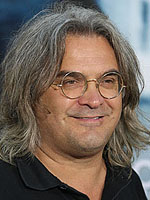
    Paul GreengrassFilmmaker Paul Greengrass has been drawn to the sphere of politics since day one in his career as a filmmaker. He launched into the fray with 2002’s blisteringly realistic “Bloddy Sunday” (an account of the Derry massacre of 1972) and followed it up with a “Bourne” installment, putting his unique knowledge of covert military operations to use.

    2005’s “United 93” was a tightrope walk that managed to land him a Best Director nomination, while 2007’s “The Bourne Ultimatum” was easily one of the best films of last year. He has been a director on an upward curve, settling quite comfortably in his role as an artist to watch, if not the artist to watch.

    One of my most anticipated productions of 2009 is Greengrass’s “Green Zone,” an adaptation of Rajiv Chandrasekaran’s “Imperial Life in the Emerald City” that could be a hell of a windfall for the Iraq stalemate when it finds its way to screen. Matt Damon will star and Greengrass will have yet another stage for his brand of cinema.

    Finally, though I’m excited for the visual splendor and dedication to source material of Zack Snyder’s upcoming “Watchmen,” I think we all would have been interested in Greengrass’s spin on the material had it come to fruition when the project was at Paramount Pictures a few years ago. The “‘Citizen Kane’ of comic books” certainly knows from the beast of politics.

    Now word is circulating that the director may be attached to direct DreamWorks SKG’s “The Trial of the Chicago 7,” a film originally stuck in Steven Spielberg’s ever-rotating wheel house of ideas. If it’s true, count this viewer excited.

    Here’s what Neil Miller of Film School Rejects has uncovered:

    Then this evening, out of almost pure chance, I was skimming through the pages of Production Weekly, checkout which productions are currently in active development when I ran across an updated listing the The Trial of the Chicago 7. After cross checking some other participants, including writer Aaron Sorkin and Producers Walter Parkes and Laurie MacDonald, I deduced that this was the same production. The only odd part was that instead of listing Steven Spielberg or no director at all, the production listed a different director: Paul Greengrass.

    Well…that’s a development, to say the least.

    Greengrass has shown in all the aforementioned films an adeptness to the even keel when dealing in hot button issues of war and policy. He spends a considerable amount of time focusing on character rather than the situation.

    I remember interviewing Kevin Macdonald in early 2006 about his then upcoming “The Last King of Scotland,” and he made it a point of mentioning that he was more interested in the way politics affects the individual, rather than the statement of the politics themselves. I think that characteristic is applicable to Greengrass’s work ethic as well.

    So count me in on this one.  I’ve never seen Brett Morgan’s “Chicago 10” documentary, but I’ve always thought this story could be a hell of a showcase in narrative form on screen.  Greengrass would be a great fit.

  • The top 10 shots of 2007: part two

    Today we round out the top 10 shots of the year with the final five.  Check out part one if you missed it.

    Let’s dive in:

    #5

    Michael Clayton

    “MICHAEL CLAYTON”
    Director of Photography: Robert Elswit

    We were completely ripping off New York filmmaking from the 1970s, things like “Klute” and pretty much everything Owen Roizman has ever shot.  But Tony’s sense of these things was not lots of little pieces; he loves making kind of graphic frames that play as long as possible.

    –Robert Elswit

    Robert Elswit had a hell of a year in 2007, finally getting his due from the American Society of Cinematographers who awarded his work in Paul Thomas Anderson’s “There Will Be Blood.”  There was another film featuring Elswit’s unique signature, however, that flew under the radar for its considerable attention to composition and camera movement: Tony Gilroy’s “Michael Clayton.”

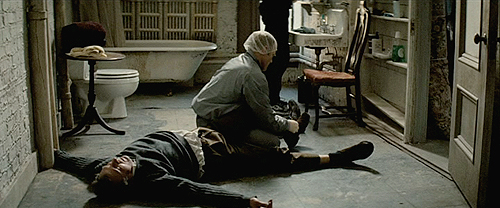
    Much is made of the film’s final sequence, a long shot focused on Clayton as he rides away from the hysteria in his life, desperate for his cab driver to “just drive.”  But a companion shot from earlier in the film was just as arresting, if not more so, as a purposeful point of transition to the second half of the endeavor.  A long tracking shot that never misses a beat, both behind and in front of the camera, the scene detailed is the expert, painfully clinical execution of Arthur Edens, played to an award-worthy T by Oscar nominee Tom Wilkinson.

    The final image is steeped in theme, and an initial tracking sequence under Edens’ opening monologue pulls the viewer into the film’s interior world, but this particular shot is so cold as to be frozen in its depiction of something at once gruesome and strangely beautiful, fluid.  I’m not privy to whether it may have been a directorial decision, though I suspect it may have been, but it is the crown jewel in a film packed with precision from Elswit.
    (more…)