The guys who put this together should start a series. The end of “The Usual Suspects,” please?
Tag: Se7en
-
THE LISTS: Top 10 below-the-line elements of Fincher films
 With “The Social Network” hitting theaters this weekend, audiences are reminded once again of director David Fincher’s skill and vision as a craftsman. The eight films he has assembled throughout an 18-year career in feature filmmaking have been dazzling showcases for below-the-line talent.
As you know, we make an effort to keep the spotlight on these elements of the filmmaking process. Art direction, cinematography, costume design, film editing, makeup, music, sound and visual effects are all key ingredients, and Fincher has always been a director consumed by their implementation in his work.
The seeds of this, of course, were planted early on in his commercial and music video career. They seemed to reach a full apex two years ago with the period and effects detail of “The Curious Case of Benjamin Button” (racking up eight of the 11 total nominations Fincher’s films have amassed in these arenas), but each film in his portfolio sports below-the-line creativity and artistry worth singling out.
So it seemed to me a great opportunity to dedicate an installment of The Lists to the best craft elements of Fincher’s filmography to date. Let’s dive in…
-
The kids are NOT all right (or alright, for that matter)
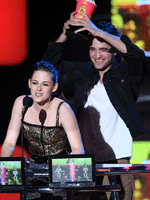 This post is so unnecessary because it is an obvious lost cause. It really shouldn’t even be enough to get a rise, but in me, it just…does.
You know, once upon a time the MTV Movie Awards (which are voted on publicly) actually seemed to reflect an edge in America’s youth. Think about it. “Terminator 2: Judgment Day” won the MTV award for Best Picture. “Menace II Society” won the MTV award for Best Picture. “Pulp Fiction,” “Seven,” “Scream,” “There’s Something About Mary,” “The Matrix,” “Napoleon Dynamite,” etc. Room was even made here and there for prestige pics that tapped a pop culture vein. “A Few Good Men,” for instance, or “Titanic,” “The Lord of the Rings” trilogy and “Gladiator,” one of only two times the award matched the Academy’s choice.
And in the last five years? Scary. “Wedding Crashers,” “Pirates of the Caribbean: Dead Man’s Chest,” “Transformers” and far and away the two worst films to win a popcorn statue: “Twilight” and “The Twilight Saga: New Moon.” (Why, Bill, why?) What the hell happened to the MTV audience? What happened to the kids’ edge? Who are these people?
-
Blast from the past
Roger Ebert and Gene Siskel review the first Fincher/Pitt collaboration in September of 1995:
-
THE LISTS: Top 20 movie endings of all time
 Alright, this was painstaking indeed. After The Times of London saw fit to rock out a list of the 20 best movie endings of all time last week, I thought I’d try my own hand at such a collective.
There are some omissions that might surprise some folks (“Bonnie and Clyde,” “The Graduate,” “Carrie”). At the same time, there are films that, on any other day, would easily slip into the list (“A Clockwork Orange,” “Once Upon a Time in the West,” “Reservoir Dogs”).
Rest assured they were taken into account, but they didn’t speak to me on whatever levels must have been necessary to push into the top 20. But I can say these are the denouements that most affected me, be it viscerally or emotionally.
Send in your picks for the top five movie endings of all time and I’ll publish a collective readers’ list in a few weeks. Email me or post your list below in the comments section.
Here’s what I came up with:
20. “The Iron Giant” (Brad Bird, 1999)
“You stay. I go. No following.”
Animation genius Brad Bird made his feature directorial debut with this effort, packing an emotional punch by film’s end with shades of “E.T.: The Extra-Terrestrial” — and an energizing final shot to boot.19.”Jacob’s Ladder” (Adrian Lyne, 1990)
“He looks kind of peaceful, the guy.”
Capping off one of the most bizarre cinematic visions ever captured (and, ultimately, quite underrated as well), this closing scene is a twist that has been lifted in various other forms ever since. (see next)18. “The Sixth Sense” (M. Night Shyamalan, 1999)
“I think I’m okay, really. I think it just went in and out.”
Hot prospect M. Night Shyamalan tainted the original power of the twist ending by attempting to make a career of it, but in the final moments of this early effort, his buried talent poked through the surface.17. “The Shawshank Redemption” (Frank Darabont, 1994)
“Get busy livin’ or get busy dyin’. That’s God damn right.”
Less a closing scene than a closing sequence, the entire third act of Frank Darabont’s Stephen King adaptation manhandles the heartstrings and lifts the spirit.16. “Se7en” (David Fincher, 1995)
“John Doe has the upper hand.”
Andrew Kevin Walker crafted a near masterpiece that culminates as perfectly as it could have, death and despair, ambition and art, plus a Hemingway rebuttal for the ages.15. “The Conversation” (Francis Ford Coppola, 1973)
“We’ll be listening to you.”
The calmly paranoid conclusion to a mind-bender from a mid-“Godfather” Francis Coppola, this finale put Gene Hackman in a position to give perhaps the greatest performance of his career.The full list after the jump!
-
What are the best movie endings of all time?
 I was working on this piece yesterday (nothing major — just pulling together the YouTube clips), but I wasn’t aware how the list was going to pan out. “Carrie” at the top? Not so sure about that.
But The Times critics like to be contrarian. Just take a look at their Top 100 Films of All Time list, which places Paul Thomas Anderson’s “There Will Be Blood” rather brazenly at #2.
Anyway, debating and sussing out the best of movie endings ever could have us chatting into the night. Most of my favorites are recent examples, but that’s probably due to what the 1990s did to the screenwriting form.
Scribes began giving a lot more thought to how the audience would feel when leaving the theater. Twists and emotional-punches became a currency of sorts, which is probably why there are more films from the decade than any other on The Times’ list.
I will say I’m glad there was room for “Seven,” “Memento” (which I re-watched recently and absolutely adore) and “E.T.,” three (perhaps) out-of-the-box choices that don’t leap to mind when the subject comes up. And it’s impossible to argue against “The Usual Suspects,” “Butch Cassidy and the Sundance Kid” and “Planet of the Apes.”
If I were to suggest a some additions, I might begin with “Heat,” “Citizen Kane,” “A History of Violence,” “Jacob’s Ladder” and “Boogie Nights,” to name a few.
The Times’ list of the best movie endings of all time:
1. “Carrie”
2. “Butch Cassidy and the Sundance Kid”
3. “Casablanca”
4. “E.T.: The Extra-Terrestrial”
5. “Chinatown”
6. “Breakfast at Tiffany’s”
7. “Some Like It Hot”
8. “The Italian Job” (1969)
9. “The Usual Suspects”
10. “The Sixth Sense”
11. “Thelma & Louise”
12. “The Wizard of Oz”
13. “Les Diaboliques”
14. “Dr. Stranglelove”
15. “Gone With the Wind”
16. “The Shawshank Redemption”
17. “Planet of the Apes”
18. “Memento”
19. “The Blair Witch Project”
20. “Seven”I might pull together my own top ten soon enough.
What are your favorite movie endings?
-
REVIEW: “Babel” (****)
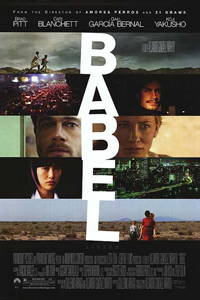 “Babel” is the crowning achievement in the early careers of writer Guillermo Arriaga and director Alejandro González Iñárritu. It will deservedly be seen as that defining moment which took them out of personal thematic expression -– the mark of a true artist -– and into the arena of global and human consciousness through artistic dexterity -– the mark of something much more.
It is the most particular specimen, yet the most universal, in the long line of socially and/or politically inquisitive filmmaking we’ve experienced over the last two years. And it goes without saying, “Babel” is the first real masterwork of 2006.
As outlined in the eleventh chapter of the book of Genesis, the Tower of Babel was a creation built by the collaborative forces of a united humanity. Having it in their hearts to emulate the Creator, the text reveals, “they said, Go to, let us build us a city and a tower, whose top may reach unto heaven.” As the legend states, God halted the project by confusing the languages of the united, so that they could no longer communicate with one another.
God then scattered the people throughout the land, forever disconnected, yet still of a similar and undeniable origin.
The Tower of Babel is a narrative used to explain the diversity of languages and race throughout the world. It is also a rather obvious warning that any who would attempt greater personal standing than that which God has outlined for them is doomed to failure. However, at its core resides another illustrative failure begging thematic expansion: We as humans are furthermore doomed to eternal miscommunication, so long as we maintain the literal and figurative borders of our own design. This thematic is the central focus of Arriaga’s and Iñárritu’s brilliant film.
“Babel” tells four stories set in the lands of Morocco, Mexico and Japan. Each of the stories, in typical Arriaga/Iñárritu fashion, shares common strands, continuing their trilogy of interconnectivity and fateful consequence (themes also found in 2000’s “Amores Perros” and 2003’s “21 Grams”).
Two Moroccan brothers, testing the range of a firearm purchased for them by their father for the purposes of killing jackals, instigate the events of the film which will outline the filmmakers’ tale. A single gunshot rings out in the Moroccan desert, spiraling the lives of Richard and Susan (Brad Pitt and Cate Blanchett, respectively) into a dizzying and confusing abyss of political turmoil, paranoia and, assuredly, dire straits.
 Vacationing and searching in vain for themselves and their emotional connection once again, Richard and Susan have recently lost one of their children. Neither has recovered, and neither has found the ability to forgive the other.
Meanwhile, at the couple’s home in San Diego, their illegally employed Mexican nanny, Amelia (Adriana Barazza), is anxious to make it to her son’s wedding back home. Against the advice of her nephew, Santiago (Gael García Bernal), she makes the fatal decision to bring Richard and Susan’s children –- whom she has raised for eleven years –- with her across the border.
The more politically relevant of the three tales, Amelia’s journey is reflective of current foreign policy as it relates to border concerns, and the heartbreaking consequences potentially harsh edicts can manifest in that regard.
Concurrently, in the communicative and technological Eden of Tokyo, Japan, Chieko (Rinko Kikuchi, the film’s unparalleled standout), is a deaf-mute girl exploring herself sexually as an adolescent, but ever lost in her own paralyzing world. Chieko is the true heart of the film, lacking the ability to communicate, not merely emotionally, with her widowed father, Yasujiro (veteran Japanese thespian Kôji Yakusho), but quite literally, with the people who surround her in one of the most populated cities in the world.
The performances in the film are all of an organic whole, but as undoubtedly diverse as the characters being portrayed. As Richard, Brad Pitt finally puts forth a commendable and saturated performance to stand alongside his best work (“12 Monkeys,” “Seven,” “Seven Years in Tibet”), while Cate Blanchett, largely relegated to painful cries and disappointed outbursts, is ever-commanding as she continues her lineage of impressive portrayals.
The actors cast as the two Moroccan brothers and their father (with whose names, I’m embarrassed to say, I am not familiar) offer performances that are fascinatingly tangible and, in many ways, the most reflective of human frailty. Meanwhile, Gael García Bernal has a comfortable supporting opportunity to give the hint of depth, but still keep his cards close to the vest.
 The most captivating and award-worthy performances in the film, however, come from Adriana Barraza and, most especially, Rinko Kikuchi. Barraza’s conflict is so frightening, and eventually, so terribly desperate, that it could burden the shoulders of the most gifted of actresses. She commands the role in such a way that we feel for her wholly, in ways both humanitarian and political in nature.
Kikuchi, on the other side of the world, provides a venue for us to experience the film’s themes ourselves. So much of her performance comes through her eyes and through her visual reaction to the events around her that the audience is forced to partake in her journey as well. Seemingly we feel no such personal connection to any other character in the film. It can be no coincidence that that character is the one so drastically isolated from the world six inches in front of her face.
“Babel” pushes through the journeys of its inter-connected characters toward its own vibrant, certainly logical, but altogether ideal (if profound) conclusion. Through their usual heart-wrenching tactics, Arriaga and Iñárritu paint the portrait of humanity scattered, just as in the days of Genesis, but not at all lacking the promise of rediscovery.
Though not nearly as dark as their last two efforts, and certainly more accessible on the whole, “Babel” concludes in the most uplifting of fashions. The film’s closing moment at once draws the sigh of hope and a tear of thankfulness that Pandora closed her box in time, another legend entirely, yet one as applicable to humanity as that of the tower which represented man’s original arrogance.