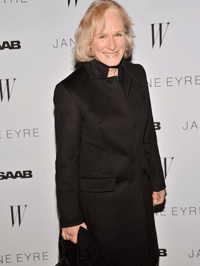
 Telluride Film Festival
Actress Glenn Close has known the title character of “Albert Nobbs” for nearly 30 years. Ever since she was first asked to audition for the play “The Singular Life of Albert Nobbs” in 1982, which brought her to George Moore’s short story about a woman living as a male waiter in male-dominated 19th Century Ireland. That’s a long time for any performer to live with a role, and it takes a special breed of stick-to-it-tiveness to see the journey she’s seen for the character all the way to the big screen.
“It’s always been a little surreal,” the actress says at the Chuck Jones Theater after introducing the film to its second crowd here at Telluride. “Every morning when I would go to the set, I couldn’t believe that, something that’s been in my head so long, people were actually working on this movie.”
The role originally sparked Close’s interest because of the inherent challenges it presented. Servants in that era, she notes, were not supposed to look people in the eye. They were meant to be invisible. And here is a character, invisible in her own right by virtue of her secret, also in a profession where she must be under the radar. It wasn’t an opportunity to be emotionally expressive for much of the narrative, but Close says that was an attraction to the part.
 One of the surprises of the TIFF coverage I’ve read so far has been the notably enthusiastic reception for Rodrigo Garcia’s “Mother and Child.” It’s a film I confess hadn’t been on my radar at all until now, despite my high regard for Garcia’s quiet, character-oriented work in film and especially television.