In Contention

Tag: Naomi Watts

  • 10/20 OSCARWEB ROUND-UP: ‘Complete Metropolis’ coming to TCM, buzz for Leo, Cameron on the usual talking points

    • Jeffrey Wells reminds of the forthcoming TCM airing of the restored “Metropolis” and one hour documentary “Metropolis Refound.”  I’ll…be…there. [Hollywood Elsewhere]

    • Steve Pond conveys positive word on Christian Bale and (as reported for months here) Melissa Leo’s performances in “The Fighter” from ShoEast. [The Odds]

    • Naomi Watts on “Fair Game,” Valerie Plame and politics in Hollywood. [HitFix]

    (more…)

  • OFF THE CARPET: The year of the woman, take two?

    It wasn’t by coincidence that the three photos decorating the season’s introductory installment of this column two weeks ago represented lead actress contenders in the 2010 Oscar race. After all the talk of 2009 being “the year of the woman,” owing much to the number of female directors who found themselves in the mix (and inevitably leading to Kathryn Bigelow’s history-making moment at the Kodak), I’m sensing an even better argument for 2010 as a singular season for the fairer sex.

    Let’s start with the performances. By my count, there are already eight nominatable offerings from lead actresses this year (which contrasts drastically with a dearth of supporting hopefuls).  This is just going by what I’ve seen, mind you.

    For starters, Natalie Portman has dazzled the early festival season with her work in “Black Swan.” Lesley Manville, meanwhile (should she remain a lead focus), sets a high bar in “Another Year.” Despite my feelings on the film, Carey Mulligan really settles into a next-level groove in “Never Let Me Go,” and Jennifer Lawrence, of course (like Mulligan last year), has already become the year’s star-in-the-making story in “Winter’s Bone.”

    Dovetailing with the performances themselves, there are also films that seem to reflect the theme in narrative. In “Secretariat,” for instance, Diane Lane capably (if a bit histrionically) portrays headstrong Penny Chenery, a woman of virtue in an era when she was expected to keep her head down and clean house. Similarly, Sally Hawkins absolutely kills as the Norma Rae-ish Rita O’Grady in “Made in Dagenham,” fighting for equal pay in a similar time (and she’s likely to be joined in the hunt by co-star Miranda Richardson for a fiery supporting turn). And we can’t forget the palpable feminism apparent in summer indie “The Kids Are All Right,” where Annette Bening and Julianne Moore both bring their “A” game.

    (more…)

  • ‘Fair Game’ trailer

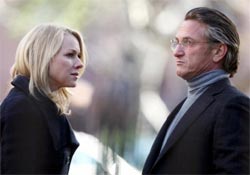
    Actress Naomi Watts is front and center as an awards prospect in Doug Liman’s “Fair Game,” and the trailer, recently launched via Yahoo! Movies, certainly conveys as much as well. At Cannes, however, the film didn’t really set things ablaze. Guy was measured in his appreciation of the film at Cannes.  We’ll see what Summit can do with a campaign but for now, it’s clearly being positioned as a thriller to bring in the dollars.  Check out the trailer by clicking the image below or watch the embed after the jump.

    (more…)

  • SHORT TAKE: “Fair Game” (***)

    Cannes Film Festival

    The presence of Doug Liman’s name in the Cannes competition lineup has inspired many an unkind crack from an idle critic — this writer couldn’t resist a couple himself. There can’t have been many filmmakers to enter that lofty club immediately after a film as uniformly reviled as “Jumper,” an inept high-concept blockbuster that drowned Liman’s flip, clever-clever personality in lumbering effects and noise.

    Coming to Cannes, then, he has a dual point to prove: not only that he can hold his own among arthouse titans, but that he can even stand up against his own previous (now rather distant) best work.

    Has he succeeded? Well, yes and no. Liman has chosen something of a lazy shortcut back to respectability: a biopic, of an honorable-lefty martyr figure, with just enough Washington-thriller varnish not to frighten the horses. It’s certainly a curious choice as the lone representative of U.S. cinema in the world’s foremost international film contest, but it’s oddly appropriate, too: this is down-the-middle Hollywood craftsmanship, short on innovation and revelation, but effective and engrossing with it. For better or worse, there’s nothing else like this in Competition.

    (more…)

  • The Great Performances: 2005

    Heath Ledger in Brokeback Mountain2005 was the year of Heath Ledger’s beautiful, moving performance in “Brokeback Mountain,” which I saw for the first time in Toronto.  It instantly became the talk of the festival, and the film became the one to beat for the Academy Award.

    Ledger was astonishing as the taciturn cowboy who is more surprised than anybody when his soulmate turns out to be another cowboy, portrayed superbly by Jake Gyllenhall. If there is a more deeply felt moment in film history than Ledger gently adjusting Gyllenhall’s shirt at the end of the film, his eyes filled with tears, I don’t know what it is. That’s loss, that is absolute heartbreak, that is one of the greatest acting performances of the decade.

    Phillip Seymour Hoffman would win the Oscar for his transformation into “Capote” and he’s very good, but just not in the same league as Ledger. I wondered from time to time if “Infamous” had been released earlier if Toby Jones might have won the Oscar instead of Hoffman. Each becomes Capote in a very different manner, and side by side it is difficult to choose the stronger portrayal. Certainly I prefer Hoffman’s as it is darker, and for me more realistic, but there can be no denying Jones.

    (more…)

  • The Great Performances: 2003

    Sean Penn in Mystic RiverThere is little doubt in my mind I am going to take some heat this week, so let’s kick it off right away with my belief that Sean Penn deserved his Best Actor Oscar for “Mystic River,” a performance of overwhelming ferocity and staggering emotional power.

    Yes, I too loved Bill Murray in “Lost in Translation,” and would have loved to have seen him win, but he didn’t, and frankly he lost to a stronger performance (in my opinion). I know it is a cliche to say the nomination is the reward, but I would hope that Murray would be happy with that.

    But there were so many great male performances in 2003!

    Robert Duvall was superb in “Open Range” as the wily old rancher who ends up in a gunfight for his life with his friend, played by the also fantastic Kevin Costner, by his side. Tom Cruise gave a great performance in “The Last Samurai” for director Edward Zwick, while Russell Crowe was again brilliant in “Master and Commander: The Far Side of the World,” adding to his string of stunning performances.

    (more…)

  • Could ‘Mother and Child’ corner the female vote?

    Mother and ChildOne of the surprises of the TIFF coverage I’ve read so far has been the notably enthusiastic reception for Rodrigo Garcia’s “Mother and Child.” It’s a film I confess hadn’t been on my radar at all until now, despite my high regard for Garcia’s quiet, character-oriented work in film and especially television.

    “Mother and Child” seems to further carve his cinematic niche of tasteful, female-focused ensemble dramas, so I was expecting the same kind of warm, if slightly reserved, critical reaction that greeted “Nine Lives” and his underrated debut “Things You Can Tell Just By Looking at Her,” but so far, “Mother and Child” seems to be aiming higher than that.

    Jeff Wells was eager to be first on Monday, gushing that it was “a super-sensitive, perfectly acted and exquisitely written adult drama” and “a Best Picture contender — guaranteed, hands down, take it to the bank.” He then rather spoiled his own party by later admitting that he’d skipped the film’s last half-hour, which he later found wanting — but still generally stands by the film.

    (more…)

  • Kidman out

    Quelle dommage. It appears that Nicole Kidman has dropped out of Woody Allen’s untitled 2010 project. No explanation has been offered.

    It’s hard to say how great a loss this is — with details on the film so sketchy at this point, we have no idea whether we’re talking about the actress ditching a major role or one of those starry cameos he occasionally sprinkles through his ensemble pieces. I’m disappointed nonetheless; Allen would have been a nice name to check off on the actress’s enviable auteur roster.

    I’d suggest the obvious replacement of Naomi Watts, but — oh, wait — she’s already in it. Is Cate Blanchett free?

  • Acting out

    Meryl StreepThe Guardian’s Ryan Gilbey offers an interesting piece today about screen acting, and the narrow criteria by which many of us judge it. He is writing principally in response to a recently released British film, “Helen,” a rigidly stylised meta-film in which actors play actors participating in a police reconstruction, which has attracted divisive reviews for the deliberately stilted performances of its cast.

    Complaining that many audiences place too much stock in “realism” in acting — using the deification of intensely studied, precise performers likes of Meryl Streep (“a walking manual on acting”) as an example — Gilbey argues the following:

    David Mamet writes that “We confuse ‘I like it’ with ‘It is very realistic.’ If we like it we say, ‘Yes, that’s very true.’” So truth becomes our alibi, our defence for that which pleases us.

    Given our myriad ideas of truth, it is no wonder we turn to the awards ceremonies to clarify and ratify. But while Sean Penn, Philip Seymour Hoffman or Meryl Streep win prizes, and their acting may feel true or right, it is detrimental to the craft to hold up as ideal only those performances that work as audition pieces, or as 30-second excerpts on Oscar night. The actors in Bresson’s Mouchette or Dumont’s La Vie de Jésus are but one component of those films’ defining philosophy and meaning; removed from that context, their performances have no meaning.

    (more…)

  • Embarrassment of riches

    Remember when, a few weeks ago, Freida Pinto was automatically declared Woody Allen’s new “muse” simply because she had committed to his next film?

    Well, it seemed premature then — and now that none other than Nicole Kidman has been added to a cast that already included Naomi Watts, I think it’s fair to say the focus (not to mention the pressure) is off Pinto.

    Even by Allen’s own lofty casting standards, Kidman is quite a coup. As usual, we have no other details of the project, but I would love to see Kidman let loose in a comedy for a change. With Josh Brolin, Anthony Hopkins and Antonio Banderas also in the mix, it’s certainly an attractive line-up. But then, when does one of Woody’s films not look good on paper?

    (UPDATE: Thanks to diligent commenter Billyboy, I can inform you that the film is “a dramatic comedy which is set in London (and) revolves around the romantic intrigues, sexual desires and ambitions of a group of people.” Business as usual for the man, then — not that we’d want it any other way.)

  • Berlin fest gets under way

    As far as press coverage goes, the Berlin Film Festival tends to get a bit drowned in the flurry of Oscar season, so you could be forgiven for failing to notice that it actually kicked off last night, with the world premiere of Tom Tykwer’s corporate thriller “The International.”

    Sadly, as I suspected, the film doesn’t seem to be much to write home about. Screen International describes it as “ploddingly talky,” describing stars Clive Owen and Naomi Watts as “leaden” and “struggling,” respectively. Variety is no more enthusiastic, deeming it a “mostly ho-hum” exercise. As a fan of both stars and the director, it’s disheartening to see them all punching so far below their weight; Owen, in particular, needs to have a word with his agent. (Why is one of the best actors of his generation stuck in a rut of identikit thrillers? Is “Inside Man 2” really called for?)

    Anyway, onwards and upwards. Tonight sees the premiere of “Ricky,” the new one from François Ozon, who is always interesting even when he misses the mark. (And I must admit that, after the unholy mess that was Ozon’s recent “Angel,” I don’t have the greatest of confidence in this new fantasy-comedy experiment.)

    The weekend will shed some light on two very intriguing titles. Sally Potter’s “Rage,” which features (amongst other things) Judi Dench, Eddie Izzard and Jude Law in drag, promises to live up to the batty eccentricity of Potter’s best work — check out Nat Rogers’ illustrated preview here. Meanwhile, Lukas Moodysson’s “Mammoth,” a seemingly “Babel”-flavoured story of families in crisis, stars Gael Garcia Bernal and Michelle Williams, and has long been one of my most anticipated films of the year. Fingers crossed.

  • ‘The International’ to kick off Berlin

    Screen International reports that Tom Tykwer’s latest, “The International,” has been named the opening film of next year’s Berlin Film Festival. The thriller, starring Clive Owen and Naomi Watts (now there’s a good pairing), will have its word premiere at the fest, screening out of competition on February 5.

    The trailer’s been out for some time, but if it passed you by, check it out below. Looks smart, slick and star-propelled, if hardly a reinvention of the wheel. I’d love to see Tykwer return to the heady formal ambition of “Run Lola Run” or the criminally underrated “Heaven” (Cate Blanchett’s best performance right there, folks), but after the disappointingly overcooked “Perfume,” I can’t blame him for playing it safe here.

    Meanwhile, with this and the recently previewed “Duplicity” marking back-to-back corporate thrillers for Owen, I wouldn’t mind seeing this fine actor take on something a bit more challenging. Solid-looking stuff nonetheless.

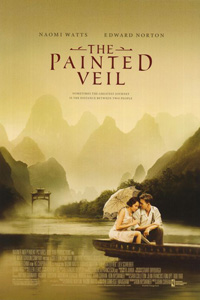
  • REVIEW: “The Painted Veil” (***1/2)

    Warner Independent Pictures\' The Painted VeilRomance seems to be the theme that sparks the most diverse reaction from the artistic community, filmmakers in particular.  There are various methods and structures utilized to tell tales of the elusiveness of love, and new, fresh takes on this binding structure of human interaction come into the cinematic arena every year.

    Some audiences prefer the restraint but equal probing of, say, “The Remains of the Day.”  Others might yearn for the creative ferocity of “Eternal Sunshine of the Spotless Mind.”

    John Curran’s “The Painted Veil” might not be as calm as the former, and certainly not as unique as the latter, but it is nonetheless a story fabulously woven and penetrating in its exhibition of a new kind of love story.  It is one of the year’s finest films.

    Based on the M. Somerset Maugham novel of the same name, “The Painted Veil” is a tale of forgiveness above all else.  It is a deconstruction of our surface frailties and a call to understanding the virtues that lie beneath, and certainly, the lessons that might be learned all too succinctly with the experience of poor decision.

    Conveyed through a creative structure and filmed with long, deep breaths of beauty and compassion, John Curran’s effort propels him from an independent background and into a stoic place of assured filmmaking competence.

    He might be a director to keep an eye on in the future.

    Naomi Watts stars in the film as Kitty, a spoiled and monetarily nurtured sort who longs to break away from her meddlesome mother and tiresome life in London.  She meets Dr. Walter Fane (Edward Norton) at a family gathering one night and the good doctor falls for her immediately.

    Inevitable courtship commences, though Kitty doesn’t seem to take a specific interest over the course of two years (which fly by in the tight structure of the first act) until Walter asks for her hand in marriage.

    Kitty agrees, if only to break free of the ties of London, and the doctor whisks her away to Shanghai, where he will be working and studying.

    All of this is told betwixt scenes depicting a very different Mr. and Mrs. Fane making an overland voyage to a Chinese village, a couple uncomfortable with one another and uninterested.

    This cross-editing comments directly upon the present in a structure recently apparent in Christopher Nolan’s “Batman Begins.”

    As the past blends with the here and now, the first act comes to a head with Walter’s discovery of Kitty’s affair with Charles Townsend (Live Schreiber), a popular diplomat in Shanghai who is also married.  Under the threat of divorce (and therefore scandal), Walter forces Kitty to accompany him to the faraway village where he will study and help treat a cholera epidemic, and in so doing, perhaps glean some sort of pleasure from Kitty’s distress at the expedition.

    Naomi Watts and Edward Norton in The Painted VeilTensions, meanwhile, are running high between nationalist Chinese and the westerners they feel are invasive to their way of life.  Held somewhat emotionally captive in this unfamiliar environment, Kitty spends her days and nights wasting away and feeling useless.

    Walter avoids her, quite clearly considering her with disgust and disdain.  But the man Kitty married, she never bothered understanding or even knowing, and so a trying excursion to the Far East, it seems, might reveal the good man she was too selfish to discover, and the life she has wasted on herself for far too long.

    “The Painted Veil” is a complicated but delicate film.  It really is a lasting sort of story, however, and credit seems to be best served to writer Ron Nyswaner.

    I personally have never read Maugham’s novel, so if the first act structure of the film is apparent therein, forgive my ignorance.  But my assumption is that is not so and it was the clever creation of Nyswaner to comment directly on the Fanes through a simple but purposeful structure from the first frame of the film.

    Whoever is responsible, the device is a brilliant one because it works on so many levels.  Nyswaner (who was nominated for an Oscar in 1993 for his original screenplay “Philadelphia”) also takes a certain care to pace the story with a sense of measure, but never at the expense of interest.  A film that might seem boring to some is in fact quite engaging throughout.

    Edward Norton and Naomi Watts have a specific chemistry that is extremely organic to the piece.  Norton in particular (who also served as one of the film’s producers) provides perhaps his best performance since “American History X,” and certainly his best since “25th Hour.”

    He trumps the quality he tends to have difficulty shaking, that tendency to be Edward Norton first, the character second.  Here, he is fully believable and lived-in as Walter.
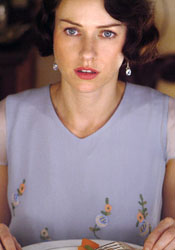
    Naomi Watts in The Painted VeilNaomi Watts shines and has the clear character arc of a woman who grieves for her past mistakes.  Kitty is extremely child-like at the film’s start.  By the end, she is a woman with a life of experience and a future that would have been uncertain otherwise.

    It is a slow revelation for the character, which in some ways makes it more poignant.  To paraphrase, a convent nun puts it to her late in the film, “When duty and love are one, then you are truly full of grace.”

    And that is the lesson Kitty learns a thousand miles from familiarity.

    Another performance worth commenting upon is Toby Jones’s portrayal of Mr. Waddington, a liaison for the Fanes who is quite the warm friend of the family, so to speak.  It’s the kind of small but meaningful turn that Harvey Weinstein would have ushered to a supporting actor nomination in the 90s, one that typically slips under the radar in today’s movie-going environment.

    The technical elements of the film are quite lovely, hinting at the works of James Ivory or Anthony Minghella in some instances.  Stuart Dryburgh’s cinematography thankfully avoids the temptation of drowning the scenery out in golden hues and tonal recreations, rather depending on putting forth beautiful imagery to tell the story first.

    The work of editor Alexandre de Franceschi is some of the most understated but clearly exemplary efforts at the AVID this year, and Alexandre Desplat’s majestic score is his finest work to date, fit with soaring themes and delicate subtlety.

    “The Painted Veil” is the crowning jewel of producer Bob Yari’s output this year.  It is also a fantastic get for Warner Independent Pictures, who might try harder with the film than a larger distributor would (though that is yet to be seen).

    It is a comforting reminder of the filmmaking medium, that stories can be told with beauty and simplicity and still evoke effective emotional impact.  A fantastic effort.