In Contention

Tag: Minority Report

  • The future is now… almost

    I love Steven Spielberg’s 2002 “Minority Report” for a number of reasons — it’s the director’s most searching and adventurous film since a certain 1993 Oscar champ, it’s got ideas as big as its set pieces and it’ll likely remain history’s only $100 million summer blockbuster to star Samantha Morton.

    All good things. But what I like most about the film is that it contains one of the cinema’s few visions of the future that I actually look forward to living in — I know I’m not the only person who was reduced to pre-adolescent gosh-wow effusiveness by its gadgetry. (For one, I know that any attempt to interest my mom in a faddish computer gizmo will result in the reply, “Until I can control the whole thing with my hands, like in “Minority Report,” I’m not interested.”)

    Good news, mom: according to this neat piece in the Guardian’s technology pages, we’re getting there. Eight years after the release of Spielberg’s film, journalist Charles Arthur offers a progress report of sorts on the film’s various futuristic inventions — pointing out the significant strides already made towards the realization of dynamic iris recognition, personalized advertising (already broached in an online capacity) and even “pre-crime” technology.
    (more…)

  • Stab me in the eye

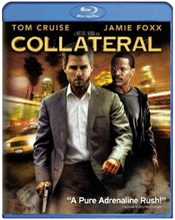
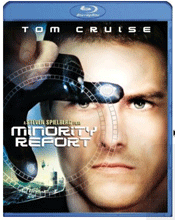
    I’m over the moon that “Minority Report” and “Collateral” are finally making their way to Blu-ray, and I look forward to owning “Up in the Air,” but I don’t understand why home video departments feel a need to rape and pillage well-considered and often times singular marketing materials in favor of such generic nonsense as this, the kind of artwork you’d expect to find at the bottom of the $5 bin at Wall Mart.

    Alright, no, I get it. Let’s make sure the star’s face is as apparent as humanly possible. But how many more dollars are they really making by sacrificing the visual identity of these films, anyway?

    CollateralMinority ReportUp in the Air

  • Which films will be remembered in 50 years?

    Daniel Day-Lewis in There Will Be BloodIt is nothing new for a film to be released, find no audience, no critical favor, and disappear to be discovered by a new generation and raised to the level of masterpiece. In fact, this has been going on since the silents.

    Charlie Chaplin’s masterpiece “City Lights” was released four years after the advent of sound, and though popular at the time with both audiences and critics, it was some years later that it was finally hailed as Chaplin’s finest work. “The Wizard of Oz,” one of the most beloved films of all time that celebrates a 70th anniversary this month, was a dismal box office flop when released in 1939.  It wasn’t terribly popular with the critics either, but years later it was finally championed as a work of art and, of course, now the film is considered one of the greatest films of all time and perhaps a more worthy Best Picture choice than the eventual winner that year, “Gone with the Wind.”

    The “Citizen Kane” tale is so well documented I need not continue, and John Ford’s magnificent “The Searchers,” written off as just another John Wayne western, was discovered by film school professors who taught its brilliance to such young minds as Martin Scorsese, John Milius and Francis Coppola. Even Stanley Kubrick’s “2001: A Space Odyssey” failed out of the gate with both audiences and critics, but within a year of its release, many of those same critics had changed their minds about the film.  Within 10 years it was being declared as important a film as “Citizen Kane.”

    When “Gandhi” won eight Academy Awards in 1982, no one was terribly surprised. Yet within a year there were rumblings within the Academy that a mistake had been made and the rightful winner should have been “E.T. : The Extra-Terrestrial,” now recognized as a sublime work of art. And that same year, “Blade Runner” began its life as a major flop, only to re-discovered on home video over the years and become a cult classic.

    Looking back over the last decade or so, which films released since will be recognized 50 years from now? Which films that were passed over by audiences, critics and/or the Oscars will be hailed as masterpieces in the years to come?  I took a stab as choosing a group of films I believe could fall under this label.

    (more…)

  • The new millennium Oscars?

    Viggo Mortensen in The Lord of the Rings: The Return of the KingLooking back over the previous Oscar winners for Best Picture since 2000, the start of a new century (and a new millennium), I find myself wondering sometimes what the hell the Academy was thinking.  It’s no secret I disagree with the Academy a lot, but I can also admit that when they get it right, they get it right.

    But since 2000, their Best Pic choices have run the gamut from incredibly ridiculous, “Gladiator” and “A Beautiful Mind” being just goofy, to bang on, with “The Departed” and “The Lord of the Rings: The Return of the King.”  I am told the Academy is moving in a more progressive direction, willing to take more risks, and I suppose some of these winners do just that.  But they could have gone further.

    Year by year, here’s a quick look, with some thoughts about who might have won, and who should have at least been nominated…

    (more…)

  • Movies that Oscar missed

    As film junkies, we all know it happens. Usually every single year there are one or more films the Academy passes over for Best Picture consideration, in some cases because there are, after all, just five slots available, but in others because, well — they blew it.

    Like the rest of you, I sit and listen to the nominees announced live every January and have never had a year when I did not roll my head and ask to no one in particular, “Where is such and such or so and so?”

    I mean for me, the great honor is the nomination, because when “Kramer vs. Kramer” defeats “Apocalypse Now” for Best Picture, how can you possibly take the winners seriously? However, a nomination — that is decidedly different.

    Where was the Best Picture nod for John Ford’s masterful “The Searchers,” arguably the greatest American western ever made? And Alfred Hitchcock’s “Psycho,” which redefined the horror genre?

    Since 1980 there have been a number of truly brilliant films passed over, leaving this critic often shaking his head in disgust, though I get over quick enough to watch the damned awards…talk about hooked. But it amazes me how “The Empire Strikes Back” can be a better film than “Star Wars,” yet not be nominated in the big race. Ditto Brian De Palma’s “Blow Out,” possibly the finest film of his career, ignored in every category despite its artistic mastery. The very same year Milos Forman gave us “Ragtime,” a much stronger film than “Chariots of Fire,” which won the Oscar, or even “On Golden Pond,” one of the five nominees!

    (more…)

  • Spielberg and blockbusters

    Can he do it? After becoming (in his own eyes) a serious filmmaker with “Schindler’s List,” “Amistad,” “Saving Private Ryan,” “A.I.” and “Munich,” is Steven Spielberg able to re-create the magic he almost always brought to his pure entertainment blockbusters?

    It takes a look at his journey as an artist to even attempt a reasoned understanding of such a question.

    On one hand, I argue that he was always a brilliant director, “Jaws,” “Close Encounters of the Third Kind,” “Raiders of the Lost Ark,” and “E.T.” all great examples of his artistry, yet he himself was never satisfied by the reaction to those films by the Academy. It is well documented that Spielberg coveted acceptance in the film community, seeing the Oscar for Best Director as the ultimate acceptance from Hollywood. Snubbed for “Jaws” in 1975, he behaved like a petulant child as live cameras caught it all on film, invited in to see his reaction when he was nominated…but — he wasn’t.

    (more…)