In Contention

Tag: Michael Arndt

  • OSCAR GUIDE: Best Writing (Adapted Screenplay)

    This year’s race for Best Adapted Screenplay has seemingly been the most predictable of the year. One script has dominated the precursor circuit and the name behind that script is as worthy as ever given his contributions to the medium over the years.

    I’m not particularly a fan of this slate. One script is an interesting experiment that doesn’t fully land as a piece of screenwriting, another is a near word-for-word adaptation of a novel (which is fine, but credit where it’s due) and another, frankly, made for the most overrated film of the year. But the two that seem to be duking it out for the win are worthy and deserve to be here, in my opinion, so I have little room to complain.

    The nominees are:

    “127 Hours” (Screenplay by Danny Boyle & Simon Beaufoy)
    “The Social Network” (Screenplay by Aaron Sorkin)
    “Toy Story 3” (Screenplay by Michael Arndt; Story by John Lasseter, Andrew Stanton and Lee Unkrich)
    “True Grit” (Written for the screen by Joel Coen & Ethan Coen)
    “Winter’s Bone” (Adapted for the screen by Debra Granik & Anne Rosellini)

    (more…)

  • OSCAR TALK: Ep. 51 — The new frontrunner, Santa Barbara tributes and panels, potential Oscar upsets

    Oscar TalkWelcome to Oscar Talk.

    In case you’re new to the site and/or the podcast, Oscar Talk is a weekly kudocast, your one-stop awards chat shop between yours truly and Anne Thompson of Thompson on Hollywood. The podcast is weekly, every Friday throughout the season, charting the ups and downs of contenders along the way. Plenty of things change en route to Oscar’s stage and we’re here to address it all as it unfolds.

    It’s been a little over a week since last we left you, and to say the least, plenty has happened in that stretch. We’re both back in Los Angeles after some festival bouncing and have a number of things to chew on so let’s see what’s on the docket today…

    (more…)

  • Could there be another ‘Network’ dagger lurking?

    I’m really not trying to drop another grenade on the season here, but I was wondering recently about surprises this year and whether there are more in store.  And one undeniable shock would be an upset in the Best Adapted Screenplay race.

    Some would point to “True Grit” or “Winter’s Bone” as the likely runner-ups to Aaron Sorkin’s all-but-assured win, but if members are voting with their heart in the Best Picture field, why not in the screenplay races, too?  In “Toy Story 3,” I think you’ve got the makings of a real spoiler.  It’s a wonderful close to a beloved series and, look at that, it has “story” right there in the title, waiting to be capitalized upon in advertising.  (That one’s free, Disney flacks.)

    In all likelihood, the Academy will feel comfortable sticking with the Best Animated Feature (and potentially Best Original Song) fields as a way to recognize this film and franchise, but if they wanted to spring for more, this would be the place.  And Michael Arndt, an Oscar already in tow, isn’t some unknown newbie making his way through the season.  When it comes to screenplays, the Academy at large simply thinks about dialogue before all else.  That’s the extent of sweeping understanding of the form.  And Sorkin has that in spades, so the smart money, no question, is on “The Social Network.” I’m just saying the smart money was also on David Fincher once upon a time.

    (more…)

  • SANTA BARBARA: Writers on writing

    Today saw Santa Barbara’s annual “It Starts with the Script” writers panel, moderated by Anne Thompson.  Participating were Michael Arndt (“Toy Story 3”), Lisa Cholodenko (“The Kids Are All Right”), C. Gaby Mitchell (“Get Low”), David Seidler (“The King’s Speech”), Scott Silver (“The Fighter”) and Aaron Sorkin (“The Social Network”).

    I was a little late to the event but it was an, as always, spirited discussion about the nuts and bolts of the screenwriting process.

    Seidler, Silver and Sorkin were the three tasked with writing scripts (each of them original, interestingly enough, give or take a “book proposal”) detailing real individuals.  Thompson asked for their various experiences with that.  Silver recalled the first screening of the film for members of boxer Micky Ward’s family, and how he expected sparks might fly.

    (more…)

  • A night at the CCMAs

    It was a good time.  The evening started off with a bit of a surprise as “The Fighter” took in the award for Best Ensemble.  I happened to be seated with Christian Bale, Amy Adams, Melissa Leo, David O. Russell and, a real treat, Jack McGee, so it was an exciting pop to start things off.  No one at that table expected to win that award so they were quite exhilarated.

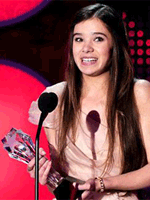
    Speaking of Bale, I thought he gave the night’s best speech, a touching, loose monologue that is certain to be repeated throughout the season.  And watching Hailee Steinfeld accept for Best Young Actor/Actress, I couldn’t help but picture her with an Oscar in her hand.  Despite Melissa Leo’s strong showing so far, the Best Supporting Actress category is still somewhat up in the air, I think (which Anne and I discussed in yesterday’s podcast).

    I bounced around here and there during the commercial breaks.  Naturally the first thing Darren Aronofsky said when he saw me was, “I finally made your list!  Next time you’ll listen to me.”  Maybe there’s a future in Oscar prognostication for him.  I also exchanged words with Colin Firth for the first time since our lengthy sit-down in Telluride.  Charming as ever.  But most exciting for me?  Honestly?  Meeting Ice Cube.  No, seriously.

    (more…)

  • 12/8 OSCARWEB ROUND-UP: Karger ranks, Kubrickian directors and Arndy on the genius of the Pixar system

    • Dave Karger takes a stab at ranking the major categories. (Rush above Bale?) [Inside Movies]

    • Anne Thompson talks “Toy Story 3” and the genius of the Pixar system with Michael Arndt. [Thompson on Hollywood]

    • Which Kubrick-compared director is the most Kubrickian? [Vulture]

    (more…)

  • Towne toasts Arndt’s success

    I had the loveliest time last night at a reception in honor of “Toy Story 3” writer Michael Arndt hosted by the great Robert Towne.  The night began to wrap up and with nearly all guests having left, things segued to the hotel bar as USA Today’s Anthony Breznican, director Lee Unkrich, composer Michael Giacchino, Arndt and I ended up hunkered down talking the night away.

    It’s a conversation that remains happily off the record, but spending a solid hour or two talking with Arndt about the craft and mechanics of screenwriting is something I’ll always cherish.  Firstly, here is a guy (we first met four years ago during the “Little Miss Sunshine” ride) well aware of the luck he’s stumbled into and so modest and borderline embarrassed by his success that you just can’t help but root for him.  But the passion he has for the form is an absolute treat for anyone interested in being a writer.

    Unkrich, meanwhile, has the most undying passion for Stanley Kubrick and, specifically, “The Shining” (his favorite film, and one referenced a number of times in the film).  He flashed a number of photos on his iPhone of collectibles from the film that he’s been accruing as of late (one of them being the axe Jack Nicholson wields in the film’s most famous sequence) and recalled his trip to London’s Stanley Kubrick Archive.

    (more…)

  • 11/11 OSCARWEB ROUND-UP: R.I.P. Dino, screenwriters round table, Gonzalez Inarritu makes the press rounds

    • Legendary producer Dino De Laurentiis dies at 91. [Reuters]

    • Screenwriters round table with Aaron Sorkin, Simon Beaufoy, Michael Arndt, John Wells, Todd Phillips and David Lindsay-Abaire. [Hollywood Reporter]

    • Todd Gilchrist talks to “Conviction” director Tony Goldwyn about capturing reality and avoiding the “Oscar Bait” curse. [Speakeasy]

    (more…)

  • 10/22 OSCARWEB ROUND-UP: Arndt, Unkrich on Fresh Air, no ‘Hangover’ for Gibson, ‘Paranormal’ sequel scares L.A.

    • Lesley Manville talks “Another Year” across the pond. [The Guardian]

    • Terry Gross talks with “Toy Story 3” director Lee Unrich and writer Michael Arndt on Fresh Air. [NPR]

    • Watch in night vision as a Los Angeles audience reacts to a screening of “Paranormal Activity 2.” [HitFix]

    (more…)

  • I’m a big crybaby

    Pixar’s “Toy Story 3” reduced me to mush, just like it has untold numbers of critics across the nation.  I’m so excited to see that 2010 has already seen two top-notch animated features, and a few of those still to come look intriguing to say the least.  But this one took a formula, injected it with more profound meaning than its two predecessors could have dreamed of, had the balls to keep its edge when push came to shove with the story’s antagonist, and at the end of the day, put a big, bright, beautiful bow on one of the most beloved franchises in — I think we can say this now — cinema history.

    The story was cooked up by Lee Unkrich, Andrew Stanton and Pixar Don, John Lasseter, but Michael Arndt was tasked with actual scripting duties.  His work is a lean vision of purpose, four years of hard work shining through.  The voice work is every bit as effective as it ever was, but all the toys in Andy’s toy box seem to be even more distinguished in their own rights this time out.

    Of course, this makes it all the more sad that we can’t hear Jim Varney’s Slinky Dog chime in, but Blake Clark gives it a decent go.  On the whole, though, we’re looking at one of the best films of the year, easily.  And a studio that knows how to do the franchise thing well.

    (more…)

  • Fletcher rides Oscar momentum to directorial debut

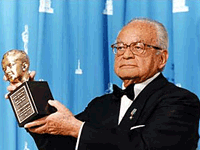
    In retrospect, Geoffrey Fletcher’s Best Adapted Screenplay win for “Precious” at last month’s Academy Awards shouldn’t have come as quite the shock it did. In the last few years, Oscar voters have been especially kind to newcomers in the writing races, with this year’s pair of freshman winners, Fletcher and Mark Boal, coming on the heels of three others who struck gold for their first feature credit: Michael Arndt, Diablo Cody and Dustin Lance Black.

    How do you follow that kind of debut success? In the case of many of those names, we’re on the verge on finding out. Arndt has lain low since striking gold with “Little Miss Sunshine” in 2006, but will be back on the radar this summer with “Toy Story 3” — for which, unusually for a Pixar production, he has sole script credit.

    Cody may have struck out with “Jennifer’s Body” last year, but is having more luck on the small screen with “The United States of Tara.” Boal, meanwhile, is continuing his happy partnership with Kathryn Bigelow, as the two are readying the South American-set thriller “Triple Frontier” for shooting.

    (more…)

  • The nominees react

    After a few weeks of frigid, citrus terrorizing temperatures, if you step outside this morning in Los Angeles, it’s a beautiful, cloudless, sunny day. But it’s a little sunnier for those who were greeted with Oscar nominations, whether expected or unexpected. I had the opportunity to talk with a few of the lucky souls who’ve had the pleasure of fielding phone call after phone call this morning. Here’s what they had to say.

    Lots of happiness in the Fox Searchlight camp today, as the little film that could, “Little Miss Sunshine” made its way to four Oscar nominations including Best Picture and, not surprisingly, Best Original Screenplay for Michael Arndt. I called Michael around 7:45 this morning to get his reaction, and he was still the same modest fellow I spoke to face to face over the weekend.

    “I knew that there were a lot of people out there who loved the film,” he told me, “but this is the ultimate validation of the idea that the film industry is democratic. A year ago we were hoping to get a distribution deal and now we have four Oscar nominations.”

    Michael says he went to sleep pretty easily (and who wouldn’t, in his shoes), but that didn’t stop him from waking up at three o’clock and suffering insomnia throughout the rest of the early morning hours. Suffice it to say, he was wide awake when he heard his name called this morning.

    Best Supporting Actor nominee Jackie Earle Haley (“Little Children”) has to be the happiest guy in the business this morning. “I think I’d have to agree with you on that,” he told me, calling from his home in San Antonio. “This is just unbelievably crazy. They need to invent a few more words, because every adjective, this is just a little bit better.”

    The most adorable and giddy Oscar nominee you could expect to talk to, Haley was clearly on cloud nine, even hitting bouts of speechlessness during our conversation. Funnily enough, even in the central time zone, Jackie was asleep when the announcement hit. His wife ran into the bedroom screaming and crying, “You got it!” “We just hugged each other and cried for, like, five minutes,” Haley said.

    One of today’s nominees was actually surprisingly snubbed for his work on “Good Night, and Good Luck.” last year, film editor Stephen Mirrione. Mirrione and Douglas Crise shared one of “Babel”‘s seven nominations this morning.

    “The types of movies I gravitate towards aren’t really mainstream movies,” he told me via telephone shortly after the nominations were announced. “So I’m pleasantly surprised when they become so widely accepted, even if I know the material I’m working with is exceptional. And I owe a lot to wonderful performances.”

    Crise has served as Mirrione’s first assistant editors for ten years. This year he got the bump to co-editor because “Babel” started shooting before Mirrione had finished work on “Good Night, and Good Luck.” Now the longtime collaborators get to share in the spoils of an Oscar nomination together.

    Another nominee who has felt the sting of Oscar’s avoidance is Patrick Marber, nominated today for his adapted screenplay “Notes on a Scandal,” based on the novel by Zoe Heller. In fact, when Marber failed to score a WGA nomination for his work two weeks ago, he says it felt exactly how the circumstance of “Closer” played out in 2004, for which he received BAFTA and Golden Globe nominations, but found no such luck with the guild and with the Academy. Suffice it to say, he was pleasantly surprised this morning.

    “Being nominated is a lot more fun than not being nominated,” he told me, calling from London. “You suddenly get lots of phone calls from people you haven’t spoken to in years. And it’s huge for us, for the film, to get four nominations. Judi and I texted each other, and I got a one word email from Zoe: ‘Yay.’ She’s always to the point.”

    Finally, one of the big stories of the morning was Picturehouse’s six nomination haul for Guillermo del Toro’s “Pan’s Labyrinth.” Hitting the ground running in its inaugural year, Picturehouse had two critically lauded efforts hit screens in “Pan’s” and director Robert Altman’s “A Prairie Home Companion.” Picturehouse president Bob Berney concedes that it was a shame not to land at least one mention for Altman’s golden-hued, poignant swansong, but it was bittersweet considering the surprising glut of appreciation thrown the way of “Pan’s Labyrinth.”

    “We decided to come out at the very end, but to do that, you have to know you’ve got a great film,” he told me earlier this morning. “It’s cool to get these broader nominations outside of the foreign film category, because this really is such a group effort. You get a lot of energy from this film and it just takes you back to the joy of movies.”

    Berney conceded that a lesson learned in this introductory year for his studio was the subtlety of positioning your film as an underdog. The strategy paid off in spades this morning, and the president affirms that he and his team are ready to do it all over again next Oscar season.

  • REVIEW: “Little Miss Sunshine” (***1/2)

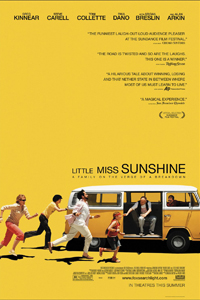
    Fox Searchlight Pictures\' Little Miss SunshineJonathan Dayton’s and Valerie Farris’s “Little Miss Sunshine” is the rare example of the quirky and fringe actually having something to say.

    It melts away the infection of suspicion and invariably lets itself into our hearts without the stench and waxing effect of sentimentality rearing its ugly head.  It takes on human frailty and maintains relevance, all the while introducing absurdity to realism like they were long lost friends.  As one of the definitive indie experiences of 2006 thus far, the film is certain to stand out as unique against whatever fray of cinematic output awaits us the rest of the year.  Regardless, at this, the mid-way point, it has to already be considered the high-water mark for films in release.

    It has been a few weeks since I screened the film, but I have to admit it remains as fresh and as popping in my mind as the vibrant yellow of it’s advertising campaign.  Coming off the festival circuit (including an oft-covered standing ovation at Sundance) and entering the marketplace July 26, “Little Miss Sunshine” is the feature film debut of commercial and music video helmers Dayton and Farris.

    They’ve made the smart decision of choosing a quaint but subtly complex yarn for their first film, steering clear of any desire to show off those surely honed skills of visual artistry.  That said, the duo still finds a way to capture screenwriter Michael Arndt’s world within a unique and meaningful frame every step of the way, filling it with performances that meld together into the finest of ensembles.

    We’re first introduced to Sheryl (the continuously underrated Toni Collette), who has come to the hospital to pick up her suicidal and woefully depressed brother, Frank (Steve Carrell).  You see, Frank is the victim of the most widespread crime of them all — heartbreak.  Upon losing the love of his life to another man, Frank has attempted to end his own suffering in the most classic of fashions by slitting his wrists and hoping the despair would drain from his body along with his life force.  Sheryl is here to take him home, to be monitored for fear of emotional relapse, but amongst family all the same – though it’s not the most settling environment, as we soon discover.

    At the homestead we meet the host of characters who will accompany us throughout, including a trying and as of yet unsuccessful paterfamilias, Richard (Greg Kinnear -– never a wrong step taken).  The irony of his lack of success spells Richard’s painful reality as he tries in vain to sell his “9 Steps to Success” workshop for greener pastures.

    Richard’s father, the sharp, yet somewhat asinine, and altogether freewheeling Grandpa (Alan Arkin) never misses an opportunity to be unnecessarily impudent, or, specifically, to make digs at Frank’s sexual orientation.
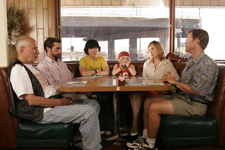
    (from left) Alan Arkin, Steve Carrell, Paul Dano, Abigail breslin, Toni Collette and Greg Kinnear in Little Miss SunshineRichard and Sheryl’s son, Dwayne (Paul Dano), has taken a vow of silence in preparation for his dream of becoming an air force pilot, fit with a “fuck off” attitude and a token bedroom poster depicting the iconic image of Friedrich Nieztche.

    And then there’s Olive (Abigail Breslin), the heart and soul of the film who defines the determination that lies at the center of Arndt’s work.  Olive has made it, via technicality, into the finals for the “Little Miss Sunshine” pageant in Redondo Beach, California, and she’s ready and willing to step up and take advantage of the opportunity.  She’s rehearsed her routine with Grandpa for weeks.  She’s honed, prepared, and damned excited.  Soon enough, a road trip, from the blistering desert of Albuquerque to the sparkling coast of Redondo Beach, lays out the film’s brightest and darkest themes, with plenty of self-discovery and familial-examination filling out the scenery along the way.

    Greg Kinnear seems to find the delicate ins and outs of every character he portrays, however miniscule the part.  Here he balances Richard’s deep-seeded love for his family with the tendency to forget all of that due to the grime and build-up of personal gratification and professional ascendancy.

    Toni Collette finds the middle ground of Sheryl, the anchor of the family and yet the most frayed of the lot.  Together she and Kinnear make for a terrifically believable couple entering the apex of their lives, perhaps fearful of the other side of life, casting a watchful and ambivalent eye toward the descent that is sure to follow middle age.

    On the other side of things is Grandpa, long past that first jolting drop and having the ride of his life.  Alan Arkin really cuts loose and allows all of the character’s irreverence to show itself, irreverence seen as nearly commendable in the final analysis.
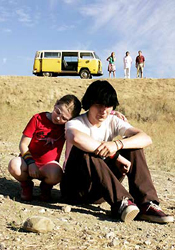
    Abigail Breslin and Paul Dano in Little Miss SunshineDano exudes the sarcastic Cobain lyric “teenage angst has paid off well” with every hooded glance or unaffected beat.  Most will remember him for his stirring work opposite Brian Cox in 2002’s “L.I.E.,” but his performance here is of a completely different emotive breed.

    Then there is Steve Carrell.  Certainly taking on the most contrasting role of his young cinematic career, he keeps the reins close on the comedy like most actors in his position could only dream.  He affords layers for Frank that are very real, yet remains mysterious enough to surprise us when he is at his most endearing.  In many ways the most balanced character of the lot, Frank is still the guy that tried to snuff it, and that irony couldn’t have been lost on Mr. Arndt as he crafted a truly contradictory experience to mirror the contradictory nature of life itself.

    The determining facet of this ensemble, however, was always going to be the casting decision for Olive, and Breslin steals our hearts and ignites our passion effortlessly in that regard.  A true mark of excellence in screenwriting is a hero worth caring for, and though the case could be made for the family as a whole being the protagonist in “Little Miss Sunshine,” it is ultimately Olive for whom we root, for whom we hope, and in whom we lose ourselves.

    “Little Miss Sunshine” is a romp as penetrating as it is sentimental.  At its core, first-timer Arndt’s screenplay is about the necessity of understanding, making some valid and, at times, poignant assertions about the importance of family.  And there is a reason it takes everyone offering a collective push to get that troublesome Volkswagon bus on the road each time.

    The script further maintains ideas concerning the support and empathy that can sometimes only come from those sharing the same blood, while simultaneously illustrating the notion that individuals in a family are still just that, individuals – separate entities with their own sets of issues and worries.  In so doing, he inevitably paints a portrait of the vilest yet most unavoidable aspect of human nature: selfishness.  But you have to love us for it, right?