In Contention

Tag: Mark Harris

  • Mark Harris joins the discussion with fringe lead actor picks

    Two years ago author and journalist Mark Harris wrote what I think is one of the most salient Oscar season observances ever squeezed out of this unnecessary corner of the web. I always look to him for one of the most above-the-fray, but smart and informed, perspectives on a given season. And this piece over at Grantland is a great example, too.

    He reduces these early days of the awards season to the echo-chamber they’ve come to represent. And I don’t count myself out of the insanity he cuts everything down to with this precise paragraph:

    If you’re like most moviegoers, or most Academy voters, you don’t attend any of these festivals. So “buzz” is really code for a two-way conversation conducted between a handful of awards handicappers eager to anoint or dismiss potential contenders, and a handful of studio publicists and independent firms who are listening for the dog-whistle frequency that tells them that somebody thinks their movie might be in the running.
    (more…)

  • Babes in arms

    We pointed you to Mark Harris’s superb examination of the Oscar campaign trail in a round-up, but if you missed it … well, don’t. If “Pictures at a Revolution” didn’t already make the case, this article reminds me that we’re due an updated equivalent of Mason Wiley and Damien Bona’s totemic “Inside Oscar” — and Harris is the man for the job.

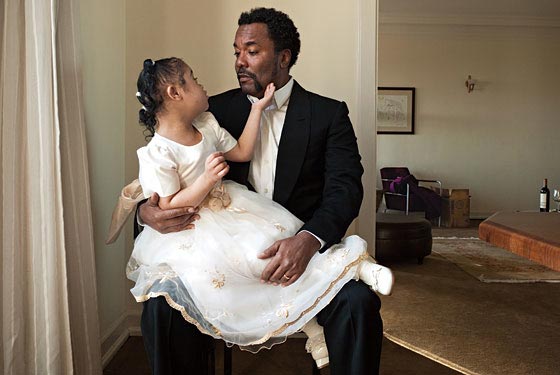
    Anyway, as icing on the cake, the article is accompanied by a wonderful photographic portfolio by Brigitte Lacombe. There’s a portrait of Marion Cotillard in there that’s worthy of Cecil Beaton, but this shot of “Precious” director Lee Daniels with young Quishay Powell (who plays the unfortunately-named Mongo in the film) is the snap of the season for me.

    Quishay Powell and Lee Daniels

  • Mark Harris on Zoe Saldana and performance capture

    Zoe Saldana in AvatarPerhaps I missed it, but I’m surprised there hasn’t been more online conversation about EW writer Mark Harris’s recent critical essay on “Avatar” and performance capture technology.As one would expect from the author of “Pictures at a Revolution,” it’s a thoughtful piece, but one that should stir up considerable dissent.

    He begins by slamming James Cameron for suggesting that performance capture can be used to preserve an actor’s physical features: “Will Smith could still make an action movie when he’s 75 years old, looking like he looks now,” Cameron stated, a thought that makes me as uneasy as it does Harris.

    But the beef of Harris’s argument comes when he turns his attention to “Avatar,” and the widely praised performance of Zoe Saldana, who some (including my esteemed editor) think merits Oscar consideration.

    (more…)

  • What does it all mean?

    Kate Winslet in The Reader“Pictures at a Revolution,” Mark Harris’s smart, keen-eyed study of the cultural implications of the 1967 Best Picture race, is without a doubt one of the best books ever written on the subject of the Academy Awards. So it’s hardly surprising that Harris, in a piece for yesterday’s Observer, has provided the most intelligent take on this year’s awards race to date.

    What’s particularly interesting is that, while he just wrote an entire volume on the countercultural meaning of a Best Picture race in a pivotal year in Hollywood history, he’s quick to avoid such a unified reading of this years nominees — effectively and wittily debunking several trends that many Oscar-watchers have attempted to glean from the crop:

    1) The Academy has a new, more global outlook, represented by the 10 nominations given to Danny Boyle’s Slumdog Millionaire. Alternatively, the Academy suddenly has a new, more insularly American outlook, as evidenced by the fact that 17 of the 20 acting nominees are from the US, the most since the early 1990s.

    2) The “gay mafia” in the Academy, outraged by the passage of the anti-gay marriage amendment Proposition 8 in California, powered the gay-rights drama Milk into the race with eight nominations. However, it will never win, because the Academy is hopelessly homophobic, as we all are presumed to have learned when Brokeback Mountain lost to Crash.

    3) In a time of great economic uncertainty for the major studios, Hollywood reasserted its authority by bestowing 13 nominations on the high-grossing, high-budget product of two conglomerates, The Curious Case of Benjamin Button. But the Academy simultaneously renounced any interest in supporting studios or representing popular taste by snubbing Christopher Nolan’s blockbuster The Dark Knight, excluding it from consideration for best picture, director or screenplay.

    (more…)