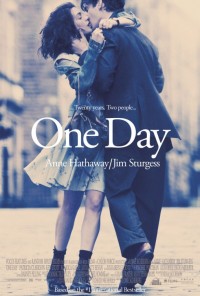
 “I love you, Dexter, I just don’t like you anymore,” a radiantly moist-eyed Anne Hathaway tells a radiantly plastered Jim Sturgess at a crucial emotional juncture in “One Day,” Lone Scherfig’s attractive, involving and curiously unmoving attempt to replicate the cosy, literate-but-not-too-literary British comforts of her 2009 “An Education.”
Cribbed by screenwriter David Nicholls from his own mega-selling novel — the kind of fast-digesting doorstop that’s been a ubiquitous presence on London public transport for the past two years — the line is one of those reductively heart-on-sleeve sentiments that Richard Curtis sharpened to a blunt point in his 1990s heyday; when Hathaway drops it, you can hear the film straining for its own place in the pop culture quote bank, somewhere between “Is it still raining? I hadn’t noticed” and “I’m just a girl standing in front of a boy, asking him to love her” in the swoon-cringe stakes.
If the film surrounding that moment seems unlikely to carry it to such relative heights, that’s because it’s at once less appealing and more adventurous than the bulk of the calculated Working Title charmers on which it is modelled. For starters, it’s one of the more neurotically male-minded films ever to be marketed as a lavender-scented chick flick.
 “I’m going to bring back the letter,” a flustered Patricia Clarkson announces as she makes her way to our lunch table, ever-so-slightly rain-mussed but otherwise immaculate in black and cream, a jaunty matching fedora astride her familiar blonde mane. “I’m never late. I blame email for this. I’m only just getting acquainted with it.”

 So
 In so many words, this is it. The Academy of Motion Picture Arts and Sciences unveils it’s slate of nominees bright and early tomorrow morning, and this being the first year with a 10-film Best Picture field, all eyes will be on the top category to gauge which way the wind blew on this AMPAS experiment.
 For once, my
 Tomorrow the Directors Guild of America will chime in with its list of nominees for the 2009-2010 film awards season. Long considered to be the best “predictor” of the Oscar game (as in, the DGA winner typically wins the Oscar for Best Director, and Best Director often matches up with Best Picture), this guild’s shenanigans makes for a heavily anticipated harbinger of the season.

 You’ve heard me natter on enough for months about how
 At this morning’s press screening for
 When the Academy Awards roll around in March, it will have been precisely two decades since the unlikely figure of Kim Basinger blasted Academy voters’ conservatism on air at the 1989 ceremony, with specific regard to their sidelining of
 It’s been a couple of months since I
 Over at MCN, David Poland has offered his first formal
 Only the greenest of awards-watchers needs reminding of the following statistic: a mere three women have been nominated for Best Director in the 81-year history of the Academy Awards. It’s long been an embarrassing state of affairs — never more so than in the late 80s and early 90s, when in three out of six consecutive years, the Best Picture nominee denied a directing nod happened to be made by a woman.
 It had become quite clear over the past few days that Lee Daniels’ sophomore feature “Push: Based on the Novel by Sapphire” was one of the few titles raising pulses at a very quiet Sundance Film Festival. The film, a hard-hitting urban tale of an African-American teenager overcoming merciless parental abuse in 1980’s Harlem, has received breathless critical notices across the board, with Variety
 Don’t say I didn’t give you the