In Contention

Tag: Joan Allen

  • The Great Performances: 2005

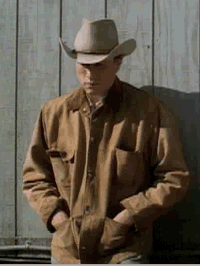
    Heath Ledger in Brokeback Mountain2005 was the year of Heath Ledger’s beautiful, moving performance in “Brokeback Mountain,” which I saw for the first time in Toronto.  It instantly became the talk of the festival, and the film became the one to beat for the Academy Award.

    Ledger was astonishing as the taciturn cowboy who is more surprised than anybody when his soulmate turns out to be another cowboy, portrayed superbly by Jake Gyllenhall. If there is a more deeply felt moment in film history than Ledger gently adjusting Gyllenhall’s shirt at the end of the film, his eyes filled with tears, I don’t know what it is. That’s loss, that is absolute heartbreak, that is one of the greatest acting performances of the decade.

    Phillip Seymour Hoffman would win the Oscar for his transformation into “Capote” and he’s very good, but just not in the same league as Ledger. I wondered from time to time if “Infamous” had been released earlier if Toby Jones might have won the Oscar instead of Hoffman. Each becomes Capote in a very different manner, and side by side it is difficult to choose the stronger portrayal. Certainly I prefer Hoffman’s as it is darker, and for me more realistic, but there can be no denying Jones.
    (more…)

  • The Great Performances: 2000

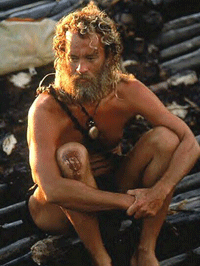
    Tom Hanks in Cast AwayMichael Douglas was robbed.

    The already Oscar-christened actor gave a career-best performance in 2000 in Curtis Hanson’s “Wonder Boys,” but he got no love from the Academy. Worse, his performance was easily among the five best of the year and won the Los Angeles Film Critics Association Best Actor prize.

    That having been said, I don’t think Douglas actually deserved the Oscar in 2000.  That honor belonged to Tom Hanks in “Cast Away” for a performance that was nothing less than astounding. For two and a half hours Hanks commands the screeen, moving into silent film territory for a stretch, the actor using strictly his body and face for the performance. Anyone who has ever, and I mean ever, doubted his range needs to take a hard look at this film.

    The five nominees for Best Actor in 2000 were Hanks, Russell Crowe for “Gladiator,” Ed Harris in “Pollock,” Geoffrey Rush in “Quills” and Javier Bardem in “Before Night Falls.” For me, Douglas was the most glaring omission, followed by George Clooney’s Gable-esque work in “O Brother, Where Art Thou?,” which I think remains one of the actor’s very best pieces of work.

    (more…)

  • The Great Performances: 1998

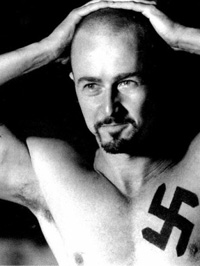
    Edward Norton in American History XFor all my bitching about Roberto Benigni winning Best Actor in 1998 for his incessant mugging in “Life is Beautiful,” I was also thrilled the Academy watched enough films and paid enough attention to realize that Edward Norton was deserving for his magnetic turn as a neo-Nazi who sees the light in “American History X.” Norton was electrifying as Derek, the charismatic leader of a group of skinheads, handpicked by the older gentleman, played with menace and sleaze by Stacey Keach, who believes in what Hitler taught and seeks to spread the word to the youth of California.
    Norton gave the best performance by an actor I saw in 1998, but the Academy got caught up in the groundswell of support of Benigni’s movie, a fable set in a death camp. I’m not a fan, either of his overwrought, over the top performance, or the film itself. No rant, you all know what I think there.

    That said, there was a bounty of great male performances in 1998, many of which went unnoticed by the Academy. They did their best to get it right, though.  Joining Norton and Benigni for nominations were Nick Nolte in “Affliction,” Ian McKellen, superb in “Gods and Monsters,” and Tom Hanks as the weary soldier in Steven Spielberg’s magnificent “Saving Private Ryan.”

    Not even nominated, however, were Warren Beatty for his brilliant turn as the truth-talking senator in “Bulworth,” Joseph Fiennes in Best Picture winner “Shakespeare in Love,” Jim Carrey in “The Truman Show,” George Clooney in “Out of Sight,” Brendan Gleason in “The General” and John Travolta in “Primary Colors” or “A Civil Action,” take your pick.  And perhaps the most deserving of all: Jeff Bridges as The Dude in “The Big Lebowski,” the actor’s finest work, in my opinion.

    Each of the aforemenetioned men gave stronger performances than the eventual Oscar winner, yet failed to nab a nomination.  Jeez!

    (more…)

  • The Great Performances: 1997

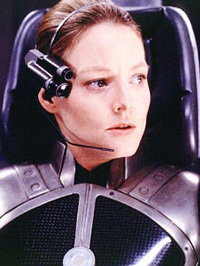
    Jodie Foster in Contact1997 was a great year for actors, but a tough year for Oscar; how do you choose when there are so many deserving nominees?
    It’s that age-old issue that some award-worthy performances are going to be left out, which though unfair and sad, is very much part of the Academy Awards and frankly what makes the whole thing interesting for us.  The Best Actor field ended up largely a battle of the old boys.  The acting warriors from the 1970s gave some of their finest performances in 1997, and four of the five nominees for Best Actor had been icons for 20 years.

    In fact the Academy could have allowed the one upstart to slip past and nominated Al Pacino in “Donnie Brasco,” which was the actor’s best work in years. As it was Pacino was by-passed in favor of young Matt Damon in “Good Will Hunting,” who found himself going toe-to-toe with Robert Duvall in “The Apostle,” Jack Nicholson in “As Good As It Gets,” Dustin Hoffman in “Wag the Dog” and Peter Fonda in “Ulee’s Gold.”

    I first saw Duvall’s performance at the 1997 Toronto International Film Festival and have written about it many times since.  He won the Los Angeles Film Critics Association’s Best Actor award, and then the National Society of Film Critics’ honor, but the Mayor of Hollywood stood in the way of Duvall’s second Oscar.

    (more…)

  • The Great Performances: 1996

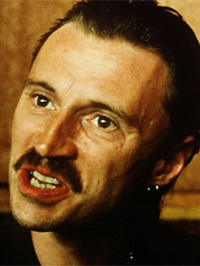
    Robert Carlyle in Trainspotting1996 was an odd year, a year when the independent cinema dominated the weak product emerging out of Hollywood. I am going to confess right off the top of this article (as I have numerous times before) that I was not a fan of “The English Patient,” which for me remains one of the most vastly over-appreciated films ever made.  I couldn’t stand Kristin Scott Thomas’s work, though I did enjoy the Dafoe/Binoche storyline.
    So with that out of the way, and firmly in mind, let’s go…

    The Best Actress race was clouded with the notion that Madonna was hell-bent on being nominated for her performance in “Evita,” which finally made it to the screen after years of starts and stops. Her performance split critics, but for me lacked the depth and edge that it was given on stage by Patti Lupone, and that Meryl Streep or Michelle Pfeiffer would have given the role. Her performance proved that Madonna should stop acting as she has little or no acting talent, and should stop making movies and trying to conquer Hollywood as she did the music industry.

    Honestly, the performance rarely rises above a really good community theater performance. Mercifully she was not nominated, but she did win the Golden Globe for Best Actress in a Comedy or Musical over the eventual Oscar winner, Frances McDormand in “Fargo.” The nominees for Best Actress included, McDormand, Kristin Scott-Thomas for the aforementionend “The English Patient,” Diane Keaton for “Marvin’s Room,” Brenda Blythyn in “Secrets and Lies,” and best of all, perhaps, Emily Watson in “Breaking the Waves.”

    (more…)

  • The Great Performances: 1995

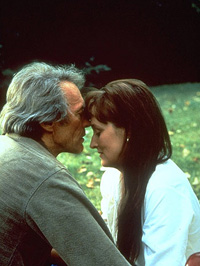
    (from left) Clint Eastwood and Meryl Streep in The Bridges of Madison CountyBased on some of the comments I received last week regarding my article on great acting, I took the suggestion of a young lady and am kicking off a series of articles, one per week, that will explore the best performances ofeach year, beginning today with 1995.  So let’s go back and work our way towards 2008 and discover the great film performances we know about, and maybe a few we do not.
    The Academy did a pretty fine job in 1995 when it came to the acting nominees.  Sure there was some shock when John Travolta was snubbed for his superb work in “Get Shorty,” and those hoping for a three-peat with Tom Hanks missed it when the actor was not nominated for his solid work in “Apollo 13.” I personally would like to have seen Clint Eastwood nominated for his wonderful work in “The Bridges of Madison County,” but there are just five slots open, and so many fine pieces of acting.

    One could also argue for Morgan Freeman and Brad Pitt, both excellent in David Fincher’s “Seven,” or Bruce Willis, who was nobly brilliant in “Twelve Monkeys,” and perhaps even Jack Nicholson in “The Crossing Guard.”

    Nobody could argue with Nicolas Cage in “Leaving Las Vegas,” Sean Penn in “Dead Man Walking” or Anthony Hopkins for “Nixon” as Best Actor nominees.  And frankly I believe Penn gave the best performance of the year, one for the ages in fact. However, Richard Dreyfuss in “Mr. Holland’s Opus?” Seriously?  I love Dreyfuss and I think he’s even been short-changed in the past, but come one.  He does fine work and it’s not his fault the script asks him to be mushy and sentimental, but I have struggled with his nomination over Hanks, Travolta and Eastwood for many years.

    (more…)

  • What does early (and excessive) Oscar hype do to a film’s chances?

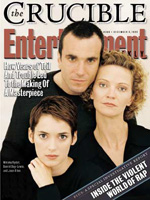
    Cover of Entertainment Weekly featuring The CrucibleIn 1996, a fall movie preview of Entertainment Weekly arrived in my mailbox, the cast of “The Crucible” staring back at me on the cover, making clear to me this was going to be THE film of the fall. There were rumors floating within the industry that the film, based on the Arthur Miller play, could conceivably be nominated for 12 or 13 Academy Awards, and it seemed a cinch for at least a Best Picture nod.
    Having directed the play twice, studied it at length in university and being a huge Arthur Miller fan, I was thrilled that the film was finally going to get the intense big screen version it deserve. The 1959 French adaptation was okay, but not enough people had actually seen it. Here was a chance for one of the greatest dramas of the 20th century to make the transition to film with a superb cast, including Daniel Day-Lewis, Joan Allen, Paul Schofield and Winona Ryder.

    Somewhere along the way Fox panicked and released the film late in December, and though Day-Lewis finished second in balloting for the New York Film Critics Awards, the picture never caught fire as it had been predicted to do. Instead it was a dismal box office failure, nabbing only a supporting actress nomination for Joan Allen and an adapted screenplay nod for Miller.

    “The Crucible” is a great film, with powerhouse performances from Day-Lewis, Allen and Ryder, though many critics attacked the latter. But was the film a victim of over hype, or were audiences simply too familiar with the story? What happened?

    The same sort of thing almost happened to Steven Spielberg’s “Munich,” which at this time in 2005 was being touted as not just an Oscar nominee, but the likely winner for Best Picture and Best Director, sight unseen. It opened and was very good, but it wasn’t the searing masterpiece everyone had been hoping for.  And somehow “Crash” won the Best Picture prize.

    (more…)

  • Will ‘W.’ hold a candle to ‘Nixon?’

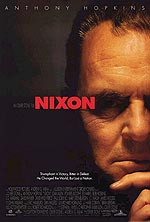
    Hollywood Pictures' NixonWith Lionsgate Films’ “W.” on the horizon, we are reminded of the last film Oliver Stone made about an American President: “Nixon,” a critically praised and Oscar nominated work that was the exact opposite of what most thought it would be.

    An angry child of the 1960s, having chronicled Vietnam on screen (some say definitively), Stone announced he was making a biography of President Richard M. Nixon and the feeling was that the film would be an attack on the man, who resigned office in 1974.  Yet when the film was released and critics got a look at it, they were overwhelmed by Stone’s work. Instead of an all out diatribe, he had created a study of a man who felt unworthy of the highest office in the land, even though he spent much of his life trying to get there, and was for most of his presidency a very good Commander-in-Chief.

    Stone’s film portrayed Nixon warts and all, the paranoia, the vulgar language he was known to use, his mistrust of even those closest to him, his jealousy of the Kennedy clan, and the strange hold his mother had on him, even in his later years.  The film displayed a brilliant statesman who struggled with his own sense of self worth, knowing that he could never be loved as Kennedy was, yet also aware of the good he was doing.

    Nixon opened relations with two communist countries, Russia and China, a huge move for him as he was a known communist hater and right hand man to no less than Senator Joseph McCarthy during the red purge of the 1950s that ruined many innocents. He would end Vietnam after having escalated a war he inherited, admitting defeat, and when the nation screamed for his impeachment just two years after being re-elected with the largest margin in the history of United States politics, he resigned in disgrace.

    (more…)