In Contention

Tag: Hoyte Van Hoytema

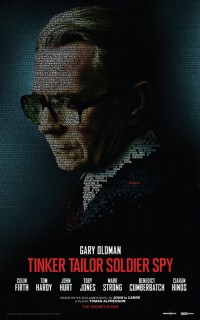
  • Alfredon’s ‘Tinker, Tailor’ smolders on screen

    I don’t want to write too much about “Tinker, Tailor, Soldier, Spy” right now because, point blank, I want to see it again and digest and — gasp! — consider.

    For now, though, I’ll start with this: It’s an impeccably made, satisfyingly dense piece of work from director Tomas Alfredson. It’s the rare film that is a slow burn but nevertheless moves along at a clip, with a very well-honed editorial sense, I might add.

    The thing is, I saddled up to the film this afternoon without knowing the source material or bothering to investigate it much. I’ve never read John le Carre’s novel (I will) and I haven’t seen the 1979 British mini-series starring Alec Guiness (I will). And the vibe I get is it would be helpful to come to the new film with a modicum of knowledge on that, but it’s no less satisfying. It just means a second look is in order, and I’m all for it, because you come away with an extreme reverence for craft here.

    (more…)

  • REVIEW: “Tinker, Tailor, Soldier, Spy” (***1/2)

    Venice Film Festival

    An uncharacteristically dark Venetian downpour greeted this morning’s premiere screening of “Tinker, Tailor, Soldier, Spy,” and if some flashbulbs of lightning last night hadn’t already previewed the turn in weather, I’d suspect the pervasively, necessarily drab atmospherics of Tomas Alfredson’s artful John le Carré adaptation of bleeding out from the screen and into the beyond.

    Looking for all the world as if the print has been stewed in black tea before being left to gather a few months’ worth of dust in the projection room — and that’s a good thing, I hasten to add — the film proves a happy marriage between two very different brands of understated precision: the British scholarliness of le Carré’s dense espionage lore and the icier Scandinavian calm that Alfredson brought to his breakout vampire drama, “Let the Right One In.”

    In many ways, Alfredson directs le Carré’s self-described “little gray men” of Britain’s MI6 intelligence service as they are themselves vampires of the Cold War: lurking in irremovable half-light, striking efficiently and selectively, and only notionally acquainted with the concept of sunlight, these thickly-tweeded spies appear to bear the burden of their profession as a lifelong alibi for the avoidance of intimacy, social functionality and even standard-issue conversation.

    (more…)

  • Predict the ASC nominees

    Now that the DGA has spoken, something to pass the time.  Tomorrow the crafts guilds continue to roll out the season as the American Society of Cinematographers (ASC) offers its picks for the best work behind the camera in 2010.  This is perhaps my favorite of the below-the-line categories, so I thought I’d offer up a lengthy preview.

    The Society is usually good for 80% when it comes to Academy crossover with its nominees. Sometimes you get a 5/5, sometimes a 3/5, but generally it’s 4/5. The trick is figuring out what the oddball selection will be. But let’s see what’s looking good for a nod, first.

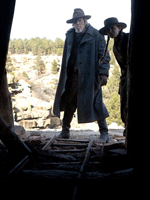
    Leading the way this time around, like most years, would have to be Roger Deakins. His work on “True Grit” will likely win him an Oscar and the road there could very well begin with a win from the Society. He seems to be papa bear these days. Chalk it up.

    (more…)

  • AFI FEST: ‘The Fighter’ crashes the party

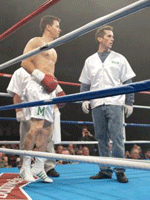
    I decided to come home and give “The Fighter,” which saw its world premiere at a “secret screening” at AFI Fest tonight, some real thought rather than rushing back to review.  How novel.

    Given the amount of press on hand, one imagines Paramount publicity was besieged with ticket requests following the last minute announcement of the screening yesterday morning, but the film played well to a largely public audience. And by “well” I mean they were kind of swinging from the rafters, as David O. Russell’s film is a mainstream crowd-pleaser through and through.

    There is much to admire about the film. For starters, there’s a unique energy that’s palpable throughout, owed largely to the camera work of DP Hoyte Van Hoytema and, especially, film editing from Pamela Martin. The fights were filmed in a retro early-90s video vein, duplicating the original HBO telecasts of “Irish” Micky Ward’s matches, and they have an energy that crackles. There is the sense of sterile choreography here and there, but for the most part, these scenes are quite uplifting and stand out against the usual boxing sequences we’ve seen over the years.

    (more…)

  • TECH SUPPORT: Best Cinematography — Volume II

    Today we take a look a second look at, well, certainly the most “cinematic” of categories: Best Cinematography. As I like to say, cinema is born out of the camera and those who wield these devices enrich our films more than a few words written here could possibly say. From capturing mood, lighting and atmosphere to telling the story visually and creatively, our cinematographers truly are artists in every sense of the word.

    Naturally, “pretty” films, war films and Best Picture nominees all have a knack for doing particularly well in this category.

    Now that the trailer for “True Grit” has reached the internet, I surely cannot be the only person asking…is this the film that will finally bring Roger Deakins his Oscar?  He has eight nominations (four for Coen brothers films), tragically winning zero times. The photography looks amazing, and the film is exactly the sort that would seem to excel in this category. That the film also looks like a bigger Oscar player across the board (more than I was originally expecting) is merely icing on the cake.

    (more…)

  • Top lensers praise ‘Slumdog’ cinematography

    Slumdog MillionaireOver at Variety, Robert Koehler has put together a survey of sorts of some of the industry’s top DPs to gauge their reaction to the year’s work behind the camera.  It could be a nice hint toward what the ASC will chose as the year’s best lensing, and judging by Koehler’s results, Anthony Dod Mantle’s “cherry on top of a career” efforts on “Slumdog Millionaire” gets the gold star.

    It’s really quite an achievement.  Even though I’ve long been on the record in favor of Wally Pfister’s innovations on “The Dark Knight,” I have to say Dogme 95 veteran Mantle broke unexpected new ground in Danny Boyle’s film.  In lieu of an Oscar win for the highly deserving Pfister, I would be very content to hear Mantle’s name called.

    Here’s a taste from Koehler’s survey:

    Mantle’s “Slumdog” was “the biggest technical achievement of the year,” says [Roger] Deakins, “because even though part of the film was shot on a 2K digital camera and part on 35mm, my eye could never detect the difference…it was quite a feat to maintain a consistent quality of image throughout.”

    Adds [Janusz] Kaminski: “I like cinematography that feels alive, and Anthony’s work felt that way for me. The shooting got the sense of the Mumbai streets, the reality of the gameshow, the nostalgia of the romance.”

    Goldblatt agrees, noting that “Slumdog” was “a very adventurous mix of media, fun and beautiful and very courageous. I’ve worked in India as a photographer and know how tough it is there, so I was quite impressed with the results.”

    McGarvey “loved how Anthony thought about how the various formats he shot in would serve each milieu in the story, so that the images never patronized the characters. It was such a ride.”

    Koehler then goes on to say Claudio Miranda’s gorgeous work on “The Curious Case of Benjamin Button” was close behind in his unscientific poll, followed by Pfister, who McGarvey says “can work on the grandest of scales but can also be terrestrial, and is able to provide an anchor to fantastical situations — a talent he shares with (director) Chris Nolan.”

    I was happy to see Maryse Alberti (“The Wrestler”) and Hoyte Van Hoytema (“Let the Right One In”) also mentioned, but hey, you’ve heard that kind of stuff out of me in this space over and over again. It’s nice to see the trades pumping up their crafts coverage, since no one seems to be willing to give them the proper attention this time of year beyond the expected outlets (American Cinematographer, Below the Line, etc.).

    For a crash course in the year’s best cinematography, have a look at our Top 10 Shots of 2008 column from last month, laced with insights from an esteemed crop of lensers.

  • The top 10 shots of 2008: part two

    The Dark KnightToday we wrap up my list of the year’s best shots.  In case you missed it, have a look at part one here.

    Before digging into the top five today, I thought I would give a shout out to the images that almost made the cut, and there were a few.  For instance, who can forget the fateful shot of Harvey Milk ascending the stairs of San Francisco’s City Hall as Dan White stalks the corridors in the distance?  Similarly, how about the image of White from behind as he psyches himself into assassinating his fellow politician?

    Meanwhile, there was an array of images to choose from in “The Dark Knight,” certainly too many to name here.  As beloved as the image of Heath Ledger’s Joker is, breathing in his freedom and tearing off into the night in a Gotham patrol car, I chalk that up to performance as much as if not more than Wally Pfister’s work behind the camera.  But the iconography of James Gordon standing, arms crossed in front of the Bat signal was a difficult one for me to snub (for reasons you’ll find out after the jump).

    “Let the Right One In” will show up on today’s list, but one other image that came very close to making the cut for me was that of Eli’s victim bursting into flames on a hospital bed once exposed to sunlight streaming in through the window.  And though Maryse Alberti’s work on “The Wrestler” has already been represented, I was always tickled by the creativity of The Ram’s walk through the bowels of a supermarket deli, mirroring his walk to the ring.

    Finally, Danny Boyle’s “Slumdog Millionaire” is loaded with wonderful cinematography.  The image I chose yesterday had personal value, but I also loved the long shot of young Jamal and young Salim on the roof of a train to start the film’s exciting montage, as well as the three-shot overhead view of the Mumbai slums during the film’s opening sequence.

    This is to say nothing of the work from fine lensers on films that just didn’t make the cut for whatever reason, but were nonetheless wonderful examples of cinematography this year.  “The Fall” (Colin Watkinson), “Gomorrah” (Marco Onorato), “The Reader” (Roger Deakins and Chris Menges) and “Vicky Cristina Barcelona” (Javier Aguirresarobe) are just a few examples.

    But enough of the also-rans, right?  Let’s get on with the real show: the five best shots of 2008…

    (more…)