In Contention

Tag: Henry Fonda

  • LIFE WITHOUT OSCAR: 1945 and 1946

    Catch up with the idea behind this series here.

    World War II was winding down and the nation was ready to be happy again. So, naturally the Best Picture award went to “The Lost Weekend.” Perhaps it was a show of unity with war partners France, as it would be the first film to win both the top Oscar and the Palm d’Or at Cannes (a feat only duplicated once more, by “Marty.”). The solidarity continued the following year, with Jacques Prevert and Federico Fellini both landing screenplay nominations for foreign films.

    “The Best Years of Our Lives” swept the 1946 ceremony, positioning itself as the definitive end of war story and earning sentimental points for casting a real-life wounded veteran. Said veteran, Harold Russell, is the only person to take home two Oscars for the same role when he won Best Supporting Actor and nabbed an honorary gong for inspiring the nation. But what did blind patriotism prevent from getting recognized?

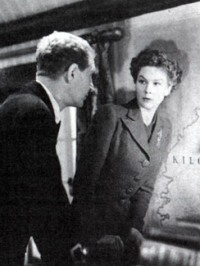
    1945 – “I Know Where I’m Going!” (Michael Powell, Emeric Pressburger)

    Powell and Pressburger may not have reached their artistic peak at this point, but they were already internationally acclaimed, accomplished, Oscar nominated filmmakers. Fresh off the quaint, small town romance, “A Canterbury Tale,” it could be considered treading creative water that they decided to follow it up with another quaint, small town romance, but if ain’t broke… They had also spent the previous few years working exclusively in war films and were determined to focus their attentions to more personal, human stories.

    (more…)

  • THE LISTS: Top 10 ‘right actor, wrong film’ Oscars

    As we head into the thick of awards season, one of the biggest “will-they-won’t-they” questions about this year’s Academy Awards concerns one of their most favored sons, Clint Eastwood. Specifically: despite wildly polarized responses to the film, and a widespread perception that he has already been amply rewarded in other categories, can Eastwood ride the wave of sentiment to a first acting victory for “Gran Torino?”
    That sneaky National Board of Review award last week suggests it’s still very much a possibility, whether or not people believe that it’s a performance for the ages — and, more to the point, whether or not it ranks with the best of Eastwood’s own onscreen work.

    It’s no secret that, in the acting races, the Academy frequently bases their vote less on the performance at hand than the actor delivering it — one can point to any number of Oscar victories determined less by merit than by personal affection for an already rewarded star (let’s say Michael Caine in “The Cider House Rules”) or industry guilt over an under-rewarded one (most recently, Alan Arkin in “Little Miss Sunshine”).

    Meanwhile, recent victories by the likes of Russell Crowe and Cate Blanchett point to the familiar “deferred-Oscar” syndrome, where an actor widely believed to have been snubbed in the recent past is hastily handed a statuette as a kind of cumulative acknowledgment of their recent strong work, frequently for a performance that doesn’t represent any particular breakthrough. (Kate Winslet might be vying for one of those this year.)

    All are variations of the oft-lamented “right actor, wrong film” Oscars that are peppered throughout Academy history — a solution generally deemed more credible (though I’m not sure why) than the honorary “quick, before they die” lifetime achievement gongs doled out to the likes of Peter O’Toole and Kirk Douglas, actors who continually slip through the cracks in Oscar voting.

    Age isn’t always the determining factor, though.  The Academy has shown in recent years by passing over Lauren Bacall and Ruby Dee — both of whom would have been exemplary “right actor, wrong film” honorees — they’re not always in a sentimental mood.  As the following list shows, reasons for rewarding actors for lesser work are many and varied: genre bias on the Academy’s part, mainstream emergence on the actor’s, or simply the voters’ collective nostalgia for a familiar face at the podium.

    The one thing all these names have in common is that they’re distinguished, even great actors who deserve to have “Academy Award winner” forever attached to their monikers — just not necessarily for that performance. Will Clint Eastwood be the latest name to join their ranks? The jury is out.

    (more…)

  • Greatest non-nominated perfs: too many to count…

    …but I’ll try.  A sprint of sorts through deacades of deserving contenders (in my opinion, of course).

    I ask you this: How did those lovable characters from “The Wizard of Oz,” portrayed so brilliantly by Ray Bolger (Scarecrow), Jack Haley (Tin Man), Bert Lahr (Lion) and Margaret Hamilton (Wicked Witch), fail to be nominated in any of the supporting categories? Any one of them should have won the damned thing let alone be nominated, but in 1939, each and every one of them was snubbed.

    (more…)

  • Fonda talks Leone

    Regarding last night’s David Mamet post and that Henry Fonda/Sergio Leone story, I was poking around YouTube and wouldn’t you know it, there’s a clip of the actor recounting the whole story. And he does it much better than me.

    Check it out:

    httpv://youtube.com/watch?v=cHI6Hl7FUqA

  • David Mamet on the greatest actor ever

    David Mamet’s “Redbelt” is releasing soon, though I just realized I haven’t made it to any of the film’s screenings this past month. I love Mamet, even when he fails. But I’m not hearing good things on that film.

    Anyway, I came across an interesting piece at Film Stew this evening that cornered the esteemed playwright and filmmaker with that most difficult of queries: Who is the greatest actor ever?

    This is the sort of thing that could change with the wind, of course, and any given person is sure to bounce a number of names around his or her head when it comes down to it. In most cases, you might expect some rote answer. Who can’t steer clear of the Pacinos, the De Niros, the Brandos and the Nicholsons?

    I was happy, and not the least it surprised, to see Mamet hang it out there for a unique choice. His pick: Henry Fonda.

    I have to say, I can run with that. I sometimes forget that two Henry Fonda films rest easy in my top five films of all time (“12 Angry Men” and “Once Upon a Time in the West”). I’d buy a “Vote for Juror #8” shirt if they made one. His career spanned decades and genres with ease as he tackled portrayals of villains and heroes with equal aplomb.

    I’m always reminded of the classic Sergio Leone story when it comes to Fonda. Leone, of course, cast Fonda in “Once Upon a Time in the West” as the lawless Frank, a character (and film, in fat) from which Martin Scorsese would borrow greatly when conceiving “Gangs of New York.” Here was America’s golden god of the screen, Henry Fonda, the quintessential good guy — and he was about to portray a guy who’d shoot a child without blinking…and in the first reel!

    Fonda shows up to set looking like, well, a haggard, ruthless villain. Hadn’t shaved, de-glammed to the max, ready to tackle the antagonist for once. Leone was beside himself. “I didn’t hire you to hide behind a beard,” the director said (and of course, I’m paraphrasing). “I hired Henry Fonda and that’s what I want.” Leone was well aware of the impact a sculpted, shaved, blue-eyed angel like Fonda would make as he tore through the narrative in such a despicable role.

    And boy was he right:

    httpv://youtube.com/watch?v=WgKsMolvDLw

    Quite an inspired choice by Mr. Mamet. It’s a shame Fonda only walked away with a solitary competitive Oscar for one of his lesser (if still wonderful) portrayals. But ain’t it always the case?

    By the way, if you’ve never flipped through Mamet’s guide for actors, “True and False,” I encourage you to do so.