In Contention

Tag: Gael Garcia Bernal

  • Italy and Spain enter foreign Oscar race

    With the official (though not necessarily final) deadline for submissions just two days away, there’s been a flood of new additions to the list in the past few days, including two big guns that were holding out on us — Italy and Spain. (Check out our updated list, now up to 55 titles, here.)

    Among those who follow this race, all eyes were on Italy’s selection, and not just because the country still holds the record for most wins in the category. (The Italians’ fortunes have dipped rather in recent years, however: since “Life is Beautiful” triumphed in 1998, they’ve managed only a single unsuccessful nod.) With a shortlist of 10 contenders to choose from, it was difficult to predict which way the Italian selectors might lean.

    Many Oscar-watchers assumed that the high-profile Tilda Swinton starrer “I Am Love” would get picked, but that was always unlikely: far less well-received in its home country than in English-speaking territories, chances are the film’s stylistic excesses wouldn’t have been to the Academy’s taste either.

    (more…)

  • García Bernal among names added to Cannes jury

    Just over a week away from the announcement of the official selection for this year’s Cannes Film Festival, and any festival-related news is received gratefully by the blogging community. Today, those who deemed Tim Burton too “Hollywood” a choice as this year’s jury president might be appeased by a host of more arthouse-leaning names lined up for jury duty.

    Chief among them are actors Gael García Bernal and Giovanna Mezzogiorno, both worthy selections to join Burton on the competition jury; that announcement surely means Bernal starrer “Even the Rain,” a Spanish-language epic telling parallel stories of Christopher Columbus and Bolivia’s Water Wars, will not appear in competition, as some speculated it might. Thanks to Anne Thompson for passing along the news.

    More exciting to me is the news that Claire Denis, one of the greatest filmmakers at work today, will be presiding over the Un Certain Regard section, where she herself competed with “I Can’t Sleep” in 1994. It’s a nice gesture towards a filmmaker who isn’t quite the Cannes fixture you might expect — she hasn’t been represented at the fest since “Trouble Every Day” played out of competition in 2001. Atom Egoyan, meanwhile, will head up the Cinéfondation jury.

    (more…)

  • The Great Performances: 2004

    Paul Giamatti in SidewaysIn Alexander Payne’s “Sideways,” Paul Giamatti gave the best performance by an actor in 2004, so said the New York Film Critics Circle, and how right they were.  So why, why, why was the actor denied an Oscar nomination?  Granted, it was a strong year, but his work was at the top of that heap and that snub was one of the biggest shocks of the year.

    Here was a man giving perhaps the finest performance in a comedic film since Dustin Hoffman in “Tootsie.” His co-stars go were recognized, save for the equally deserving Sandra Oh, but the leading man, around whose performance the film stands, is snubbed.  All I can remember saying is: “Wow.”

    Certainly Jamie Foxx deserved the attention he received for “Ray” and Leonardo DiCaprio was astonishing in “The Aviator,” even though he drew some criticism for before too youthful in the role. Rubbish, I thought.  He was superb, inhabiting Howard Hughes as he must have been in those days, brash, cocky, wealthy and willing to do anything that interested him.

    Clint Eastwood was terrific in “Million Dollar Baby,” while Jim Carrey gave a wonderful performance in “Eternal Sunshine of the Spotless Mind” — a marvelous piece of acting, in fact.  Equally fine, and dark, was Kevin Bacon as a pedophile struggling to start anew in “The Woodsman,” which was one of the most daring American films in a long time.

    (more…)

  • 7/13 Web Round-up

    (from left) Joseph Gordon-Levitt and Zooey Deschanel in (500) Days of Summer• Gael Garcia Bernal: activist. [Daily Telegraph]

    • Phil de Semlyen chats it up with Bruno. [Empire]

    • Michael Powell goes deep on “Golden Age” survivor Andrew Sarris. [New York Times]

    • Mike Jones profiles the child actors of Harry Potter, wonders if their fame can last beyond Hogwarts. [The independent]

    (more…)

  • ‘Mammoth,’ ‘Rage’ land with a thud at Berlin

    Oh dear. Colour me very disappointed indeed. “Mammoth,” Lukas Moodysson’s would-be entry into the mainstream, had me so hopeful — not least because it features Gael Garcia Barnal and Michelle Williams, arguably the two most exciting actors of their generation. But judging from a hostile crowd reception and cool-to-icy reviews, it appears the film isn’t likely to join Moodysson’s “Fucking Amal” or “Together” in the pantheon of greatness.

    IndieWire’s Eugene Hernandez reports that the film actually elicited boos at its screening — something that should always be taken with a pinch of salt, given the weird, unnecessarily cruel crowd mentality that often reigns at European festivals. (Just ask Sofia Coppola.) But Screen International’s trustworthy Jonathan Romney’s review isn’t much more merciful:

    Mammoth is an elephantine dud from a director who has plenty to say about the state of the world – and not a whit of new insight to offer nor artistic invention to express it … Moodysson’s humourless, finger-wagging script ticks every expected box, and he’s not averse to heavy visual underlining … The film’s title (alludes) – geddit? – to the capitalist global system, a wasteful titan doomed to extinction, though it applies equally well to the lumbering shaggy monster that Moodysson has created here.

    (more…)

  • Berlin fest gets under way

    As far as press coverage goes, the Berlin Film Festival tends to get a bit drowned in the flurry of Oscar season, so you could be forgiven for failing to notice that it actually kicked off last night, with the world premiere of Tom Tykwer’s corporate thriller “The International.”

    Sadly, as I suspected, the film doesn’t seem to be much to write home about. Screen International describes it as “ploddingly talky,” describing stars Clive Owen and Naomi Watts as “leaden” and “struggling,” respectively. Variety is no more enthusiastic, deeming it a “mostly ho-hum” exercise. As a fan of both stars and the director, it’s disheartening to see them all punching so far below their weight; Owen, in particular, needs to have a word with his agent. (Why is one of the best actors of his generation stuck in a rut of identikit thrillers? Is “Inside Man 2” really called for?)

    Anyway, onwards and upwards. Tonight sees the premiere of “Ricky,” the new one from François Ozon, who is always interesting even when he misses the mark. (And I must admit that, after the unholy mess that was Ozon’s recent “Angel,” I don’t have the greatest of confidence in this new fantasy-comedy experiment.)

    The weekend will shed some light on two very intriguing titles. Sally Potter’s “Rage,” which features (amongst other things) Judi Dench, Eddie Izzard and Jude Law in drag, promises to live up to the batty eccentricity of Potter’s best work — check out Nat Rogers’ illustrated preview here. Meanwhile, Lukas Moodysson’s “Mammoth,” a seemingly “Babel”-flavoured story of families in crisis, stars Gael Garcia Bernal and Michelle Williams, and has long been one of my most anticipated films of the year. Fingers crossed.

  • THE LISTS: Top 10 actors who need a nomination, stat!

    Kevin Bacon in Mystic RiverA couple of weeks ago, we invited you to submit ideas for our ‘The Lists’ feature, and, true to form, the suggestions came thick, fast and occasionally puzzling. (The Ten Best Bond Actors, for example, would require a couple of rather inventive entries. But hey, we like challenges.) As I was sifting through the suggestions ahead of this week’s edition, I noticed that a couple of you brought up the ever-popular issue of under-rewarded performers.

    No surprise there. It’s a subject that has endless mileage because our relationship with on-screen actors is so personal and idiosyncratic — everyone has their own list of thesps who we feel that tiny bit closer to than anyone else, who we’ll watch and defend even in their lowest career troughs, and whose lack of formal recognition from the likes of the Academy is something we take very, very personally. With actors, our devotion may not always be rational (as any of my friends who I’ve dragged with me to see the latest Jennifer Aniston disappointment can attest) but it is unwavering.

    So it is that Oscar blogs are littered with impassioned posts about the overdue and the unfairly snubbed, with Kate Winslet and Johnny Depp seemingly the current patron saints of the ‘how have they not won’ brigade. But today I want to celebrate the victims of an even more fundamental oversight: The Un-nominated.

    From Buster Keaton to Dirk Bogarde, from Marilyn Monroe to Katrin Cartlidge, the list of gifted and/or iconic actors whose careers ended without so much as a single Oscar nomination is distinguished, baffling and surprisingly long. The Academy tends to ensure that most great actors get at least one bite at the cherry, even if it’s not always for their best work. (The fact that Tim Roth’s Oscar resume begins and ends with “Rob Roy” is but one embarrassing example.)

    But every now and then, for whatever reason, a worthy name continues to slip through the cracks, despite consistently doing the right work in the right films with the right people. (Just ask Mia Farrow.) For the list below, I’ve gathered 10 men and women for whom it’s not too late. All are fine, actively working actors who should have at least one — usually more — Oscar nomination by now, but thus far, the Academy has turned a blind eye. Wake up, guys.

    Steve Buscemi in Ghost World10. Steve Buscemi
    Indiewood’s go-to guy for neurotic, bug-eyed eccentrics ever since his immortal protest against being Mr Pink in “Reservoir Dogs,” and the comic high point in many an overblown Hollywood product, Buscemi’s Oscar drought is proof how slack Oscar can be in rewarding character actors. Passed over for his hilarious work in Best Picture nominee “Fargo,” he seemed to be on course for his first nod in 2001, when he picked up a slew of awards for his turn as sweet, socially inept record collector Seymour in “Ghost World.” Sadly, the Academy had other ideas.

    (more…)

  • TORONTO: ‘Lovely, Still,’ ‘Blindness’

    Miramax Films\' BlindnessFinally, a great little film…

    I love it when a film comes out of nowhere, from an unlikely source, a new talent, old talents re-discovering their gifts, or something that just plains shocks the hell out of the audience with its audacity and brilliance.

    That happened to me today with the wonderful, heartbreaking love story “Lovely, Still,” boasting Oscar-caliber performances from Ellen Burstyn and Martin Landau. More on that later.

    I also finally saw the new cut of “Blindness,” as well as “Good,” the second Viggo Mortensen starrer to hit the festival this year. At this writing I still have to go see “The Burning Plain” later tonight.

    Part of the day was spent chatting it up with Ellen Burstyn (a lovely lady), Martin Landau (great guy) and fresh-faced Nik Fackler.  The interview ran behind but was thoroughly enjoyable for old anti-social me.

    Atom Egoyan, Mischa Barton and Scott Speedman made appearances at this event, but I did not get a chance to chat with my fellow Canadians…simply too busy.

    (Reviews after the jump.)

    (more…)

  • Sight & Sound weighs in on Cannes

    OK, so Cannes is old news, but for me it’s never really over until Sight & Sound prints its annual Cannes review – for my money, the British magazine offers the most expansive and thoughtful coverage of the festival around. It’s not available online, but it’s worth grabbing a copy if you can. Meanwhile, I’ve picked out a few highlights from editor Nick James’ commentary on the key festival films.

    Interestingly, James agrees by and large with the jury’s selections. He names “The Class” as his favourite film of the festival, declaring it “so electrifying, satisfying and inspiring that it’s hard to believe it isn’t the work of professional fiction weavers at the top of their trade.” He also joins the chorus of approval for “Gomorra:” “So compelling is the detail that there’s no need for thriller conventions … Garrone’s direction makes incredible use of desolate locations and the acting is impeccable.” I must admit I am getting more excited about this film with every notice I read.

    (more…)

  • Cannes arrivals: ‘Blindness’ set to bow

    Wow, that seemed to sneak up on us quickly. The 61st annual Cannes Film Festival kicks off today, with Fernando Meirelles’ hotly anticipated “Blindness” opening the proceedings tonight.

    Pete Hammond at The Envelope has a neat round-up of the Cannes arrivals, with an emphasis on the Oscar prospects of the American films in competition. (Although, as I mentioned in an earlier post, the world cinema lineup this year is equally, if not more, mouthwatering.)

    Hammond does take care to point out to the awards-watchers out there that Cannes glory and Oscar victory don’t often go hand in hand, however:

    This year, particularly with the talent involved, there is lots of speculation about Oscar potential for new Cannes entries from past academy nominees and winners like Fernando Meirelles, Atom Egoyan, Charlie Kaufman, Walter Salles, Steven Soderbergh, Clint Eastwood, Woody Allen and others, although the sad fact remains that since it won, no film other than “Marty” has gone on to win the best picture Oscar after also nabbing the Palme d’Or — and that was in 1955!

    Several Palme D’Or victors over the years, like “Friendly Persuasion,” “MASH,” “The Conversation,” “Taxi Driver,” “Apocalypse Now,” “All That Jazz,” “The Piano” and “Pulp Fiction” did go on to best picture nominations.

    Roman Polanski’s 2002 Cannes winner “The Pianist” probably came closest, taking the academy’s director, actor and screenplay awards before what we imagine had to be the narrowest of losses to “Chicago” in the big category.

    All true, of course, but still – it’s been a while since the Cannes slate featured this many Oscar darlings in the official competition. And they don’t come any more Academy-beloved than the venerable Clint Eastwood, whose “Changeling,” starring Angelina Jolie, is one of the Cannes titles generating the most buzz from the awards-geek set. I remain less excited about the film than others, but one cannot overestimate the amount of industry goodwill out there towards Eastwood (and indeed Jolie, whom many feel was unfairly snubbed by the Academy for “A Mighty Heart” – though I thought that was one of their smarter calls, personally.)

    (more…)

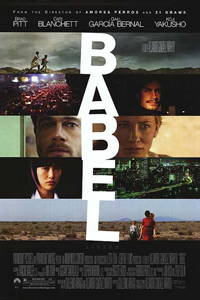
  • REVIEW: “Babel” (****)

    Paramount Vantage\'s Babel“Babel” is the crowning achievement in the early careers of writer Guillermo Arriaga and director Alejandro González Iñárritu.  It will deservedly be seen as that defining moment which took them out of personal thematic expression -– the mark of a true artist -– and into the arena of global and human consciousness through artistic dexterity -– the mark of something much more.

    It is the most particular specimen, yet the most universal, in the long line of socially and/or politically inquisitive filmmaking we’ve experienced over the last two years.  And it goes without saying, “Babel” is the first real masterwork of 2006.

    As outlined in the eleventh chapter of the book of Genesis, the Tower of Babel was a creation built by the collaborative forces of a united humanity.  Having it in their hearts to emulate the Creator, the text reveals, “they said, Go to, let us build us a city and a tower, whose top may reach unto heaven.”   As the legend states, God halted the project by confusing the languages of the united, so that they could no longer communicate with one another.

    God then scattered the people throughout the land, forever disconnected, yet still of a similar and undeniable origin.

    The Tower of Babel is a narrative used to explain the diversity of languages and race throughout the world.  It is also a rather obvious warning that any who would attempt greater personal standing than that which God has outlined for them is doomed to failure.  However, at its core resides another illustrative failure begging thematic expansion: We as humans are furthermore doomed to eternal miscommunication, so long as we maintain the literal and figurative borders of our own design.  This thematic is the central focus of Arriaga’s and Iñárritu’s brilliant film.

    “Babel” tells four stories set in the lands of Morocco, Mexico and Japan.  Each of the stories, in typical Arriaga/Iñárritu fashion, shares common strands, continuing their trilogy of interconnectivity and fateful consequence (themes also found in 2000’s “Amores Perros” and 2003’s “21 Grams”).

    Two Moroccan brothers, testing the range of a firearm purchased for them by their father for the purposes of killing jackals, instigate the events of the film which will outline the filmmakers’ tale.  A single gunshot rings out in the Moroccan desert, spiraling the lives of Richard and Susan (Brad Pitt and Cate Blanchett, respectively) into a dizzying and confusing abyss of political turmoil, paranoia and, assuredly, dire straits.

    Adriana Barazza in BabelVacationing and searching in vain for themselves and their emotional connection once again, Richard and Susan have recently lost one of their children.  Neither has recovered, and neither has found the ability to forgive the other.

    Meanwhile, at the couple’s home in San Diego, their illegally employed Mexican nanny, Amelia (Adriana Barazza), is anxious to make it to her son’s wedding back home.  Against the advice of her nephew, Santiago (Gael García Bernal), she makes the fatal decision to bring Richard and Susan’s children –- whom she has raised for eleven years –- with her across the border.

    The more politically relevant of the three tales, Amelia’s journey is reflective of current foreign policy as it relates to border concerns, and the heartbreaking consequences potentially harsh edicts can manifest in that regard.

    Concurrently, in the communicative and technological Eden of Tokyo, Japan, Chieko (Rinko Kikuchi, the film’s unparalleled standout), is a deaf-mute girl exploring herself sexually as an adolescent, but ever lost in her own paralyzing world.  Chieko is the true heart of the film, lacking the ability to communicate, not merely emotionally, with her widowed father, Yasujiro (veteran Japanese thespian Kôji Yakusho), but quite literally, with the people who surround her in one of the most populated cities in the world.

    The performances in the film are all of an organic whole, but as undoubtedly diverse as the characters being portrayed.  As Richard, Brad Pitt finally puts forth a commendable and saturated performance to stand alongside his best work (“12 Monkeys,” “Seven,” “Seven Years in Tibet”), while Cate Blanchett, largely relegated to painful cries and disappointed outbursts, is ever-commanding as she continues her lineage of impressive portrayals.

    The actors cast as the two Moroccan brothers and their father (with whose names, I’m embarrassed to say, I am not familiar) offer performances that are fascinatingly tangible and, in many ways, the most reflective of human frailty.  Meanwhile, Gael García Bernal has a comfortable supporting opportunity to give the hint of depth, but still keep his cards close to the vest.

    Rinko Kikuchi in BabelThe most captivating and award-worthy performances in the film, however, come from Adriana Barraza and, most especially, Rinko Kikuchi.  Barraza’s conflict is so frightening, and eventually, so terribly desperate, that it could burden the shoulders of the most gifted of actresses.  She commands the role in such a way that we feel for her wholly, in ways both humanitarian and political in nature.

    Kikuchi, on the other side of the world, provides a venue for us to experience the film’s themes ourselves.  So much of her performance comes through her eyes and through her visual reaction to the events around her that the audience is forced to partake in her journey as well.  Seemingly we feel no such personal connection to any other character in the film.  It can be no coincidence that that character is the one so drastically isolated from the world six inches in front of her face.

    “Babel” pushes through the journeys of its inter-connected characters toward its own vibrant, certainly logical, but altogether ideal (if profound) conclusion.  Through their usual heart-wrenching tactics, Arriaga and Iñárritu paint the portrait of humanity scattered, just as in the days of Genesis, but not at all lacking the promise of rediscovery.

    Though not nearly as dark as their last two efforts, and certainly more accessible on the whole, “Babel” concludes in the most uplifting of fashions.  The film’s closing moment at once draws the sigh of hope and a tear of thankfulness that Pandora closed her box in time, another legend entirely, yet one as applicable to humanity as that of the tower which represented man’s original arrogance.