
In Contention

Tag: Frances McDormand

  • CANNES CHECK: ‘This Must Be the Place’

    The director: Paolo Sorrentino (Italy)

    The talent: Sean Penn (a Best Actor winner at Cannes back in 1997 for “She’s So Lovely”) pops up in his second film of the Competition, though this time in a clear lead role. Frances McDormand makes it two Oscar-winners on board, while the eccentric supporting cast includes Harry Dean Stanton, Judd Hirsch, Talking Heads frontman David Byrne (guess he sanctioned the film’s title, then) and Eve Hewson — the 19 year-old daughter of Bono.  Byrne also contributed the film’s score, with original songs by US folk star Will Oldham (aka Bonnie ‘Prince’ Billy). Overall, however, the crew remains heavily Italian; Sorrentino’s regular (and regularly flashy) cinematographer, Luca Bigazzi, is also on board.

    The pitch: Sorrentino’s first English-language feature — hardly a surprising move, given how his previous features toyed with Hollywood forms — sounds like a decidedly odd duck on paper. If you think the film’s various connections to rock royalty seem thematically related, you’d be right: Penn plays Cheyenne (!), a former Goth rock star living in wealthy retirement in Dublin, shaken out of his self-involved stupor by his estranged father’s death.

    (more…)

  • The Great Performances: 2000

    Tom Hanks in Cast AwayMichael Douglas was robbed.

    The already Oscar-christened actor gave a career-best performance in 2000 in Curtis Hanson’s “Wonder Boys,” but he got no love from the Academy. Worse, his performance was easily among the five best of the year and won the Los Angeles Film Critics Association Best Actor prize.

    That having been said, I don’t think Douglas actually deserved the Oscar in 2000.  That honor belonged to Tom Hanks in “Cast Away” for a performance that was nothing less than astounding. For two and a half hours Hanks commands the screeen, moving into silent film territory for a stretch, the actor using strictly his body and face for the performance. Anyone who has ever, and I mean ever, doubted his range needs to take a hard look at this film.

    The five nominees for Best Actor in 2000 were Hanks, Russell Crowe for “Gladiator,” Ed Harris in “Pollock,” Geoffrey Rush in “Quills” and Javier Bardem in “Before Night Falls.” For me, Douglas was the most glaring omission, followed by George Clooney’s Gable-esque work in “O Brother, Where Art Thou?,” which I think remains one of the actor’s very best pieces of work.

    (more…)

  • The Great Performances: 1996

    Robert Carlyle in Trainspotting1996 was an odd year, a year when the independent cinema dominated the weak product emerging out of Hollywood. I am going to confess right off the top of this article (as I have numerous times before) that I was not a fan of “The English Patient,” which for me remains one of the most vastly over-appreciated films ever made.  I couldn’t stand Kristin Scott Thomas’s work, though I did enjoy the Dafoe/Binoche storyline.

    So with that out of the way, and firmly in mind, let’s go…

    The Best Actress race was clouded with the notion that Madonna was hell-bent on being nominated for her performance in “Evita,” which finally made it to the screen after years of starts and stops. Her performance split critics, but for me lacked the depth and edge that it was given on stage by Patti Lupone, and that Meryl Streep or Michelle Pfeiffer would have given the role. Her performance proved that Madonna should stop acting as she has little or no acting talent, and should stop making movies and trying to conquer Hollywood as she did the music industry.

    Honestly, the performance rarely rises above a really good community theater performance. Mercifully she was not nominated, but she did win the Golden Globe for Best Actress in a Comedy or Musical over the eventual Oscar winner, Frances McDormand in “Fargo.” The nominees for Best Actress included, McDormand, Kristin Scott-Thomas for the aforementionend “The English Patient,” Diane Keaton for “Marvin’s Room,” Brenda Blythyn in “Secrets and Lies,” and best of all, perhaps, Emily Watson in “Breaking the Waves.”

    (more…)

  • SHORT TAKE: “Burn After Reading” (*1/2)

    Focus Features' Burn After ReadingI really didn’t like “Burn After Reading,” but I laughed.  A LOT.
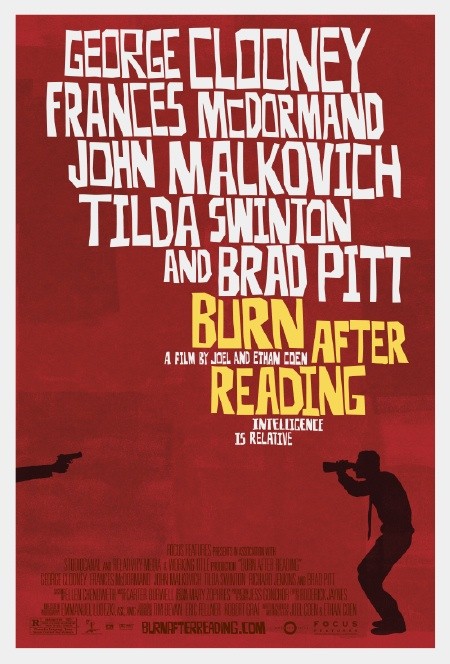
    I think the Coen brothers are probably the only filmmakers who can generate such a reaction.  The entire film is expendable.  It doesn’t even work on the grounds of slapstick, really.  It’s a series of events strung together, no point, no thematic ingenuity, a tapestry of…stuff.

    And that’s obviously the point.  The film willfully aimless.  Like J.K. Simmons says at film’s end, “I’ll be damned if I know what happened.”  And I stand on my chair and applaud the Coens for doing exactly what they wanted to do after the critical embrace of “No Country for Old Men” last year, because it takes balls to crank out (probably knowingly) your least accomplished film one year after what could be considered your most successful one.

    Only the Coens.

    The star of the film’s wacky ensemble is, without a doubt, Brad Pitt.  The actor’s age, however, pokes through sometimes, making his character oddly askew and somewhat…creepy?  But he takes the bull by the horns and rides this character for all it’s worth.  Chad Feldheimer is without a doubt Pitt’s most inventive creation since Jeffrey Goines in “Twelve Monkeys.”

    The rest of the cast is merely passable.  Frances McDormand gets the appropriate snorts as a superficial, middle-aged gym employee trolling the Internet for love interests.  Tilda Swinton is awkward as the stuck-up wife of John Malkovich’s disgraced CIA agent.  Malkovich provides plenty of laugh-out-loud moments but seems consistently aware that the story is spiraling out of control.

    Elsewhere, George Clooney is probably the runner-up for talent on display as he makes his way through a character addicted to sex in the most humorous and matter-of-fact ways, while Richard Jenkins kind of gives the audience something to attach themselves to as a life jacket in the choppy waters.  Kind of.

    But ultimately, the film is nothing more than a romp.  A harmless one, but a difficult one to qualify in any sense.  Enjoyable, yes, but hollow and lacking any ability to fully satisfy.  Not unlike eating large amounts of candy.