In Contention

Tag: Diane Lane

  • 11/24 OSCARWEB ROUND-UP: Kunis on her ‘Machinist’ impression, Hammer talks twinning, bad boy celebrity

    (Ended up unexpectedly taking the day off yesterday.  Not that I’m complaining.)

    • Anne Thompson talks to “Secretariat” star Diane Lane. [Thompson on Hollywood]

    • Mila Kunis on dropping to a bony 95 pounds for “Black Swan.” [E! Online]

    • Dave Karger, meanwhile, wonders if the actress can score an Oscar nod alongside co-star Natalie Portman. [Inside Movies]

    (more…)

  • Portman on ‘Black Swan’ eroticism: “Extreme, not raunchy”

    When it comes to Oscar campaigning, sex can be something of a double-edged sword. We all know that the Academy has often responded well to attractive young actresses baring flesh for their art: Kate Winslet was the most recent beneficiary, but Halle Berry, Charlize Theron, Holly Hunter and Jane Fonda are among the other actresses who spun open onscreen sexuality into Oscar gold.

    That said, while raw sex scenes don’t necessarily offend the Academy’s delicate sensibilities, voters can nonetheless shy away from performances that delight in their own kinkiness: recent snubs for the likes of Naomi Watts in “Mulholland Drive” and Maggie Gyllenhaal in “Secretary” suggest that Oscar favors solemnly tasteful kitchen-sink eroticism over more heightened depictions of sexual pleasure. (After all, it wasn’t Diane Lane’s hot love scenes that earned her that unlikely Best Actress nod for “Unfaithful”; it was that guilt-ridden reaction shot on the train ride home.)

    (more…)

  • 10/8 OSCARWEB ROUND-UP: ‘Superman’ does well, Paramount grabs Reitman’s next, Lane on ‘Secretariat’

    • Davis Guggenheim’s “Waiting for Superman” has performed better than several other high profile releases. [The Envelope]

    • David Poland sits down with “Let Me In” director Matt Reeves. [Movie City News]

    • Paramount to distribute Jason Reitman’s “Young Adult,” written by Diablo Cody. [Hollywood Reporter]

    (more…)

  • ‘Secretariat’ makes for a bumpy ride

    Last month, it was somewhat fascinating to watch Randall Wallace’s “Secretariat” a day after Anton Corbijn’s “The American.” There is no comparison to draw between the two, of course, but if the latter is the ultimate “show, don’t tell” film, then the former is most certainly the ultimate “tell, don’t show” film.

    Mike Rich’s screenplay (which was “suggested” by William Nack’s book “Secretariat: The Making of a Champion,” the closing titles tell us — I don’t know if that makes it original or adapted) is soaked in the most viscous sentiment you could imagine, and perhaps as much as you’d expect from the sampling of materials put out thus far.  But while that might be forgivable given the feel-good nature of the narrative, the repetition of that sentiment is what kills it.  My guess is director Wallace couldn’t settle on which blatant example of force-fed symbolism or thematic showmanship to trim from the potent mixture, so he just kept it all.

    (more…)

  • OSCAR TALK: Ep. 34 — Screeners arrive, ‘Social Network’ and ‘Let Me In’ open, ‘Secretariat’ thoughts, remembering Sally Menke

    Oscar TalkWelcome to Oscar Talk.

    In case you’re new to the site and/or the podcast, Oscar Talk is a weekly kudocast, a one-stop awards chat shop between yours truly and Anne Thompson of Thompson on Hollywood. The podcast is weekly, every Friday throughout the season, charting the ups and downs of contenders along the way. Plenty of things change en route to Oscar’s stage and we’re here to address it all as it unfolds.

    Two incredibly well-reviewed films are hitting theaters today and Academy voters already have screeners sitting on their doorsteps, not to mention a somber week for the Hollywood community, so there’s plenty to dive into. Let’s see what’s on the docket…

    (more…)

  • OFF THE CARPET: The year of the woman, take two?

    It wasn’t by coincidence that the three photos decorating the season’s introductory installment of this column two weeks ago represented lead actress contenders in the 2010 Oscar race. After all the talk of 2009 being “the year of the woman,” owing much to the number of female directors who found themselves in the mix (and inevitably leading to Kathryn Bigelow’s history-making moment at the Kodak), I’m sensing an even better argument for 2010 as a singular season for the fairer sex.

    Let’s start with the performances. By my count, there are already eight nominatable offerings from lead actresses this year (which contrasts drastically with a dearth of supporting hopefuls).  This is just going by what I’ve seen, mind you.

    For starters, Natalie Portman has dazzled the early festival season with her work in “Black Swan.” Lesley Manville, meanwhile (should she remain a lead focus), sets a high bar in “Another Year.” Despite my feelings on the film, Carey Mulligan really settles into a next-level groove in “Never Let Me Go,” and Jennifer Lawrence, of course (like Mulligan last year), has already become the year’s star-in-the-making story in “Winter’s Bone.”

    Dovetailing with the performances themselves, there are also films that seem to reflect the theme in narrative. In “Secretariat,” for instance, Diane Lane capably (if a bit histrionically) portrays headstrong Penny Chenery, a woman of virtue in an era when she was expected to keep her head down and clean house. Similarly, Sally Hawkins absolutely kills as the Norma Rae-ish Rita O’Grady in “Made in Dagenham,” fighting for equal pay in a similar time (and she’s likely to be joined in the hunt by co-star Miranda Richardson for a fiery supporting turn). And we can’t forget the palpable feminism apparent in summer indie “The Kids Are All Right,” where Annette Bening and Julianne Moore both bring their “A” game.

    (more…)

  • The Great Performances: 2002

    Chris Cooper in Adaptation2002 was probably one of the greatest years for performance excellence in film history, from leading actor right through all the supporting players. They could have easily nominated 10 actors in each of the four acting categories, and still missed some.

    Though Adrien Brody won the Oscar for “The Pianist,” which was a huge shock, I have always felt that Jack Nicholson gave one of his finest performances in “About Schmidt.” I suspect he and Daniel Day-Lewis in “Gangs of New York” may have split the vote in some way, allowing for Brody’s win.

    Michael Caine was up for “The Quiet American” after that film scored with critics at many precursor fests, and Nicolas Cage was the fifth nominee in “Adaptation.” Great performances all, deserving performances all, but there were so many other noteworthy turns.  Like Robin Williams’s chilling performance in “One Hour Photo” as a deranged photo lab worker obsessed with a family. Equally brilliant was Leonardo DiCaprio as the young fraudster in “Catch Me If You Can” while Tom Cruise gave one of his very best performances in Steven Spielberg’s “Minority Report.”

    One of the year’s very best films, “Road to Perdition,” contained one of the year’s best leading performances from Tom Hanks, as a lethal killer on the run from his own mob.  And though I loathe the work of Richard Gere, I must confess he did some of his finest work in “Chicago,” winning a Golden Globe for his performance, but no Oscar nod.

    (more…)

  • REVIEW: “Hollywoodland” (***)

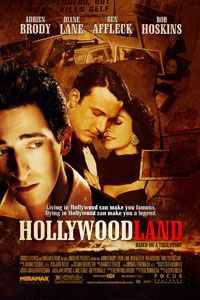
    Focus Features\' HollywoodlandThe death of George Reeves, television’s original Superman, in 1959 defined the loss of innocence for a generation.  There are many who remember where they were the moment they discovered Reeves’s body had been found, the victim of an apparent suicide.

    The lore surrounding the event has even wound itself into incorrect information that perpetuates itself mythically, forever living on as one of Hollywood’s greatest mysteries –- or is there a mystery at all?

    “Hollywoodland” is a project that has seen a long road to the screen, bouncing from one studio to another and back again, enduring rigorous casting scrutiny and a number of raised eyebrows regarding the direction a screenplay based on these questionable events would take.

    Now the feature film debut of television veteran Allen Coulter, “Hollywoodland” is a vivid and self-propelling experience that lingers much longer than you would expect it to.

    In the film, Adrien Brody portrays the fictional private investigator Louis Simo, who makes his way from buck to buck stringing along suspicious husbands and picking at closed LAPD cases like a scavenger of public enforcement.  When he is tipped off to the notion that, following a quick investigation deeming Reeves’s death a suicide, Reeves’s mother believes her son was murdered, Simo embarks on a journey that will become much more personal than he would have ever intended.

    The Reeves story is told through flashback, with Ben Affleck (in his career best work) taking on the role of the tragically typecast actor who rose to stardom as television’s Superman.  Parallel to Simo’s investigation, we’re made witness to the long, inevitable and sad road Reeves travels, at once a handsome lady-killer and a depressed dreamer.

    You see, Reeves was cut from the classic movie star mold.  Cary Grant, Clark Gable and Spencer Tracy would have been fitting company for the talented thespian.  However, such stardom always seemed just out of Reeves’s grasp, and after ambivalently taking the role of the Man of Steel merely to make ends meet, he would endure the sort of fame that would forever seem cheap and lacking artistic context.
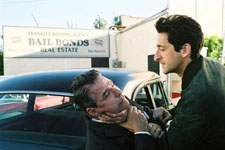
    Adrien Bridy in HollywoodlandWhen audiences were distracted by the actor’s iconic image during his scenes in Fred Zinnemann’s “From Here to Eternity,” the director inevitably had the work Reeves had put into the picture removed.  Suicide, it seemed, made complete sense to the community at large.

    The film takes time to properly examine three popular theories about how Reeves actually met his end.  The perspectives stem from a raucous girlfriend (Robin Tunney) peeved at the actor’s refusal to marry her being responsible, to former mistress Toni Mannix (Diane Lane) becoming so grief-stricken over his leaving her that her husband, MGM general manager Eddie Mannix (Bob Hoskins), had Reeves murdered – not the most implausible act in the eyes of many Angelenos.

    And, of course, the script – written by Paul Bernbaum – takes a thorough look at the classically accepted suicide theory, which certainly carries more legitimate pathos than any other.

    Brody’s work in the film takes a moment to really fit the character, but once he gets into the groove of a divorced father struggling to make his own ends meet, he taps into the personal ferocity that really begins to drive Simo after a tragedy late in the second act propels him to reassess his own perspective.  This is his first true starring role since his Oscar winning performance in “The Pianist,” and he reminds us exactly why he is worthy of the distinction.

    The supporting cast fills out in typical fashion, with Bob Hoskins and Diane Lane seemingly phoning their work in.  Though Robin Tunney really stands out as Reeves’s fiancé, Lenore Lemmon.  The real story, however, is certainly Ben Affleck, in a role that could easily be seen as too demanding given the work we’ve seen out of the actor in recent years.
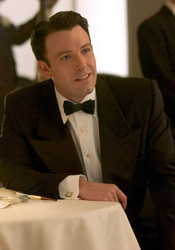
    Ben Affleck in HollywoodlandNo, in “Hollywoodland,” Ben Affleck shows us what he can do when he really wants it.  The actor took a sizeable upfront pay cut on the film (as did pretty much everyone), and while at first glance it may seem that his beefcake persona would laughably overpower the mythos of George Reeves, we soon discover just how tailor-made his screen presence is for the role.

    He captures the man in spirit, voice and mannerism like I certainly wouldn’t have expected, and perhaps many other filmgoers, casual and otherwise, will see the same awards-caliber work.

    When the film opens on September 8th, the Best Supporting Actor race may have truly commenced — or maybe the film will just stay low on everyone’s radar altogether.  But this is a savory, layered performance that does its job in context and is commanding as a supporting turn, giving us a character on which to base the events of the present – a character to care about, to root for and, all at once, to mourn.

    All things considered, Allen Coulter’s work on his first feature is capable and smooth-sailing, if unremarkable by virtue of necessity.  He never gets overly fancy, even with the unique structure, and he guides the film with the anonymous sort of hand that is certainly a positive thing.  This may well be the only cinematic testament to the legacy of George Reeves, and it is as thorough a testament as one could have asked for, despite dramatic twists and turns that might have been more suitably trimmed for a tighter overall experience.

    In the end, however, a focused performance in the film’s background works off of a truly driven performance in the foreground to give an appropriately rounded take on what has to be considered one of the most devastating events in television history.