 Continuing the discussion of yesterday’s London Film Festival offerings:
Spearheaded by such titles as “The Class” and “Gomorrah,” the big story of world cinema this year appears to be the fusion of a documentary aesthetic with fictional storytelling, in many cases employing semi-improvised scripts and non-professional actors to create the spontaneous, slightly unnerving feel of watching life being lived. The latest in this cinematic line is “Tulpan” (***), a spare, sure-footed and thoroughly winning first foray into fiction film from documentarian Sergei Dvortsevoy.
Since picking up the Un Certain Regard award at Cannes, the film has built up healthy buzz on the festival circuit, and was recently named Kazakhstan’s entry in the Best Foreign Language Film Oscar race. (Kazakhstan, incidentally, is seeking their second consecutive nomination in the category after the surprise success of 2007’s “Mongol” — for all the “Borat” associations, this country is no joke.)
Part folk tale, part National Geographic-style environmental study, the film unfolds on the barren, windswept steppes of south Kazakhstan, a milieu familiar from 2003’s documentary “The Story of the Weeping Camel.” “Tulpan” actually resembles that film in more ways than one, employing a similarly leisurely, observational shooting style with a keen eye for domestic ritual.
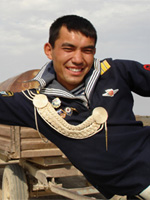
The story, such as it is, concerns a socially awkward young man, Asa, who returns from naval service to settle on the deserted steppe with his sister and her sheep-herder husband. Determined to find a wife, he sets his sights on marrying Tulpan, the daughter of neighbouring herders, who remains an unseen presence in the film. However, as he fails to win her over, while his herding abilities prove inadequate, he comes to re-evaluate his goals.
(more…)
 While I was away in Paris earlier this week, I was reminded there of the nominations for the Louis Delluc Prize. Awarded to a single title, it is arguably the most prestigious award in French cinema, having been won by such titans as Truffaut, Renoir, Chabrol, Malle, Bresson, Cocteau, Tati … well, you get the idea.