In Contention

Tag: Billy Wilder

  • PAGE TO SCREEN: “London Boulevard” by Ken Bruen

    When Oscar-winning screenwriter William Monahan (“The Departed”) brings Irish crime writer Ken Bruen’s 2001 novel “London Boulevard” to screen in his directorial debut, he won’t be adapting the text so much as returning it to its natural source.

    A short, sharp, deliciously black-hearted thriller that reads not unlike a readymade screenplay in its brisk, dialogue-dominated prose, Bruen’s novel makes its debt to Hollywood clear not only in its construction (brief, propulsive chapters of only a couple pages’ length resemble individual cinematic scenes) and its assorted winking namechecks of bygone films and stars, but in its very conception.

    The title – not a location (locals will know that there is no London Boulevard in the British capital) but a metaphor of sorts – is our first clue to what Bruen is up to: the novel is itself an adaptation, and Billy Wilder’s gothic Hollywood noir “Sunset Boulevard” is the source material.

    The novel’s allusions to the 1950 classic aren’t exactly subtle. Where Wilder’s film gave us Joseph C. Gillis, a destitute L.A. screenwriter who seeks shelter in the mansion of faded movie goddess Norma Desmond to escape the repo man, “London Boulevard” crosses the Channel, jumps a half-century forward, and replaces Gillis with Mitchell, a middle-aged ex-con who dodges the ghosts of his past (and his own compulsive criminal urges) by shacking up in the plush Holland Park pad of Lillian Palmer, a washed-up theater diva plotting her triumphant West End return.

    (more…)

  • More on Reitman/Wilder

    Billy WilderFriday I posted a piece asking whether Jason Reitman might be on track to becoming the new Billy Wilder (an idea first put forth by USA Today writer Anthony Breznican).  The notion was met with some wicked vitriol from those who felt it a silly comparison or, at the very least, too soon to discuss.

    Fair enough on the latter, as I mentioned in my piece to begin with and in the ensuing discussion.  But three days later, Stephen Farber invoked Wilder’s name in his Hollywood Reporter review of “Up in the Air” and compared the film’s protagonist to the “corporate pimp” of Wilder’s “The Apartment.”  And today, in going back and forth on the idea with Breznican, he has offered a clarification but isn’t backing off on his point:

    “My comment is bound to provoke that sort of thing,” Breznican wrote of the reaction.  “I think you got what I meant, but I probably should have been more precise. Obviously Reitman, at the start of his career, does not add up to Billy Wilder’s entire output. But of course, that wasn’t what I was saying. Rather, I meant Reitman is working with Wilder’s toolbox, and telling the kind of stories that incomparable veteran once told.

    (more…)

  • Wilder on Wilder

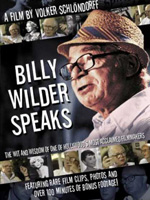
    Cover of Billy Wilder SpeaksI don’t know if you’ve been keeping up with TCM’s “Great Directors” theme this month.  A new vanguard every day for 30 days.  My DVR is getting a workout.
    Anyway, if I could spend a few hours with any director, alive or dead, it would have to be the affable, wily Billy Wilder.  I love his philosophy on filmmaking, his attitude through the years, his no nonsense artistry, etc.  If I had made it to Los Angeles prior to his death in 2002, I’m sure I’d have stalked his Brighton Way office in Beverly Hills like a moth to the flame, Bela Lugosi to my impressionable Ed Wood.

    I bring this up because I caught up with Volker Schlondorff’s “Billy Wilder Speaks” this morning, which ran on TCM Saturday amid a retrospective of the director’s greatest hits — “Double Indemnity,” “Stalag 17,” “The Apartment,” etc.  It’s a fascinating look at Wilder’s career through his own eyes, the old codger spinning anecdote after anecdote.

    (more…)

  • Raymond Chandler’s secret ‘Indemnity’ cameo uncovered

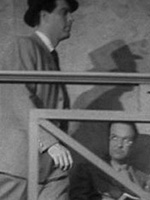
    (from left) Fred MacMurray and Raymond Chandler in Double IndemnityI don’t dig into my list of all-time greatest films often beyond this brief mention/hint or that, though I regularly get emails and comments asking me to chart them out.  One of these days I’ll crank out the whole collective.  One fixture of the top 20, however, has always been Billy Wilder’s seminal film noir effort “Double Indemnity.”

    So it was with considerable surprise and enthusiasm that I stumbled across this Guardian story from Adrian Wootton that uncovers the until-now-undiscovered cameo from author Raymond Chandler in the film.  Chandler, of course, co-wrote the screenplay with Wilder, which was itself based upon the novel by fellow noir legend James M. Cain.

    The discovery comes 60 years after the film’s release and 50 years after Chandler’s death.  I’m stunned no one has uncovered it until now.  Author (and blogger) Mark Coggins is credited with the discovery (thanks to a tip from fellow author John Billheimer).

    Writes Coggins:

    The scene where Chandler appears comes relatively early in the move, just after Fred MacMurray, as insurance salesmen Walter Neff, leaves the office of Edward G. Robinson playing the character of claims adjuster Barton Keyes. Keyes has just told Neff that “his little man” tells him whenever a claim is crooked and Neff shines him on and then lights his (cheap) cigar with a kitchen match and walks out of the office.

    As he exits the office, he goes down a corridor, and there is Chandler waiting outside reading a magazine and smoking a cigarette.

    (more…)