 This year’s race for Best Adapted Screenplay has seemingly been the most predictable of the year. One script has dominated the precursor circuit and the name behind that script is as worthy as ever given his contributions to the medium over the years.
I’m not particularly a fan of this slate. One script is an interesting experiment that doesn’t fully land as a piece of screenwriting, another is a near word-for-word adaptation of a novel (which is fine, but credit where it’s due) and another, frankly, made for the most overrated film of the year. But the two that seem to be duking it out for the win are worthy and deserve to be here, in my opinion, so I have little room to complain.
The nominees are:
“127 Hours” (Screenplay by Danny Boyle & Simon Beaufoy)
“The Social Network” (Screenplay by Aaron Sorkin)
“Toy Story 3” (Screenplay by Michael Arndt; Story by John Lasseter, Andrew Stanton and Lee Unkrich)
“True Grit” (Written for the screen by Joel Coen & Ethan Coen)
“Winter’s Bone” (Adapted for the screen by Debra Granik & Anne Rosellini)
 I’m really not trying to drop another grenade on the season here, but I was wondering recently about surprises this year and whether there are more in store. And one undeniable shock would be an upset in the Best Adapted Screenplay race.
 The USC Libraries Scripter Award is an annual honor (now in its 23rd year) in recognition of “the best adaptation of the printed word into film.” It is one of the more unique awards along the circuit as it is not only awarded to the screenwriter but the source material’s author, as well.
 For the third episode in our new
 I’m not sure how I missed the memo, but in the past 48 hours,
 This news actually dropped a few weeks ago, but I neglected to mention it while I was distracted with Venice goings-on. Anyway, since the award was presented at the San Sebastián Film Festival this past weekend, it seems appropriate to bring it up now.
 I’ve been hearing for a while now that Aaron Sorkin’s screenplay for
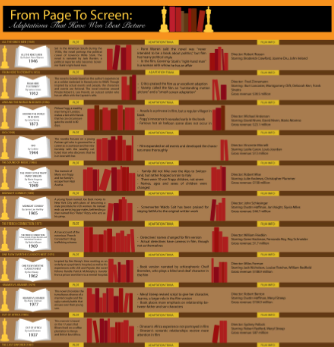
 In most cases, the adapted screenplay category of a given Oscar race is packed with Best Picture nominees or contenders. This year, however, there was a nice balance of adapted and original screenplays in the Best Picture category, and in fact, of the “top five” films that trickled down throughout the season, three were original and two were adapted, a rarity.
 He may currently be basking in the glow of a surprise Oscar nomination, but when I call him up at his London home,
 So here we are. For the most part, the crafts category nominations weren’t surprising, and there is not a single film that fared drastically better – or worse – than I expected.
 Steve Pond sure is getting a nice bunch of scoops today. Mainly because, I imagine, he’s doing the dilligence of looking over the ballots and accompanying eligibility forms, which so often tend to reveal last minute category shockers, something I’ve been meaning to do for a few days now.
 •
 As always, the year’s adapted screenplay race is much more competitive than the original screenplay race. But what’s intriguing to note is that of the anticipated “big four” still to be widely screened, three of them are right in the thick of this discussion.
 For Scott Z. Burns, the best way to tell the story of a compulsive liar was to take some liberties with the truth himself.
 Amid the swirl of hype for