In Contention

Tag: Bela Tarr

  • ‘Turin Horse’ among latest foreign Oscar entries

    This news has been hanging around for a few days, but amid the Venice hubbub, I haven’t found a moment to post it until today — though we did address it briefly in Friday’s Oscar Talk. With less than a month to go until the deadline, the pile of official submissions for the Best Foreign Language Film Oscar is slowly growing — and the most prominent of them is a title I already reviewed at February’s Berlinale.

    That film would be Béla Tarr’s “The Turin Horse,” which won the runner-up Grand Prix at the festival and just screened at Telluride this weekend, and which I described as “a stately, granite-textured and altogether rather tremendous” work in the famously austere director’s canon. Hungary has a history of choosing ballsy and utterly doomed Oscar submissions — “Taxidermia,” anyone? — but this is the first time they’ve dared to enter a Tarr opus.
    (more…)

  • BERLIN: ‘Nader and Simin’ wins big

    Unlike large voting bodies such as the Academy, the decisions of rotating festival juries are rarely easy to anticipate — when only six people are determining the awards, as was the case at this year’s Berlinale, who knows what idiosyncratic personal tastes might come into play?

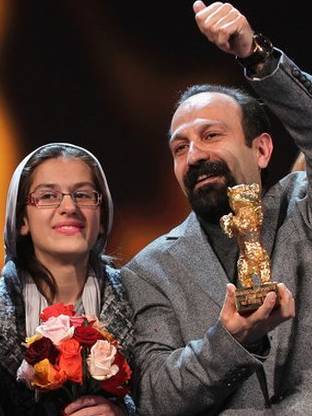
    So it is that the only truly surprising thing about this year’s Berlin Competition winners, announced at a ceremony last night, is just how unsurprising they are. As I predicted in my Friday review of both films, Isabella Rossellini and her fellow jurors sided with the critics, as it came down to Béla Tarr’s imposing survival study “The Turin Horse” and Asghar Farhadi’s intricate moral drama “Nader and Simin, a Separation” for the Golden Bear.

    As expected, it was Farhadi’s more accessible, though no less deserving, film that came out on top — two years after the filmmaker took the festival’s Best Director award for “About Elly” — while a seemingly surly Tarr had to settle for the runner-up Grand Prix. (The severe Hungarian auteur was there to pick up his award, but refused to give an acceptance speech.)

    (more…)

  • BERLIN: Béla Tarr and Golden Bear favorites

    The Berlinale competition drew to a close this morning, with Joshua Marston’s “The Forgiveness of Blood” — more on that in a final roundup this weekend — wrapping up a selection that’s been a typically mixed bag for the festival. Healthy critical argument has flared up over a number of titles — including lone Asian entry “Come Rain, Come Shine,” a bare-bones day in the life of a separating couple that struck some as delicately affecting and others merely as attractively vacant. (I’m one of the others, sad to say.)

    Meanwhile, films the critical majority has sided against include “Lipstikka,” a reportedly bananas Israeli melodrama that Telegraph critic Tim Robey warned me off with this choice dialogue sample: “You play games with me, like you used to do with your men, with your sex and boobs.” Part of me regrets missing this one.

    Amid the splinters of the Competition, however, a pair of critical favorites have moved comfortably ahead of the pack in terms of general approval and all-round buzz — they screened three days ago, eons in festival time, yet I’ve barely heard anyone talk about any other films since. I’m afraid to say that my own top film of the fest, Cameroon-set German drama “Sleeping Sickness” (reviewed here), isn’t one of them.

    (more…)

  • Off to the Berlinale

    In a couple of hours, I’m jumping on a crack-of-dawn flight to one of the coolest cities on earth for a week at the Berlin International Film Festival — or, to use the name that rolls more luxuriously off the tongue, the Berlinale.

    I probably should have mentioned this earlier and posted some sort of festival preview. The truth, however, is that I’ve been so preoccupied with other business that I’ve barely read through the festival programme myself — the date rather snuck up on me. I’ve never done so little homework ahead of a festival — yet after my first Berlinale experience last year, that doesn’t feel like a bad approach.

    Berlin prides itself as being a festival of discovery, with more of an emphasis on rising talent than the lofty auteur names that tend to favor the sunnier festival climes of Cannes and Venice. True to form, my favorite finds of last year’s festival were ones I knew little about in advance (like Arvin Chen’s “Au Revoir, Taipei,” which wound up in my 2010 Top 10) or ones I wasn’t aware would show up until the last minute (like “The Illusionist,” buried so deep in last year’s programme many critics missed it altogether).

    (more…)

  • LIFE WITHOUT OSCAR: 1981 and 1982

    Catch up with the idea behind this series here.

    Can I just take a moment here to publicize that the 1980’s are by far, my least favorite decade in cinema. Despite the great titles that I’ll be spotlighting here and my feelings that it was the best time for blockbuster filmmaking, it’s just a generally depressing era. Genuine artistic voices were in short supply so if anyone has recommendations for these years, definitely throw them my way.

    Perhaps I should start with “Chariots of Fire,” one of only a handful of Best Picture winners I have yet to see. The unheralded British production was a surprise winner over Warren Beatty’s “Reds,” which I have also not seen.

    I was, however, conceived in 1981 so cut me some slack on these titles. I’ll get to them. As I was preparing to enter the world, all four acting winners were on their way out, averaging 71 years old, including Henry Fonda’s first ever win.

    Another British production about a true story, “Gandhi,” took top honors in 1982. This was also the year “Tron” was disqualified from the Best Visual Effects category because the Academy thought using a computer was cheating.

    (more…)