In Contention

Tag: Atonement

  • Tailoring ‘Tailor’

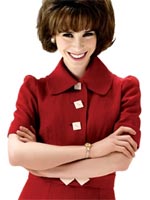
    One craft aspect I didn’t get around to praising in last week’s review of “Tinker, Tailor, Soldier, Spy” is the immaculate costuming by Jacqueline Durran — a designer with only 11 feature credits under her belt, yet one who already seems something of an institution.

    Durran is one of those rare designers capable of equal deftness and creativity in period and contemporary work: her reputation will likely forever rest on that green evening gown from “Atonement,” but she was also responsible for the highly idiosyncratic thrift-store ensembles worn by Sally Hawkins in “Happy-Go-Lucky.” (Indeed, she’s been a loyal member of Mike Leigh’s crew for the last decade.)

    Her male-centric work on “Tinker, Tailor,” meanwhile, falls somewhere in between. Set in 1973, the film is a highly specific period piece, but one whose costumes call for the subtle character focus and practicality of her modern-day work. The gentlemen’s game of British espionage calls for some dapper suiting, and the film is every bit as stylishly dressed as you’d expect one that thanks Sir Paul Smith first in its closing credits to be.

    (more…)

  • Previewing BAFTA

    In the 10 years since they moved up in the calendar to pre-Oscar status, the BAFTAs have hovered uncertainly between complying with awards trends across the pond, thereby establishing themselves as a viable precursor, and stubbornly standing by their own – as in 2007, when they opted out of the Coen Brothers-P.T. Anderson faceoff by picking “Atonement,” despite the film’s only other award coming for Best Art Direction.

    This year, however, offers them the best of both worlds. Rewarding “The King’s Speech” will simultaneously allow them to co-sign a heavy Oscar favourite and preserve their national pride.

    Add in the fact that a vote for the film also represents a vote for the much-mourned UK Film Council – oh, and that it just happens to be a smash hit with British audiences – and the royal biopic would likely have been a lock for the top prize even without the support of major US guilds.

    (More, plus predictions, after the jump.)

    (more…)

  • THE LONG SHOT: It was always you

    “Let me get this straight. The one’s about a precocious computer geek who’s also a bit of an asshole.”

    “Yeah.”

    “And the other’s about King George VI.”

    “Yeah.”

    “And King George VI has a disability.”

    “Well, he has a stutter. I mean, it’s not crippling or anything — ”

    “But it’s an obstacle that needs to be overcome.”

    “Yeah.”

    “And I assume, at the end, he does. And becomes King.”

    (more…)

  • ‘King’s Speech’ told to mind its language

    Admittedly, this isn’t much of a story, but following last week’s furore over the NC-17 certificate handed to the starkly adult marital drama “Blue Valentine,” it’s amusing to see a rather more milquetoast Oscar hopeful having its own trouble with the ratings board.

    London’s Evening Standard paper reports that “The King’s Speech,” already rated R by the MPAA, has been given a 15 rating (permitting no viewers under that age) by the British censors — not a severe rating, but more restrictive than one might expect for a polite period biopic revolving around speech therapy.

    The reason for the adult rating is the same on both sides of the Atlantic: a short comic scene where Colin Firth’s stuttering King George VI is required to say “fuck” 42 times in quick succession as part of a therapeutic exercise. To be frank, 14 year-olds were unlikely to be queueing around the block to see “The King’s Speech” in the first place, but that’s not really the point: R or 15 ratings could wrongfoot mild-mannered mature viewers who otherwise sit squarely in the film’s sights.

    (more…)

  • THE LONG SHOT: I’m just here for the movies

    “You’re the Oscar guys, aren’t you?” asked the spike-heeled PR officer upon eyeing the press badge dangling from my neck, her voice exuding the steely sweetness they teach you on the first day of public relations boot camp. It was midway through the Venice Film Festival and I was too beat — or my mouth just too full of complimentary cheese — to rephrase her blunt description. I nodded in reply: yes, I am indeed “the Oscar guys.” One of them, at any rate.
    “Thought so,” she said, eyes darting across the room, perhaps in search of my chart-brandishing entourage. “Not much for you here, is there?”

    On the one hand, I could hardly argue, not least since we’d both just emerged from a film — Chilean auteur Pablo Larrain’s brilliant nightmare of a black comedy “Post Mortem” — that stands as much chance of securing an invitation to the Kodak Theater as Kim Kardashian does to the Kennedy Center Honors.

    Five days into the festival, and the only film screened that belonged in the Oscar conversation (following the critical belly-flop of Julian Schnabel’s “Miral,” at least) was high-gloss opener “Black Swan,” and even that was generating “too cool for the Academy” conclusions. Oscar-watching at European festivals, even blogger-inundated Cannes, is a pretty spotty sport compared to the FYC frenzy of Telluride and Toronto.

    (more…)

  • Telegraph predicts “global hit” for ‘Dagenham’

    Two weeks ago, when I made my first Oscar predictions of the 2010 season, I went out on a bit of a limb for “Made in Dagenham,” the upcoming true-life Britcom that will have its world premiere at Toronto next month.

    I have yet to see the film, but the story material, the talent involved and the promisingly perky trailer (embedded after the jump) combined to suggest one of those undemanding, broadly appealing UK charmers that sneak up on the Academy every couple of years — and that, as “An Education” proved last year, face a gentler climb to a Best Picture nod in a field of ten.

    With the Academy’s sizable British voting bloc having often made their presence felt even in the days of five nominees — hello, “Atonement” — the odds do favor at least one British film making the cut in most years. Many see Mike Leigh’s “Another Year” as the prime candidate for that hypothetical slot this year, and it’s certainly a worthy one, but it remains a tough sell in many respects: a quiet, sometimes despairing essay on middle-aged loneliness unlikely to register beyond a rarefied arthouse audience.

    (more…)

  • THE LISTS: Top 10 Oscar nominee fields

    Ralph Fiennes in Schindler's ListIn exactly one week’s time, we’ll have a brand new list of Oscar nominations to pore over, pick apart and eventually file away in our subconscious with the other 81 editions of this annual collective. For Oscar geeks, nomination day is in many ways more exciting than the ceremony itself, celebrating a broader spectrum of work and throwing up far more surprises along the way.

    For all that, once the winners are announced, the nomination list as a whole tends to be disregarded, returned to only by trivia buffs and the geekiest of Oscar geeks. (Guilty on both counts.) And that’s shame, because a field of five nominees can often be more illuminating viewed collectively than even the worthiest of individual champions.

    Today’s list, then, is devoted to that most elusive of Oscar holy grails: the perfect nominee field.

    Yes, more often than not, the Academy will nominate several notable achievements in a single category. But rarer than hen’s teeth are the robust Oscar categories that feature a full house of five outstanding nominees, five contenders that would all be worthy of a win in any other year. No unremarkable coaster nominees sliding in on the coattails of a popular picture. No bad films with an expensively studio-bought  nominations. No filler. No fat. Just five superb achievements.

    (more…)

  • THE LONG SHOT: A little bit of English

    Rosamund Pike in An EducationYesterday, while talking with one of my sane friends whose thoughts drift to film awards perhaps one day a year, the conversation turned to the BAFTAs, which announce the nominations for their 2009 film awards tomorrow.

    “The BAFTAs, they’re like the Oscars for British films, right?” she asked.

    “Not quite,” I replied. “They’re open to all films.”

    “But the British films always win, right?”

    “No, not always.” I stared into my pint. “Well, a lot of the time, yeah.”

    “Why not just make them for British films, then?”

    “Because they want to be like the Oscars.”

    “So why do they keep rewarding the Brits?”

    The conversation could have circled this way for some time, but fortunately, it was time for another round – and by the time I returned from the bar, the topic had shifted to Pat Robertson.

    My friend’s innocent but pertinent questions only grazed the surface of the peculiar identity crisis suffered by the BAFTA Awards, a longstanding institution, kindly regarded by many, that only joined the pack of Oscar precursors nine years ago. Since they did so, it’s become increasingly difficult to ascertain who they are, what they stand for in awards season.

    (more…)

  • THE LONG SHOT: What is an “Oscar movie” these days?

    George Clooney in Up in the Air“God, that thing’s just going to shit Academy Awards out of its ass next year, isn’t it?,” I overheard a journo behind me remark to his companion, as I made my way out of the “Up in the Air” press screening on Sunday. “It’s such an Oscar movie.”

    Two things struck me as interesting about this throwaway remark, both relating to the lack of care with which both Oscar pundits and “serious” film lovers tend to regard the Academy Awards.

    The first was that, isolated and in print, the guy’s words appear dismissive of “Up in the Air,” yet they actually capped a mostly enthusiastic response to the film. His tone dipped almost apologetically as he applied the “Oscar movie” label, as if it somehow sullied an otherwise fine effort.

    More to the point, however, the remark seemed indicative of the transitive stage the Academy Awards seem to be in at the moment, as simultaneously resistant and vulnerable to industry change as the protagonist of Jason Reitman’s film – and facing a similar crisis of purpose. For 15 years ago – if not necessarily 15 years before that – “Up in the Air” wouldn’t have been decreed an “Oscar movie” at all.

    (more…)

  • Wright returns to Britain

    We have yet to see how Joe Wright’s first foray into contemporary American cinema turned out, though the demotion of “The Soloist” from prime 2008 awards-bait to quiet 2009 spring release has had the sceptics whispering for some time now.

    Perhaps unsurprisingly, then, Wright’s next project will find the “Atonement” helmer in the more familiar territory of the British period drama: “Indian Summer” will chronicle the last days of British colonial rule in India in the 1940s, following the handover of power from Viceroy of India, Lord Mountbatten, to new Indian PM Jawaharlal Nehru. (Some sources, meanwhile, suggest that the focus of the film will be a rumoured affair between Nehru and Mountbatten’s wife Edwina.)

    Besides Wright, more notable names are falling into place: as the fourth collaboration between Wright and Working Title, Tim Bevan and Eric Fellner are naturally on board as producers, while William Nicholson (“Shadowland,” “Gladiator”) is taking script duties. The Guardian reports “speculation” that Cate Blanchett and Hugh Grant are in line to star, which I’d take with a pinch of salt — though it’s plausible enough casting.

    As a fan of the widely misrepresented “Atonement” (it was a far smaller, stranger film than the romantic epic it was sold as), I’m on board for this. It’s not going to do much to clear the “next Anthony Minghella” buzz that has been circling around Wright for a few years now (misplaced talk at best, not least because he isn’t a writer), but it seems a good fit for his storytelling abilities. “The Jewel in the Crown” remains the benchmark for screen depictions of this fascinating era — if Wright can conjure similar magic, this could be a real contender.

  • Andy Trudeau reviews the Oscar nominated scores for NPR

    Alexandre DesplatOne of my favorite pre-Oscar specials is music critic Andy Trudeau’s analysis of the Oscar nominated original scores on NPR’s weekend edition.  He used to stretch the piece over two weekends and discuss the pieces with the show’s host, but this year he both waited until the last minute and did the piece as a stand-alone by himself.

    Trudeau’s favorite of the nominees (and mine) is Alexandre Desplats beautiful work on “The Curious Case of Benjamin Button,” putting together compositions that can be played both forward and backward.  Last year his pick was Darion Marianelli and “Atonement,” so maybe he’ll be spot on again this year — but I think we all doubt that.

    “Call me old-fashioned, but if I had a ballot, I’d go for a score with strong melodies, crystalline orchestration; one that takes us on an emotional journey,” Trudeau says.  “So I’m casting my one, unofficial vote for ‘The Curious Case of Benjamin Button’ by Alexandre Desplat.”

    Listening to the piece I was suddenly taken with how competitive it might actually be.  The A.R. Rahman win has become a foregone conclusion, and for many good reasons.  In addition to the “Slumdog” sweep train, the Academy simply likes music from other cultures.  “Babel,” “Frida and “Crouching Tiger, Hidden Dragon” are examples.  Maybe the work simply stands out a little more from the rest of the field.  I don’t know, but it’ll be interesting to see how the re-instated allowance for CD mailers made a difference.  “Button” probably has the most beautiful, listenable score, but Thomas Newman’s work on “WALL-E” is also brilliant.

    Anyway, it’s a short piece, well worth the listen this Oscar morning.  Head on over and feed your brain as we wait for the season to come to an end.  And check out Gerard’s Tech Support interview with Desplat here and with Rahman here if you missed them in the last few weeks.

  • Guessing the Globes

    UPDATE: That pesky Best Actor (Comedy/Musical) category has been running through my head all day, and I’m still not happy with my conclusion. So I’m making a last minute switch to Colin Farrell. I’ll probably be proved wrong in a few hours, but hey — there’s gotta be a surprise somewhere. Right?

    EARLIER: Well, hello there. After laptop theft has left me in the offline wilderness this past week, I’m back, albeit on borrowed facilities. (Thanks Alec, if you’re reading!) And not a moment too soon – any longer, and you’d have been deprived of my uninformed, inconsequential and in some cases wildly guessed Golden Globe predictions. Whew.

    The Globes come at a delicate point in awards season, just as consensus, or even a sense of inevitability, is building around certain prospective Oscar victors – but their timing, especially in the condensed awards season of recent years, means they don’t always catch the wave. So, while they frequently hop on an Oscar-bound bandwagon, as bellwethers, they can also be left behind – as in 2005, when they missed the momentum shift from “The Aviator” to “Million Dollar Baby.”

    Of course, their distinctive taste can also be a complicating factor, as we saw last year, when they bypassed long-established favourite “No Country for Old Men” for the rapidly cooling “Atonement.” And who can account for what happened in 1993, when they bizarrely crowned “Scent of a Woman” ahead of “Unforgiven,” “Howards End” and “The Crying Game?”

    What I’m saying, in a long-winded fashion, is that I’m finding this year’s Globes harder to call than they may appear. “Slumdog Millionaire” may be the obvious frontrunner, but I can’t shake a nagging suspicion that it’s not really an HFPA sort of film, that as with “Atonement” last year, the more stately, romantic “The Curious Case of Benjamin Button” may be more to their taste. It’s a toss-up to me, but I’m ultimately playing it safe, and guessing that Danny Boyle’s Mumbai fable has too much momentum to overcome.

    (more…)

  • Will BAFTA stick by their own?

    I have a bit of a love-hate relationship with the BAFTA Awards. On the one hand, they can be far more daring and playful in their choices than the American Academy — this is an organisation, after all, that has handed their Best Film award to such enduring works as “The Purple Rose of Cairo,” “GoodFellas” and “Lacombe, Lucien,” while nominating the Oscar-snubbed likes of “Eternal Sunshine of the Spotless Mind” and “The Usual Suspects.”

    Their technical awards are invariably more imaginatively awarded, too — take a look at their Best Film Editing category, for example, which in recent years has crowned “Eternal Sunshine,” “City of God” and “Mulholland Drive” as winners. And they can often be counted upon for gratifying upsets, as when Pedro Almodovar pushed past Sam Mendes for Best Director in 2000, or when “Trainspotting” blindsided “Sense and Sensibility” in the 1996 screenwriting race.

    For an awards show that fancies itself world-class, however, BAFTA can be infuriatingly parochial in their selections, stubbornly rewarding their own in the face of bigger, bolder competition. I doubt most of the voters could say with a straight face that “Four Weddings and a Funeral” was the very best film of 1994, nor “The Full Monty” of 1997, but they cleaned up nonetheless.

    For the last two years running, that kind of provincialism has ruled the voting, with this year’s awards looking particularly suspect. I think “Atonement” is a fine film, but handing it their top award seemed tokenistic at best, not least when the only other gong it took was for Best Art Direction.

    It’s a trend that Variety thinks could continue this year. In an article previewing the British contenders in the acting categories, they point out that Limeys have taken 16 acting BAFTAs in the last decade, compared to seven Oscars. Needless to say, they are frequently justified. It’s fair to say that this year, several British names will be cropping up in awards lists on either side of the Atlantic, and deservedly so — particularly in the Best Actress category, where thesps like Kristin Scott Thomas, Sally Hawkins and the ubiquitous Kate Winslet are all likely to figure.

    (more…)

  • Italy leads the charge at European Film Awards

    Proof positive that 2008 is a banner year for Italian cinema: Matteo Garrone’s “Gomorrah” and Paolo Sorrentino’s “Il Divo,” both masterpieces of a very different stylistic ilk, lead all nominees for the European Film Awards, with five nominations apiece.

    Joing them in the hunt for Best European Film are “The Class” and “Happy-Go-Lucky,” which makes four of my favourite films of the year in the list. Rounding out the nominees in that category are “Waltz With Bashir” and “The Orphanage,” neither film one to be sniffed at either.

    By any standards, that’s one hell of a group — I would be very surprised if the eventual five Oscar nominees for Best Picture match that collective quality. I’d be hard pressed to pick a personal favourite, though my gut says the Italian nominees will split the vote, and the wonderful “The Class” will emerge victorious.

    Four of those six reappear in the Best European Director category, with Steve McQueen (“Hunger”) supplanting Mike Leigh as the British nominee in that race. More puzzlingly, Leigh is also absent in the Best European Screenwriter category — curious, since “Happy-Go-Lucky” strikes me as more of a writerly achievement than the nominated “Waltz With Bashir.”

    More thoughts, and a full list of nominees, after the cut.

    (more…)

  • Hollywood Awards get the craft races rolling

    I’ve never quite got a handle on what purpose the Hollywood Awards serve, since they frequently seem to honour achievements in still-unseen films. Their picks can be quite prescient (last year’s honorees included Marion Cotillard and Dante Ferretti), but they can frequently baffle too. (Based on “Charlie Wilson’s War,” did anyone really think that Stephen Goldblatt was the cinematographer of 2007?)

    However, following the announcement of this year’s craft honorees, I am pretty confident that we will see a couple of these names in the awards derby.

    A couple of months ago, I discussed the awards prospects of “Australia” DP Mandy Walker, so it’s nice to see she’s been named Cinematographer of the Year. The one thing that’s not in doubt about “Australia” is that it’s going to be a visual feast, so things are looking good for Walker to become the first female Best Cinematography nominee in Oscar history.

    Also on this site, Kris recently mused on the surprisingly poor Oscar record of Danny Elfman, one of the most distinctive composers in the business. He in turn has been named Composer of the Year. Elfman’s had a busy 2008, scoring “Wanted,” “Hellboy II: The Golden Army,” and Errol Morris doc “Standard Operating Procedure,” but it’s the heavily-buzzed “Milk” that could reverse his Academy fortunes.

    (more…)

  • Can ‘Revolutionary Road’ be too good for film?

    It’s a slow month for news, so I understand that film bloggers’ minds can wander. I sympathize with that. But even taking that into account, Jeff Wells’ recent post outlining his doubts over the upcoming ‘Revolutionary Road’ struck me as pretty tenuous. Wells’ essential argument is that the film’s stumbling block looks to be the sheer brilliance of Richard Yates’ source novel:

    The more formidable the reputation of the book that’s been made for the big screen, the greater the odds that the film will have problems of one kind or another. The motto, in short, is that it’s not the beauty of the prose but the strength of the bones that counts.

    Truthfully or not, fairly or unfairly, that’s the general belief. And given this, it’s hard not to feel a little queasy about Sam Mendes’ “Revolutionary Road,” the forthcoming Leonardo DiCaprio-Kate Winslet drama that’s based upon Richard Yates’ hugely respected novel about suburban middle-class malaise in the 1950s.

    In response, let me begin by offering offer a subjective, by-no-means comprehensive selection of exceptions to Wells’ stated theory – literary adaptations that are in equal proportion of greatness to their source material. “One Flew Over the Cuckoo’s Nest,” for one. “The Unbearable Lightness of Being” is another. “To Kill a Mockingbird” was okay, and “A Clockwork Orange” didn’t totally suck either. “The Grapes of Wrath,” “LA Confidential,” “Tess,” “Trainspotting,” “Kes,” “Howards End” … you get the idea.

    (more…)

  • As Cannes winds down, TIFF looms…

    With Cannes on the downswing, it becomes time to to start making preparations for the annual Toronto International Film Festival, for which screening announcements begin next month. I have been covering Toronto for more than 15 years and can safely say it is Christmas to a film critic.

    Each September I move into the Delta Chelsea Hotel for the duration of the festival — it makes no sense to make the 90 minute drive home each night as the days begin at dawn and often tie into the following morning. My wife and girls make the drive into the the city for the weekend and swim while I screen. And if time permits, I take Sherri to a Gala screening at Roty Thomson Hall.

    Over the course of each festival I see between 30 and 50 films (50 being my personal high, in fact) and though it sounds like tons of fun, and I would not miss it for the world, it is exhausting to say the least.

    (more…)

  • Could Robert Downey Jr. own this year?

    I remember when Robert Downey Jr. was cast in the role of Tony Stark for Jon Favreau’s “Iron Man,” my colleague David Poland made the shrewd observation that the former drug-addled wash-up was once again insurable.

    Not that I like putting such language to an actor I love so much, but the truth is, he hit one of the deepest downward spirals a star of his caliber could imagine, all of it following nearly 10 years of Brat Pack fame and a heralded Oscar nominated performance in 1992.

    But how about the turnaround? After the bad days of the mid-to-late 90s, and some major relapses in the first part of the new millennium, Downey finally turned the corner. A new role on one of television’s hottest shows wasn’t enough to get him bonded for Woody Allen’s “Melinda and Melinda” (which waited another four years to hit screens, with Will Ferrell ultimately taking the role), and there were pitfalls ahead still, but the upward curve seemed on the horizon somewhere, lurking.

    And here, eight years later, Downey is one day away from the release of one of the year’s most anticipated, likely highest-grossing films. Insured doesn’t say the half of it. Robert Downey Jr. is vindicated.

    But it doesn’t end with Tony Stark. The actor has two other very high profile performances landing in 2008, one of them set to be a laugh riot as he sports black face opposite Ben Stiller in “Tropic Thunder,” releasing in August. To cap off the year, Downey will star in Joe Wright’s “Atonement” follow-up, “The Soloist,” an awards season hopeful for DreamWorks SKG and perhaps a ride to a second Oscar nomination for the actor.

    I bring all this up because it is the story people should be writing, however much publicity would likely prefer to shine the light elsewhere. David Carr wrote a superlative piece that touched the finer points for The New York Times a few weeks ago, and my colleague Blake Rutherford offered his own thoughts in that light as well. But there isn’t enough patting on the back going around for my taste — sue me. An actor taking this big a stumble, looking like straight-to-DVD material if ever a career could be salvaged, and then pushing back with a creative and hard-working fury such as this — it is cause for celebration.

    When all is said and done, I have a feeling Robert Downey Jr. will be the toast of Hollywood in 2008. Entertainer of the year? Maybe. But it’s certainly the story of the year.

    Bravo. And here, here.