 Walking into to interview with any actor/director can be a tad intimidating, even after 20 years of doing it. They have a tendency to be…difficult. But 30 minutes into my interview with Ed Harris, he pays me a compliment that could keep wind in my sails for the duration of the fest: “Thank you for your integrity, intelligence and dedication to your job. This has been a pleasure.” He smiled as we shook hands and he walked me to the door
Harris has been an actor I have admired since first seeing him as squeaky clean John Glenn in “The Right Stuff” back in 1983, which he followed with a chilling turn as a mercenary in “Under Fire,” his bright blue eyes windows into hell’s furnace. His career has moved along an interesting trajectory, shifting between supporting roles and leads with ease, often dominating whatever film he takes on with powerhouse acting.
Oddly enough, he did not receive his first Oscar nomination until 1995 when he gave a sterling performance as Gene Kranz in “Apollo 13,” followed by another brilliant turn in “The Truman Show” as a God-like TV producer. He nurtured his dream project, “Pollock,” through its funding, before taking up the reins as director and grabbing another Oscar nod in front of the camera. And in 2002 he was nominated for a fourth time for his AIDS-afflicted writer in “The Hours,” a critically acclaimed ensemble piece from director Stephen Daldry.
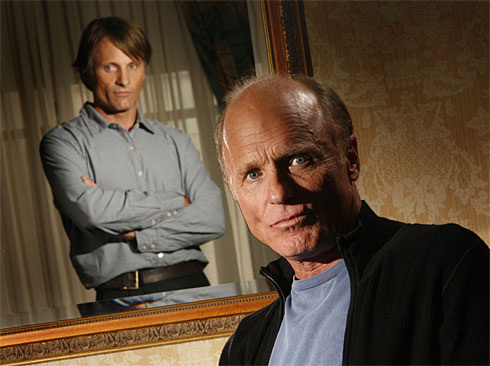
It is doubtful that “Appaloosa” will see any Oscar attention. Though it is beautifully shot and the art direction is sublime, the film was something of a letdown, despite strong work from Harris and co-stars Viggo Mortensen and Jeremy Irons.
“I gave the book to Viggo here at this festival in 2005,” Harris said, “when we were here for ‘A History of Violence.’ There was no one else I really wanted to do the film with, and I certainly never considered anyone else. I just thought he and I would make a strong partnership on screen. We don’t hang out, I mean we’re friends, but we don’t see much of each other. He agreed to do it, and Viggo’s the sort of guy where his word is his bond, so that gave me the start to keep moving on the film. It didn’t really occur to me that the film was a western, what struck me was the relationship between these two men in 1882, that’s what really grabbed me about the film. That it happened to be a western was incidental.”
(more…)
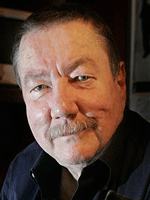 This is one of those fleeting AP reports that causes a double take, since I wasn’t aware of any illness or anything. Apparently it’s a sudden death, natural causes kind of thing, when the universe just decides your time is up.
 Yesterday was another busy event day for the Santa Barbara fest. It was a shame the Director’s Panel was canceled, but participant Andrew Stanton switched gears to join Robert Knott (“Appaloosa”), Tom McCarthy (“The Visitor”) and Dustin Lance Black (“Milk”) for an Anne Thompson-moderated discussion on their work at the keyboard this year.

 I had heard earlier this week that John Hillcoat’s “The Road” might be pushed to 2009, but was sworn to secrecy. Well, Dave Karger is
 And this, as they say, is the week that was:
 Like a number of film music composers, Jeff Beal makes his home north of Los Angeles in the rocky, canyoned city of Agoura Hills. One feels a sense of the old west before even seeing the ranch-style houses in his neighborhood and the tail-flipping horses tied out back. Questions about his work on “Appaloosa,” Ed Harris’s latest entry in the western genre, seem to manifest out of thin, dusty air by the time we make it downstairs to his efficient but Spartan studio.




 Maybe mid-way through the Toronto Film Festival, two things are strikingly clear: Darren Aronofsky
 A few weeks ago, Viggo Mortensen was

 Rough day on the legs yesterday, a lot of walking. Five films. One of them I will watch on DVD in the luxury of my room tonight, so four that I am running to, but hey, these are films I want to see, which always helps, right?