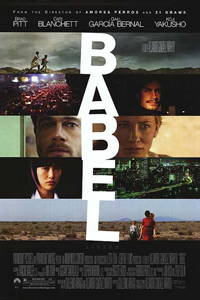
 “Babel” is the crowning achievement in the early careers of writer Guillermo Arriaga and director Alejandro González Iñárritu. It will deservedly be seen as that defining moment which took them out of personal thematic expression -– the mark of a true artist -– and into the arena of global and human consciousness through artistic dexterity -– the mark of something much more.
It is the most particular specimen, yet the most universal, in the long line of socially and/or politically inquisitive filmmaking we’ve experienced over the last two years. And it goes without saying, “Babel” is the first real masterwork of 2006.
As outlined in the eleventh chapter of the book of Genesis, the Tower of Babel was a creation built by the collaborative forces of a united humanity. Having it in their hearts to emulate the Creator, the text reveals, “they said, Go to, let us build us a city and a tower, whose top may reach unto heaven.” As the legend states, God halted the project by confusing the languages of the united, so that they could no longer communicate with one another.
God then scattered the people throughout the land, forever disconnected, yet still of a similar and undeniable origin.
The Tower of Babel is a narrative used to explain the diversity of languages and race throughout the world. It is also a rather obvious warning that any who would attempt greater personal standing than that which God has outlined for them is doomed to failure. However, at its core resides another illustrative failure begging thematic expansion: We as humans are furthermore doomed to eternal miscommunication, so long as we maintain the literal and figurative borders of our own design. This thematic is the central focus of Arriaga’s and Iñárritu’s brilliant film.
“Babel” tells four stories set in the lands of Morocco, Mexico and Japan. Each of the stories, in typical Arriaga/Iñárritu fashion, shares common strands, continuing their trilogy of interconnectivity and fateful consequence (themes also found in 2000’s “Amores Perros” and 2003’s “21 Grams”).
Two Moroccan brothers, testing the range of a firearm purchased for them by their father for the purposes of killing jackals, instigate the events of the film which will outline the filmmakers’ tale. A single gunshot rings out in the Moroccan desert, spiraling the lives of Richard and Susan (Brad Pitt and Cate Blanchett, respectively) into a dizzying and confusing abyss of political turmoil, paranoia and, assuredly, dire straits.
 Vacationing and searching in vain for themselves and their emotional connection once again, Richard and Susan have recently lost one of their children. Neither has recovered, and neither has found the ability to forgive the other.
Meanwhile, at the couple’s home in San Diego, their illegally employed Mexican nanny, Amelia (Adriana Barazza), is anxious to make it to her son’s wedding back home. Against the advice of her nephew, Santiago (Gael García Bernal), she makes the fatal decision to bring Richard and Susan’s children –- whom she has raised for eleven years –- with her across the border.
The more politically relevant of the three tales, Amelia’s journey is reflective of current foreign policy as it relates to border concerns, and the heartbreaking consequences potentially harsh edicts can manifest in that regard.
Concurrently, in the communicative and technological Eden of Tokyo, Japan, Chieko (Rinko Kikuchi, the film’s unparalleled standout), is a deaf-mute girl exploring herself sexually as an adolescent, but ever lost in her own paralyzing world. Chieko is the true heart of the film, lacking the ability to communicate, not merely emotionally, with her widowed father, Yasujiro (veteran Japanese thespian Kôji Yakusho), but quite literally, with the people who surround her in one of the most populated cities in the world.
The performances in the film are all of an organic whole, but as undoubtedly diverse as the characters being portrayed. As Richard, Brad Pitt finally puts forth a commendable and saturated performance to stand alongside his best work (“12 Monkeys,” “Seven,” “Seven Years in Tibet”), while Cate Blanchett, largely relegated to painful cries and disappointed outbursts, is ever-commanding as she continues her lineage of impressive portrayals.
The actors cast as the two Moroccan brothers and their father (with whose names, I’m embarrassed to say, I am not familiar) offer performances that are fascinatingly tangible and, in many ways, the most reflective of human frailty. Meanwhile, Gael García Bernal has a comfortable supporting opportunity to give the hint of depth, but still keep his cards close to the vest.
 The most captivating and award-worthy performances in the film, however, come from Adriana Barraza and, most especially, Rinko Kikuchi. Barraza’s conflict is so frightening, and eventually, so terribly desperate, that it could burden the shoulders of the most gifted of actresses. She commands the role in such a way that we feel for her wholly, in ways both humanitarian and political in nature.
Kikuchi, on the other side of the world, provides a venue for us to experience the film’s themes ourselves. So much of her performance comes through her eyes and through her visual reaction to the events around her that the audience is forced to partake in her journey as well. Seemingly we feel no such personal connection to any other character in the film. It can be no coincidence that that character is the one so drastically isolated from the world six inches in front of her face.
“Babel” pushes through the journeys of its inter-connected characters toward its own vibrant, certainly logical, but altogether ideal (if profound) conclusion. Through their usual heart-wrenching tactics, Arriaga and Iñárritu paint the portrait of humanity scattered, just as in the days of Genesis, but not at all lacking the promise of rediscovery.
Though not nearly as dark as their last two efforts, and certainly more accessible on the whole, “Babel” concludes in the most uplifting of fashions. The film’s closing moment at once draws the sigh of hope and a tear of thankfulness that Pandora closed her box in time, another legend entirely, yet one as applicable to humanity as that of the tower which represented man’s original arrogance.
 And then there were ten.
 You might not be aware of it, but the competition is already formally under way in Oscar’s most perennially problematic category, Best Foreign Language Film.
 Well, as