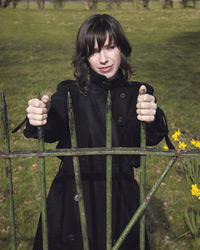
 “We didn’t necessarily set out to create someone as perpetually sunny as Poppy,” says Sally Hawkins of her radiant performance in Mike Leigh’s “Happy-Go-Lucky,” which is currently making waves in the awards race. “But Mike was very dismissive of doing anything maudlin or moody with this project. So the optimism came early on for her. It’s like trying on different skins. And this skin just fit.”
Spoken in a breezy, unassuming tone, it strikes me as a statement — equal parts pragmatic and eccentric — that could as easily have some from the mouth of Poppy herself, the cheery North London schoolteacher who forms the delightful center of Leigh’s latest perceptive study of British social mores.
Indeed, when I first encounter Hawkins in the top-floor café of a West End bookshop, dressed in a somewhat Poppy-esque ensemble of emerald-green cardigan and flowing tie-dye skirt, it’s difficult not to be reminded at least a little of her character. Hawkins is certainly calmer and a little softer in person, but her easy-flowing conversation, accompanied by increasingly wild hand gestures, reveals something akin to Poppy’s humor and generosity of spirit.
“I’m nothing like as extroverted as she is,” she says, smiling broadly. “But how many people are? If anyone says they see even a little of me in Poppy, or vice versa, I take that as the hugest compliment, because she just has life worked out. It’s not as if she’s negating that it’s hard. She just finds a way to deal with it, and finds a way to flow with people. She’s an extraordinary person. I think I learned a lot from her.”
 Thanks to bright-eyed, bushy-tailed commenter Silrone for pointing out that the winners of the British Independent Film Awards were announced while I was mired in technical problems.
 The British Independent Film Awards are an odd, under-the-radar institution that frequently like to avoid the obvious and champion the underdog. Last year, for example, they bypassed the starrier likes of “Eastern Promises” and “Notes on a Scandal” to award their top prize to Anton Corbijn’s magnificent, under-rewarded “Control.” The previous year, they were even more daring: Best Film justly went to “This Is England” over “The Queen,” while Helen Mirren and Forest Whitaker — gasp — lost to the unknown leads of Andrea Arnold’s “Red Road.”