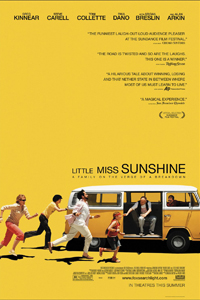
 Jonathan Dayton’s and Valerie Farris’s “Little Miss Sunshine” is the rare example of the quirky and fringe actually having something to say.
It melts away the infection of suspicion and invariably lets itself into our hearts without the stench and waxing effect of sentimentality rearing its ugly head. It takes on human frailty and maintains relevance, all the while introducing absurdity to realism like they were long lost friends. As one of the definitive indie experiences of 2006 thus far, the film is certain to stand out as unique against whatever fray of cinematic output awaits us the rest of the year. Regardless, at this, the mid-way point, it has to already be considered the high-water mark for films in release.
It has been a few weeks since I screened the film, but I have to admit it remains as fresh and as popping in my mind as the vibrant yellow of it’s advertising campaign. Coming off the festival circuit (including an oft-covered standing ovation at Sundance) and entering the marketplace July 26, “Little Miss Sunshine” is the feature film debut of commercial and music video helmers Dayton and Farris.
They’ve made the smart decision of choosing a quaint but subtly complex yarn for their first film, steering clear of any desire to show off those surely honed skills of visual artistry. That said, the duo still finds a way to capture screenwriter Michael Arndt’s world within a unique and meaningful frame every step of the way, filling it with performances that meld together into the finest of ensembles.
We’re first introduced to Sheryl (the continuously underrated Toni Collette), who has come to the hospital to pick up her suicidal and woefully depressed brother, Frank (Steve Carrell). You see, Frank is the victim of the most widespread crime of them all — heartbreak. Upon losing the love of his life to another man, Frank has attempted to end his own suffering in the most classic of fashions by slitting his wrists and hoping the despair would drain from his body along with his life force. Sheryl is here to take him home, to be monitored for fear of emotional relapse, but amongst family all the same – though it’s not the most settling environment, as we soon discover.
At the homestead we meet the host of characters who will accompany us throughout, including a trying and as of yet unsuccessful paterfamilias, Richard (Greg Kinnear -– never a wrong step taken). The irony of his lack of success spells Richard’s painful reality as he tries in vain to sell his “9 Steps to Success” workshop for greener pastures.
Richard’s father, the sharp, yet somewhat asinine, and altogether freewheeling Grandpa (Alan Arkin) never misses an opportunity to be unnecessarily impudent, or, specifically, to make digs at Frank’s sexual orientation.
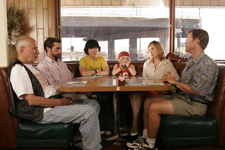 Richard and Sheryl’s son, Dwayne (Paul Dano), has taken a vow of silence in preparation for his dream of becoming an air force pilot, fit with a “fuck off” attitude and a token bedroom poster depicting the iconic image of Friedrich Nieztche.
And then there’s Olive (Abigail Breslin), the heart and soul of the film who defines the determination that lies at the center of Arndt’s work. Olive has made it, via technicality, into the finals for the “Little Miss Sunshine” pageant in Redondo Beach, California, and she’s ready and willing to step up and take advantage of the opportunity. She’s rehearsed her routine with Grandpa for weeks. She’s honed, prepared, and damned excited. Soon enough, a road trip, from the blistering desert of Albuquerque to the sparkling coast of Redondo Beach, lays out the film’s brightest and darkest themes, with plenty of self-discovery and familial-examination filling out the scenery along the way.
Greg Kinnear seems to find the delicate ins and outs of every character he portrays, however miniscule the part. Here he balances Richard’s deep-seeded love for his family with the tendency to forget all of that due to the grime and build-up of personal gratification and professional ascendancy.
Toni Collette finds the middle ground of Sheryl, the anchor of the family and yet the most frayed of the lot. Together she and Kinnear make for a terrifically believable couple entering the apex of their lives, perhaps fearful of the other side of life, casting a watchful and ambivalent eye toward the descent that is sure to follow middle age.
On the other side of things is Grandpa, long past that first jolting drop and having the ride of his life. Alan Arkin really cuts loose and allows all of the character’s irreverence to show itself, irreverence seen as nearly commendable in the final analysis.
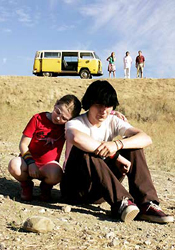 Dano exudes the sarcastic Cobain lyric “teenage angst has paid off well” with every hooded glance or unaffected beat. Most will remember him for his stirring work opposite Brian Cox in 2002’s “L.I.E.,” but his performance here is of a completely different emotive breed.
Then there is Steve Carrell. Certainly taking on the most contrasting role of his young cinematic career, he keeps the reins close on the comedy like most actors in his position could only dream. He affords layers for Frank that are very real, yet remains mysterious enough to surprise us when he is at his most endearing. In many ways the most balanced character of the lot, Frank is still the guy that tried to snuff it, and that irony couldn’t have been lost on Mr. Arndt as he crafted a truly contradictory experience to mirror the contradictory nature of life itself.
The determining facet of this ensemble, however, was always going to be the casting decision for Olive, and Breslin steals our hearts and ignites our passion effortlessly in that regard. A true mark of excellence in screenwriting is a hero worth caring for, and though the case could be made for the family as a whole being the protagonist in “Little Miss Sunshine,” it is ultimately Olive for whom we root, for whom we hope, and in whom we lose ourselves.
“Little Miss Sunshine” is a romp as penetrating as it is sentimental. At its core, first-timer Arndt’s screenplay is about the necessity of understanding, making some valid and, at times, poignant assertions about the importance of family. And there is a reason it takes everyone offering a collective push to get that troublesome Volkswagon bus on the road each time.
The script further maintains ideas concerning the support and empathy that can sometimes only come from those sharing the same blood, while simultaneously illustrating the notion that individuals in a family are still just that, individuals – separate entities with their own sets of issues and worries. In so doing, he inevitably paints a portrait of the vilest yet most unavoidable aspect of human nature: selfishness. But you have to love us for it, right?
 As the season hits its stride, and precursors turn murky perceptions of pack leaders and stragglers into harder realities, I find myself wondering how I would fill out my ballot if I were an Academy member.
 As we head into the thick of awards season, one of the biggest “will-they-won’t-they” questions about this year’s Academy Awards concerns one of their most favored sons, Clint Eastwood. Specifically: despite wildly polarized responses to the film, and a widespread perception that he has already been amply rewarded in other categories, can Eastwood ride the wave of sentiment to a first acting victory for “Gran Torino?”