In Contention

Category: Featured

  • First set of winner predictions

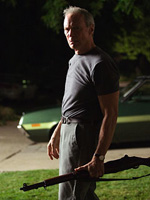
    Clint Eastwood in Gran TorinoBefore the holiday I thought I’d make my first calls on the year’s Oscar winners.  Bear in mind we don’t even have a list of nominees yet and anything can happen.  I think around this time last year I was predicting “Into the Wild” for across-the-board wins and it only managed two nominations at the end of the day, so, grain of salt and all that.  I just like to go on the record around this time, so here we go:

    Best Picture: “Slumdog Millionaire”
    Best Director: Danny Boyle, “Slumdog Millionaire”
    Best Actor: Clint Eastwood, “Gran Torino”
    Best Actress: Cate Blanchett, “The Curious Case of Benjamin Button”
    Best Supporting Actor: Heath Ledger, “The Dark Knight”
    Best Supporting Actress: Viola Davis, “Doubt”
    Best Adapted Screenplay: “Slumdog Millionaire”
    Best Original Screenplay: “Milk”
    Best Art Direction: “The Curious Case of Benjamin Button”
    Best Cinematography: “Defiance”
    Best Costume Design: “The Duchess”
    Best Film Editing: “Slumdog Millionaire”
    Best Makeup: “The Curious Case of Benjamin Button”
    Best Music – Original Score: “Defiance”
    Best Music – Original Song: “The Wrestler”
    Best Sound Editing: “The Dark Knight”
    Best Sound Mixing: “The Dark Knight”
    Best Visual Effects: “The Curious Case of Benjamin Button”
    Best Animated Feature Film: “WALL-E”
    Best Documentary Feature: “Man on Wire”
    Best Foreign Language Film: “Captain Abu Raed”

  • OFF THE CARPET: Insert witty Oscar column headline here

    Brad Pitt in The Curious Case of Benjamin ButtonThis year’s Oscar season is sapping the creativity from my bones.  Perhaps it’s foolish to come to this space every week and offer a full-blown column.  Sometimes there isn’t much to talk about.  This year, however, the things we do have to talk about don’t seem worth talking about.

    “The Curious Case of Benjamin Button,” for instance, was the most anticipated film of the season.  But three days after finally seeing the film, I’m not feeling the resonance I anticipated.  The film is a cinematic marvel, a stroke of screenwriting brilliance and a massive leap forward across an array of technical achievements.  But it hasn’t captured my imagination like I thought it would.

    Your guess is as good as mine on that one.

    “The Reader” finally screened to the press at large yesterday, both here in Los Angeles and in the Big Apple.  The buzz leading up to the big reveal was that, hey, this might be a bigger contender than we anticipated.  But personally speaking, the result is almost an afterthought — no lingering, no spirited embrace of the film’s themes and story particulars.  Just another film.

    So, is it just me, or is the soft landing of so many of the year’s perceived heavies beginning to tangibly expose 2008 as the Oscar low point we all thought it would become?

    (more…)

  • INTERVIEW: ‘Changeling’ screenwriter J. Michael Straczynski

    J. Michael Straczynski“In the feature film world, we television writers barely exist,” explains J. Michael Straczynski screenwriter of Clint Eastwood’s “Changeling,” starring Angelina Jolie.  “So for this to all happen so fast is really a fairy tale year for me. I am elated with how this has all gone down and changed the course of my life.”

    Straczynski was making a fine living on the small screen, writing episodes of “Murder She Wrote” and “Jake and the Fatman” before moving on to  Showtime’s series “Jeremiah” and “Babylon 5,” two of his most well-known credits.  He had worked as a journalist for the Los Angeles Times and upon discovering the story of Christine Collins, he put it on the back burner for a few years until he found the time to do it right.

    He describes his research and fact-finding like “putting a jigsaw puzzle together” for the simple reason that facts and articles had been lost, and they simply did not have the technology then to store everything he required. Taking a year off writing television, he researched the Collins case and put a script together, which his agent sent off to Imagine Entertainment and Ron Howard.  The script was bought as is and Howard wanted to direct the film, but when his schedule became impossible, “Frost/ Nixon” looming on the horizon, he sent the screenplay to Clint Eastwood.  The grizzled vet read the work on a plane back to the States and committed to direct after the first reading.

    Yes.  This was a FIRST DRAFT that went before the cameras within a year of being sold, something rather unheard of in Hollywood unless you’re Woody Allen.

    (more…)

  • ‘Button’ drops (UPDATED with audio)

    Taraji P. Henson in The Curious Case of Benjamin ButtonUPDATED (5:30 p.m.): Alright, now that I’m home and away from the shuffle, I can unfold some further thoughts on this.  Judging by the mood of the room — mostly guild members and industry types, a lot of press folks have decided on the 6:00 screening — the verdict is a big thumbs up.  Lots of positive thoughts dished about all around.

    I spoke briefly with Kathleen Kennedy, who has seen this project go up and down, back and forth for 18 years.  We talked about the visual effects in the film and how refreshing it is that this innovative work came within such a cerebral and affecting story.  “Jurassic Park” (which she also produced) has held the industry effects crown for 15 years, and now, a new leap forward.  Though director David Fincher has said from the start that he and his crew weren’t particularly sure whether they could pull it off, Kennedy took solace in her filmmaker’s professionalism.

    “When you bring in a director like Steven [Spielberg] or David [Fincher], you trust their instincts when it comes to that stuff,” she said.  “They come along with this giant tool box and they know which tool to use for this or that.”

    I also chatted with Eric Roth for a good while, screenwriter-to-screenwriter type stuff.  He really did work wonders with this story, and picking his brain for the reasons behind this decision or that can be a lot of fun.  One of the odd reactions I took away from the film, however, was that the work felt strangely cold.  I wasn’t sure whether I meant that in a good way or a bad way, and surely, people were crying their eyes out over this thing, so I might be in a minority.  Perhaps it’s my youthful cynicism, who knows, but I thought Fincher brought an arm’s length approach to the emotions in the film and I wanted Roth’s reaction to that.

    Of course, Roth doesn’t particularly agree with my take.  Indeed, he was right in the middle of telling me how the bathroom was filled with sobbers after the screening when a beautiful young lady walked up to us and told him how much the movie had affected her.  But he took my comment in stride.

    “Fincher is the kind of director that brings you right up to the point of sentiment and then brings it back,” he said.  “There’s something to be said for that I think.”

    (More, plus audio of tonight’s Q&A, after the jump.)

    (more…)

  • TECH SUPPORT: Best Original Score — Volume One

    Tech Support at In ContentionMusic is one of few of the “tech” awards cited by the Academy that tends to result in passionate discussions among moviegoers, including non-cinephiles. Awarded in the Best Original Score category, the film music composer has one of the most difficult and lonely jobs in filmmaking. Almost always arriving at the end of the editing stage, and typically the most expendable element of the mixture, he or she has to fashion music appropriate to the mood and, hopefully, serve as a nice commentary for the on-screen goings-on.

    AMPAS musicians tend to have their favorites, however. This is notoriously one of the most insular branches (though it has warmed up slightly in recent years). It also tends to award music that features prominently in the films. Subtle scores rarely find a home here.

    A cardinal rule of this category is “never bet against John Williams.” The 45-time nominee has been recognized for all but two eligible years since 1976! Having been ineligible for two consecutive years now, Williams would seem a good bet this year for “Indiana Jones and the Kingdom of the Crystal Skull.” The music was notable and he was nominated for all the predecessors in the series. That having been said, for some reason I’m still not convinced of this. Perhaps that’s because of the strength of other contenders.

    Thomas Newman is another favorite – an eight-time nominee — though he is still awaiting this first statuette. He could very well double-dip this year with “Revolutionary Road” and “WALL-E.” The former seems like it could be a big player this year, while music was absolutely pivotal in the latter. Newman was a double nominee for “Little Women” and “The Shawshank Redemption.” (Newman is also credited as a songwriter on “Down to Earth” from “WALL-E,” so he could even be up thrice this year!)

    (more…)

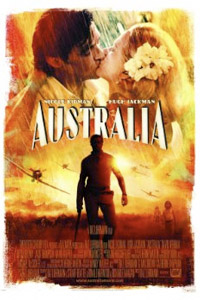
  • REVIEW: “Australia” (**1/2)

    20th Century Fox's AustraliaGod bless Baz Luhrmann.  There are few directorial talents with the energetic potential he brings to his projects.  Danny Boyle comes to mind.  On good days, Fernando Meirelles does as well.  But one thing each of these filmmakers capitalizes on through their complicated sense of visual storytelling is the power of intimacy in the scripts they set out to film.

    Somehow, Baz Luhrmann forgot about that.  Not that he wouldn’t be capable of tacking a project as ambitious as “Australia,” but at least right now, it has proven to be simply too much movie for the filmmaker at this stage in his career.

    Visceral satisfaction it has.  Larger than life characterizations are its forté.  If you’re willing to let it, you’ll probably be swept off your feet.  But somewhere in the ambition, Luhrmann loses a grip on his own talents, producing something that is a considerable mess.

    “Australia” is really two movies smashed together.  The 165-minute run time becomes taxing if only because each thread is so haphazardly meshed with the other.  It is all the more ironic considering the film is, at heart, about the power of storytelling.

    The first half details the arrival of Lady Sarah Ashley (Nicole Kidman) to the Outback and her husband’s property at Faraway Downs.  She comes to the territory with a mind to sell off the land and bring her husband back home to England, but soon discovers the wicked and thieving ways of local beef baron King Carney (Bryan Brown) and his flunky Neil Fletcher (David Wenham).

    There to meet her at the boat in the seaside burg of Darwin is the Drover (Hugh Jackman), a rough-and-tumble cowboy cut from the same cloth as Clint Eastwood’s many characterizations.  (Drovers move livestock across large distances, real cattle drive type stuff.)  A blue collar guy to say the least, with an impeccable physique that Luhrmann never shies away from displaying (and never fails to leave one feeling the need to do a few crunches), the Drover works with and lives among the indigenous peoples of the country: the Aborigines.

    (more…)

  • THE LISTS: Top 10 films of the 1970s

    (from left) Dustin Hoffman and Robert Redford in All the President's MenWhen critics and historians of the cinema sit down to discuss uh, cinema, the conversation almost always turns to the great decades in movie history. And n nearly conversation I’ve been a part of, the 1970s reigns supreme as the single decade of brilliance.

    It was a time of enormous artistic growth for film, as up-and-coming directors grabbed Hollywood and ran with it, merging their love for cinema and the works of John Ford, Billy Wilder, and Elia Kazan (among others) with their own fresh ideas. And the releases of “Bonnie and Clyde,” “The Graduate” and “2001: A Space Odyssey” had already announced the arrival of the new American cinema by the end of the 1960s.

    But the next 10 years brought us Francis Ford Coppola, who exploded onto the scene wit four brilliant works and mentored many of the younger directors of the time. Steven Spielberg would earn the name “whiz kid” for his incredible visual storytelling gifts that would eventually make him one of the greats of all time.

    Martin Scorsese was making unsettling character studies that alarmed the studios but thrilled critics and actors, who felt challenged by his work. Woody Allen evolved from comedy writer, to comedic actor-director, to world-class filmmaker by the end of the decade. And Oscar winning film editor Hal Ashby would make a name for himself behind the camera with a swath of works.

    Sidney Lumet, William Friedkin, Peter Bogdonavich, Bob Fosse, Roman Polanski, Bernadro Bertolucci, Alan J. Pakula, Milos Forman, and Michael Cimino would all leave their mark in the 1970s and continue directing to varying degrees of success in the 1980s and beyond.

    Society heavily impacted the work as films about the war in Vietnam dominated much of the 70s’ final years. Watergate raged mid-decade. Stories were plucked from the headlines and committed to celluloid. Movies were exciting, well made, and interesting. Films like John Frankenheimer’s “Black Sunday,” Milos Forman’s “Hair” and Don Siegel’s “The Shootist.”

    Big budget disaster films enlivened the trade, along with movies about divorce, drug addiction, mental illness, organized crime, vigilantes, prostitution, and countless other topical issues that were explored with great courage on screen. I found narrowing it down to a 10 best list to be nearly impossible and enormously frustrating because some the films left off the list should really be here. But that’s just a testament to the era’s resilience.

    (more…)

  • INTERVIEW: Rosemarie DeWitt

    Rosemarie DeWittRosemarie DeWitt is excited.

    It can be difficult to gauge emotion in the formal, slightly removed context of a phone interview, but DeWitt’s warm, clear voice betrays an eagerness right from the get-go, articulating thoughts at a pace that occasionally exceeds my shorthand. Only when addressing the heady buzz of awards season does she finally pause to reach for words.

    “It’s crazy, seriously crazy, but more than anything, it’s just really flattering,” she says.  “This is the best job I’ve ever had, and I’m so, so proud of the film. Anything more than that is just…” A moment passes as she takes a breath, and considers the matter. “Wow,” she concludes simply.

    The film in question, of course, is “Rachel Getting Married,” Jonathan Demme’s barbed family drama that has been widley declared the filmmaker’s return to form after some years in the wilderness. The buzz, meanwhile, is for DeWitt’s subtle, complex turn in the title role, which has garnered considerable plaudits for the hitherto low-profile 34-year-old actor, a frequent stage presence only recently receiving her due on screen, both big and small.

    Best known until now for her tart, sexy portrayal of Midge, Jon Hamm’s bohemian city mistress in TV critics’ darling “Mad Men,” DeWitt is calling from Los Angeles.  She’s just finishing work on another cable series, “The United States of Tara,” a dark, high-concept comedy created by Diablo Cody and starring Toni Collette (an “absolute genius,” DeWitt gushes).

    All of which would be enough to get excited about without Oscar talk being thrown into the mix. But as Rachel, the older sister of Anne Hathaway’s self-destructive addict Kym, DeWitt’s attentive, commendably unflattering performance finds itself right in the thick of the Best Supporting Actress competition. Hers is, for me, the most resonant performance in a film that doesn’t want for thespian fireworks, largely because DeWitt never pushes Rachel into the stock character of the saintly, long-suffering sibling.

    (more…)

  • INTERVIEW: ‘Gomorrah’ author Roberto Saviano

    Roberto SavianoI’m pretty sure that only in Hollywood can you find publicity mobilized behind a targeted man for the purposes of securing an Oscar nomination (and, of course, prepping a film release).  But there Roberto Saviano was yesterday at the…wait, I probably shouldn’t even mention the hotel should I?

    Saviano has been pegged for assassination (let’s not mince words) by the Neapolitan Camorra organized crime syndicate following the massive success of his book “Gomorrah,” adapted for the screen this year by a swath of writers and entering the Oscar race as Italy’s foreign language film submission.  Peeved at how deep Saviano’s book plunges behind the veil of the wide-reaching organization, the result of “great rage” as the author describes the passion that drove him within its pages, the Camorra has reportedly declared they want Saviano dead by Christmas.

    A highly sincere security guy/bodyguard was my first impression, me waving my iPhone as the only device concealed on my person — I swear.  Moving into the Spartan hotel room, Saviano was seated in the most unassuming manner, feet crossed in front like a child passing the time.  His bald head and dark eyebrows set off a striking complexion, and he certainly looks as young as his 29 years.  Which makes the achievement of “Gomorrah,” written in a style compared to the “non-faction” of Truman Capote, all the more impressive.

    The film adaptation, spear-headed by Saviano and director Matteo Garrone, is an absolute success, managing to steer clear of any modern cliches its multiple narrative structure might have allowed.  It took Cannes by storm over the summer, landed nominations across the board at the European Film Awards and has already been bandied about in this space as a potential Oscar spoiler in more than just the anticipated Best Foreign Language Film category.

    And now, those who can make that kind of thing happen are aiming to do just that.  “Gomorrah,” it seems, won’t be settling for the obligatory tip of the hat in one ghettoized field, nor should it.  And if anything, it ought to be a testament to Saviano’s courage (the guy is in hiding for Christ’s sake) if the film manages to be seen and awarded by more than the already fickle and questionable foreign language film committee.

    I spoke with Saviano, through a translator, for about a half hour.  Rather than piece together an interview article I thought I’d let the exchange speak for itself.  I didn’t realize how much of an honor it was to meet the guy until maybe half-way through, and when I tell him I think he’s a hero, I assure you I mean it.  Have a listen:

    [display_podcast]

  • OFF THE CARPET: Getting to know you

    Leonardo DiCaprio and Kate Winslet in Revolutionary RoadThis is the first season I can think of, at least since I’ve been covering this crazy beat on the west coast, that studios have become so terrified by the media that guild screenings are preempting press screenings with such consistency.

    Some have whined about “The Curious Case of Benjamin Button” screening for SAG 10 days before the media at large gets a look (with the usual brand of entitlement that turns the stomach).  Others actually snuck into the screening, surely freaking out a few publicists desperate to unfold the film at their own pace (and the pace dictated by the meticulous David Fincher).  I’m just waiting.

    Plenty have taken the altered ending story behind “Australia,” not to mention the film being held from the press until two weeks before it opens, as a sign that the movie is in trouble.  I’m just waiting.

    Lots of anticipation has suddenly been blown into “The Reader”‘s previously deflated balloon.  I’m just waiting.

    But I have to say, seeing a couple of the year’s contenders last week with big industry audiences proved to be just the breath of fresh air this incredibly stifling season needed.

    (more…)

  • My stance: ‘The Dark Knight’ will be nominated for Best Picture

    Heath Ledger in The Dark KnightSo much speculation has surrounded the possible inclusion of this tremendous film in the year’s final five.  And though there are those who believe it has no chance of happening, the majority has gradually seen otherwise.

    Where is written that entertaining films cannot be art? Where does it say that a box office smash cannot be a genuinely great film? May I remind everyone that “The Godfather” was a major hit at the box office before it won the Oscar for Best Picture, basking in some of the finest reviews ever written. That said, success can sometimes be the enemy of both the film and the director (ask Steven Spielberg).

    While no one is calling “The Dark Knight” a film on the level of “The Godfather,” it certainly has its own particular brand of appeal and excellence. Made with breathtaking confidence, technical brilliance and spectacular command of the language of the cinema, the film moves constantly, yet director Nolan never allows the spectacle to overwhelm the very intimate story he is telling here.

    His actors are sublime, beginning with the extraordinary performance from Heath Ledger as the Joker, a performance that takes madness to a new level, one that is terrifying in its realism and authenticity. Yet Ledger is surrounded by a strong ensemble, Christian Bale very good as Batman/Bruce Wayne, a troubled, contradictory man at war with himself, knowing the only way he can remain a hero is to appear to be the enemy.

    (more…)

  • TECH SUPPORT: Best Makeup — Volume One

    Tech Support at In Contention“Norbit.” “Click.” “The Time Machine.” “Life.” What do all of these dreadful films have in common? They are Oscar nominees because of the category of Best Makeup!

    I will give this branch kudos for often willing to think outside the box but they still manage to be quite bizarre in their choice of nominees more often than not.

    All things considered, it’s is a difficult category to predict. While the three nominees are chosen from seven pre-announced finalists, the “bake-off” to seven often has shockers in store. Films that would appear slam-dunks are ignored while movies no one was considering end up short-listed.

    All that said, I’m still going to do my best to handicap it!

    One film that would logically seem to be leading for a nod is David Fincher’s “The Curious Case of Benjamin Button.” As I have said before, I suspect this film could be headed to across-the-board nominations in the tech categories. Aging both Brad Pitt and Cate Blanchett over 80 years (albeit it different directions) will be enormously visual and integral to the plot. My only concern would be if there is use of visual effects to “brush up” the makeup work. This branch does not like having their territory intruded upon by CGI.

    Fincher’s movie is no lock. Nothing ever can be in this category. But I do believe it is out in front by a significant margin at this point, especially with veteran Greg Cannom in charge. Beyond that, I have no idea.

    (more…)

  • ‘Dark Knight’ score officially DQ’d by Academy

    (from left) Aaron Eckhart and Gary Oldman in The Dark KnightUPDATE (8:14 p.m.): Now comes this story from Jon Burlingame at Variety (always well-informed on this stuff), spelling out the particulars:

    Sources inside the committee said that the big issue was the fact that five names were listed as composers on the music cue sheet, the official studio document that specifies every piece of music (along with its duration and copyright owner) in the film.

    Zimmer said, in an interview with Variety prior to this week’s Acad action, that listing multiple names on the cue sheet was a way of financially rewarding parts of the music team who helped make the overall work successful. (Performing-rights societies like ASCAP and BMI use the cue sheet to distribute royalties to composers.)

    Zimmer, Howard and the other three individuals — music editor Alex Gibson, ambient music designer Mel Wesson and composer Lorne Balfe — reportedly signed an affidavit stating that the score was primarily the work of Zimmer and Howard.

    That apparently wasn’t enough for the majority of the committee, which was also supplied with documentation indicating that more than 60%, but less than 70%, of the score was credited to Zimmer and Howard.

    What a load of horseshit, no?

    EARLIER: Not that this is a surprise, but I’m hearing that because there were too many names listed on the cue sheet for “The Dark Knight” score, the work has been disqualified.  The music branch apparently spent a considerable amount of time discussing the issue and likely due to their labyrinthine rules, which have been bandied about considerably in other outlets.

    It’s a shame, seeing as I thought James Newton Howard and Hans Zimmer really added considerably to the flavor of their original work in “Batman Begins” (also disqualified in 2005).  But the bottom line here is, someone needs to take a sandblaster to this branch’s rulebook and do away with the subjectivity that can really eat away at some fine work.

    More as it comes…

  • Is ‘Gomorrah’ this year’s ‘City of God’?

    Since May, based on nothing but a gut feeling following the film’s Cannes reception, I’ve been predicting that Matteo Garrone’s astonishing “Gomorrah” would score nominations for Best Director, Adapted Screenplay and Film Editing — in addition to a Best Foreign Language Film nod. (Garrone has recently slipped from my Best Director predictions, but he’s still on my radar.)

    It may seem a far-fetched proposition, but clearly I’m not alone in thinking it’s possible. The news this morning that distributor IFC Films has shifted the film’s L.A. release to December, in order to qualify for main-category Oscar consideration, is a clear vote of confidence. One wonders if they have “City of God” at the back of their minds — a similarly violent, kinetic foreign-language study of urban social decay that stunned pundits in 2004 when it scooped four Oscar nominations, including Best Director and Best Adapted Screenplay.

    It’s a slightly different situation, of course — “City of God”‘s amazing haul was surely partly motivated by the Academy’s embarrassment over its exclusion the previous year from the foreign-language race. “Gomorrah,” however, is eligible for the gold in that category this year, so the Academy may feel that would be sufficient recognition for it.

    Still, we all know how the directors’ branch of Academy likes to throw arthouse curveballs now and then (in addition to Fernando Meirelles, think Mike Leigh and Pedro Almodovar), while I think a Best Adapted Screenplay nod looks increasingly likely given this year’s sparse slate of contenders in that category. (The Hollywood Reporter agrees that the film’s writing may represent its best shot.)

    (more…)

  • Why does the Academy fear controversy?

    Jon Voight in Midnight CowboyIn 1969, the Academy saw fit to give “Midnight Cowboy” the award for Best Picture — a first ever for an X-rated film.  Some saw the moment as a bellwether signaling a new dawn for the group, that they were developing a growing acceptance for the films that would start coming at them around this time of creative invigoration in the cinema.  But was it really?

    I remember somewhere that a high-ranking Academy official stated that if “A Clockwork Orange” won the Oscar for Best Picture they would resign their membership! The film had already won top honors from the New York Film Critics Circle and was nominated for four Academy Awards, among them Best Picture and Best Director. A ground-breaking work, the best of Kubrick’s career, still looking futuristic 37 years later, the film is an obvious masterpiece.  But it frightened the Academy for whatever reason.

    A year later Bernardo Bertolucci’s “Last Tango in Paris” came along with a galvanizing performance from Marlon Brando and was certainly a better film than at least two of the pictures nomination int he top race, “The Sting” and “A Touch of Class,” yet as expected, the Academy backed away from the film, nominating only Brando and Bertolucci.

    What is it in the makeup of this esteemed organization of artists that makes them steer clear controversial films, films that push the envelope, that go further out on a limb than most in exploring dark and sometimes daring subject matter?

    (more…)

  • THE LISTS: Top 10 biopics

    It’s no real secret that the Academy is partial to the biopic. Big or small, intimate or epic, celebratory or critical, they never seem to tire of the allure of actors channelling real-life figures, past and present. Lately, in the performance categories in particular, biopics have been the surest route to voters’ hearts, with seven of the last nine Best Actress winners falling under the category, and Daniel Day-Lewis having just broken a three-year run of biopic winners in Best Actor.

    The genre is no less prominent this year, with titles like “Milk,” “Frost/Nixon,” “Che” and “W.” all garnering varying degrees of awards buzz, for their star turns in particular. Meanwhile, from the arthouse, European titles like “Hunger” and “Il Divo” are significantly challenging the formal boundaries of the biopic, proving that the genre has far more adventurous terrain to cover than the solid, occasionally stodgy awards catnip the Academy frequently chooses to laud.

    Back in August, I wrote a post about how I was wearying of Oscar’s devotion to the genre; in turn, after my unenthusiastic “Frost/Nixon” review, a friend said to me, “Well, you do hate biopics.” I really don’t. But I am a little bored of the more linear, prosaic examples of the genre that reduce the narrative to CliffsNotes highlights in order to showcase a performance. (Step forward, “Ray” and friends.)

    Real life offers an infinite number of structural and cinematic possibilities, and it is the films that best take advantage of this fact that this week’s list is designed to celebrate. The ten films here take a wide range of approaches in portraying an equally diverse array of lives, but for me, they all pass the principal test of the great biopic: defamiliarizing the familiar. By creating living, breathing characters out of figures best known from history books and pop culture annals, they make real life as revelatory and surprising as fiction.

    It’s interesting to note how few of the films I’ve chosen qualify as the Oscar-bait that biopics are widely perceived to be — we have four Best Picture nominees here, and only one winner. It was by no means a deliberate or elitist move on my part, but the fact remains that a lot of the most interesting and audacious work within the genre doesn’t get the recognition it deserves.

    The biopic is clearly maturing — as I was drawing up the shortlist for this piece, I was surprised by how recent many of my inclusions were, but it’s clear that filmmakers are getting more adventurous with time. For example, in the 1950s, a film like “La Vie en Rose” would have been made as a stolid music weeper in the “I’ll Cry Tomorrow” mold — today it comes in a considerably more fractured form, structurally and stylistically. It’s just one of several recent films, from “The Assassination of Jesse James by the Coward Robert Ford” to “Marie-Antoinette,” to show that the biopic need never be safe cinematic territory. The following ten films prove that.

    10. “American Splendor” (Robert Pulcini and Shari Springer Berman, 2003)
    An ingeniously intertextual account of the life and work of comic book author Harvey Pekar, “American Splendor” goes against the grain of nearly every other biopic of a creative being by revelling in its subject’s ordinariness. Riffing off Pekar’s own autobiographical comics, Pulcini and Berman brought their keen documentarist’s eye to Pekar’s unremarkable world of beige offices and supermarket checkouts, making as much dramatically of the absences in his life as his achievements. Anchored by a quicksilver performance from Paul Giamatti, this achieves the rare biopic feat of matching its subject’s individualism.

    (more…)
  • Anthony Dod Mantle — it is time

    Anthony Dod MantleI don’t generally throw myself full force behind a contender with the kind of FYC spirit I’m about to project.  We all have our favorites and we all hope this person or that will finally get the recognition deserved, but it’s a different thing to full on advocate.  But today, I just can’t help myself.

    Watching “Slumdog Millionaire” a second time Friday night as part of the AFI Danny Boyle tribute, I was taken once again by the urgent nature of the film’s visual style.  It’s a direct reflection of Boyle’s energetic attitude toward life and the cinema, of course.  But it’s also the result of wonderful creativity from cinematographer Anthony Dod Mantle.

    Boyle says he first took notice of Mantle’s work on the Dogme classic “Festen.”  The two first collaborated on television’s “Strumpet” before moving into daring digital territory with the modern zombie classic “28 Days Later,” and then Mantle moved back to his Dogme roots, taking on projects for Thomas Vinterberg and Lars von Trier with a little Boyle thrown in between (2004’s “Millions”).

    I never much responded to the supposed revelation that was Dogme, so Mantle first caught my eye with “28 Days Later” and especially with Kevin Macdonald’s “The Last King of Scotland,” where I suddenly felt the earth move under the weight of a new talent’s insistence on a refreshingly vigorous intimacy with his photography.

    Much like Harris Savides, Cesar Charlone or Rodrigo Prieto, Mantle is finding himself moving in and out of the independent market with eye-popping work that can go unnoticed in the wake of the postcard photography that tends to be singled out during the awards season.  But his work is alive, crackling with immediacy and actively creative in the service of story, never more so than in “Slumdog Millionaire,” Boyle’s latest vibrant contribution to the silver screen.

    The time has come for Mantle to be recognized for the innovation he lends not only this film, but the trade itself.  I fully expect “Slumdog” to find a home in numerous categories, but if I could insist consideration of just one aspect of its elaborate below-the-line construction, it would be for Mantle’s contribution.  What fierce life he has captured here.

  • INTERVIEW: Mickey Rourke

    Mickey Rourke at the Los Angeles premiere of The WrestlerMickey Rourke fucked up his career.  Who am I to say that though?  I don’t get to chastise the guy, pass judgment, even comment really.  It’s a cliche to say it, so why not be specific otherwise: Mickey Rourke had some shit to work out.  Who doesn’t?

    He looks at you with stone eyes that seem to betray the early moments of a blackout.  But after another look, it’s clear that he’s focused.  He’s walking a straight line to spite his former self these days, even if it means lighting up in a non-smoking room to get through the unfamiliar terrain of a major film awards push.  Because fuck it, right?

    His pet chihuahua, Loki, moves slowly about the room, using what senses are still available to her after 17 long years, like some externalized representation of Mickey’s busted professional life.  But she’s still here, isn’t she?  So is Mickey.

    He’s the kind of guy Bob Dylan calls up in the middle of the night with a modest, “Hey, it’s Bob.”  He’s the kind of guy who can tell you he and Bruce Springsteen lost touch for 13 years and mean it.  His fight-ravaged hand cracks after a forceful handshake.  “Everything’s still crackin’.”  With a smile, no less.

    Everything could seem like a name drop but somehow becomes an honest, bard-like story of purpose.  He repeats himself.  Maybe he forgets, maybe he wants to make his point.  Maybe he can’t believe it himself — stories of self-destruction or good fortune — so he has to hear himself say the words again.  Introspection seems to come forth like the memorized therapy over a decade on the couch will give you.  But the necessity of that hard work comes through.  This is just where he is for the moment.

    He’s a steward of the truth and takes his work bringing that truth to bear quite seriously.  He won’t even waste time on a biography because he can’t get into his associations with the Hell’s Angels and John Gotti, so why bother?  It wouldn’t be true.

    (more…)